Cloud adoption didn't slow innovation. It just sped up the number of things teams must keep under control.
Every week brings new services, new IaC modules, new environments, new workloads, and new configuration changes. And while all of this flexibility is excellent for engineers, it creates a governance challenge for the people responsible for keeping clouds clean, compliant, and predictable.
Modern governance isn't a checklist to complete and then forget about. It needs to be a continuous system that ensures your cloud stays healthy, even as everything around it changes. And the tools you choose to make that possible matter.
Here's how Firefly helps you govern your cloud: clearly, predictably, and without slowing anyone down.
The Problem: Why Traditional Governance Fails
Governance used to be about policies written in Confluence pages, access spreadsheets, and periodic checkups, but that model doesn't work anymore.
Today's cloud is multi-cloud, multi-IaC, multi-team, partially managed, partially unmanaged, and constantly drifting. Even with the best IaC practices, manual changes still happen. Teams experiment, security teams tighten configurations, and developers fix issues directly in consoles all the time.
If governance depends on humans remembering rules, it fails.
In practice, three forces consistently break cloud governance:
Force #1: Runtime changes and unmanaged assets
Infrastructure defined in IaC drifts as soon as someone tweaks something in the console. This breaks compliance, introduces misconfigurations, and makes environments unpredictable. Shadow infrastructure emerges: resources that exist in cloud accounts but live in no Terraform file.
Force #2: Misconfigurations and silent security gaps
Incorrect IAM policies, open security groups, unencrypted storage, public buckets, insecure defaults, outdated container images: they’re easy to create, but hard to spot manually.
Force #3: Lack of consistent standards
When teams move fast without guardrails, tags go missing, cost policies get ignored, deprecated versions stay running, S3 buckets multiply, and EBS volumes pile up. None of this is intentional.
Yet still, governance breaks when these problems compound faster than humans can detect or fix them. You need continuous detection, clear visibility, and automation that enforces your standards so engineers can move fast safely.
What Cloud Governance Actually Means
Governance is often misunderstood. It's not about slowing developers down or introducing approval gates that kill velocity. Instead, think of governance as the system that ensures every cloud resource follows your rules for security, cost management, compliance, reliability, and operational consistency.
More simply: governance makes sure your cloud behaves the way you expect, even as it grows and changes.
When done right, governance becomes invisible to engineers who follow best practices, while automatically catching issues that would otherwise slip through. It's not a blocker, but a reliability system.
How Firefly Ensures Your Governance is Continuous
Firefly takes a straightforward approach: governance should be automated, continuous, and IaC-aware.
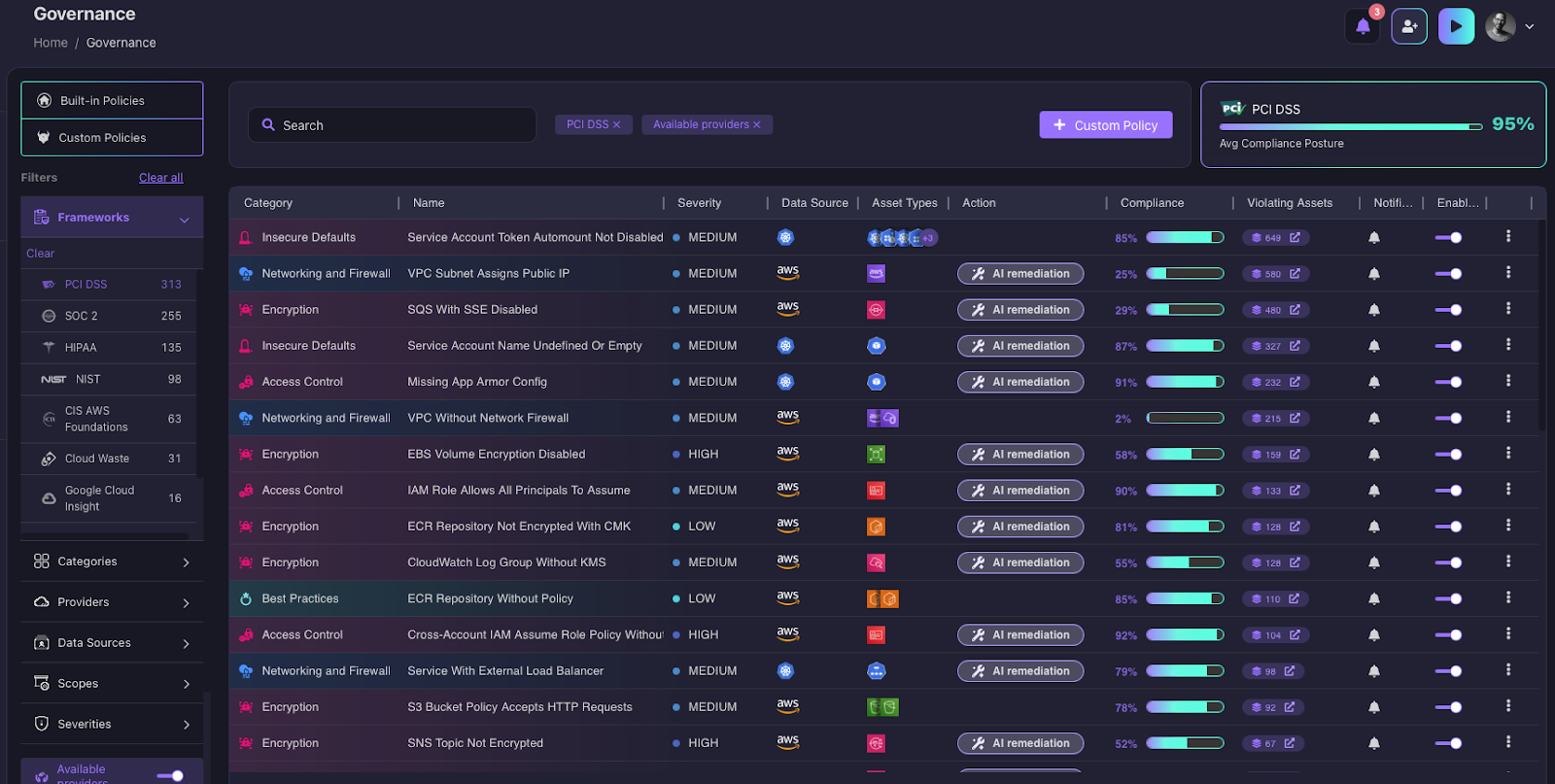
Firefly evaluates the runtime configuration of your assets in the cloud. When IaC exists, Firefly uses it as context (ownership, intent, history), but governance is enforced on what is actually running. This becomes continuous, not scheduled, so engineers get fast feedback, while leadership gets consistency and compliance.
1. You Can Detect Misconfigurations Across Your Entire Footprint
Firefly ships with governance checks that run automatically: misconfigurations and security risks (open ports, missing encryption, overly-permissive IAM, insecure defaults), compliance frameworks (CIS, NIST, SOC 2), cost and waste policies (untagged resources, unused volumes, idle instances), tagging governance, and EOL monitoring for deprecated versions.
Firefly continuously evaluates resources in your accounts and highlights assets that don't meet your standards, including those not covered by any IaC at all.
1. You Can Write Policies Without Becoming a Rego Expert
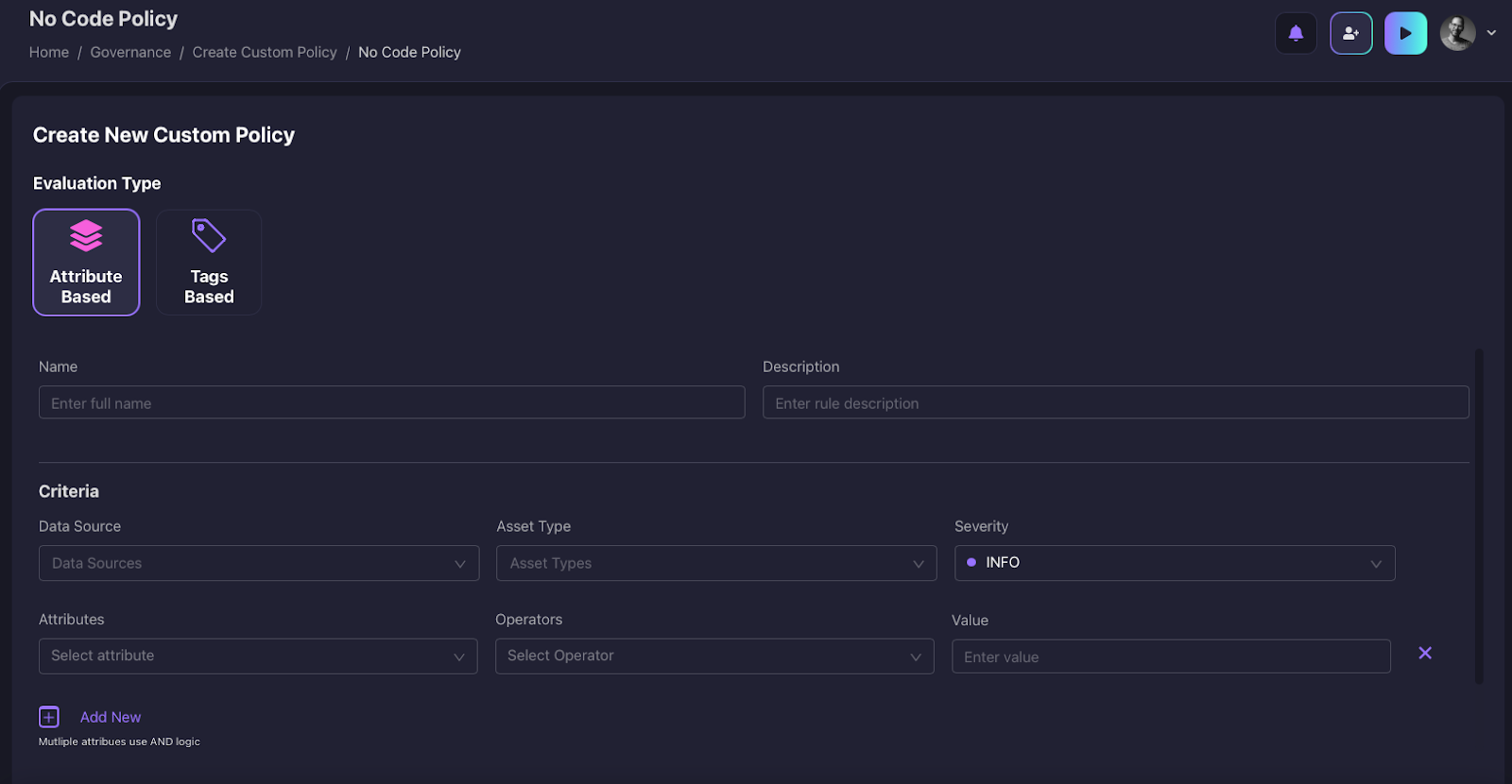
Most policy engines force you to become a Rego expert or learn vendor-specific languages. Firefly removes this friction with built-in best practice policies, KICS-powered checks, custom policies without writing code, unified enforcement across all cloud resources, and GitOps-friendly workflows.
You define the standards. Firefly enforces them everywhere.
3. You Can Catch Issues Before They Reach Your Cloud
Everything Firefly enforces on your live cloud can also be applied before deployment. This enables true shift-left governance.
Developers get instant feedback when IaC violates governance policies. Terraform plans fail early when changes introduce risky configurations. CI/CD pipelines enforce the same rules that run in production. Platform teams gain consistency upfront instead of cleaning up drift later.
Firefly applies the same governance policies to runtime cloud (where issues lead to real exposure) and pre-deployment (where issues are cheapest to fix). Governance becomes proactive, not reactive.
4.You Can Turn Violations Into Fixes Automatically
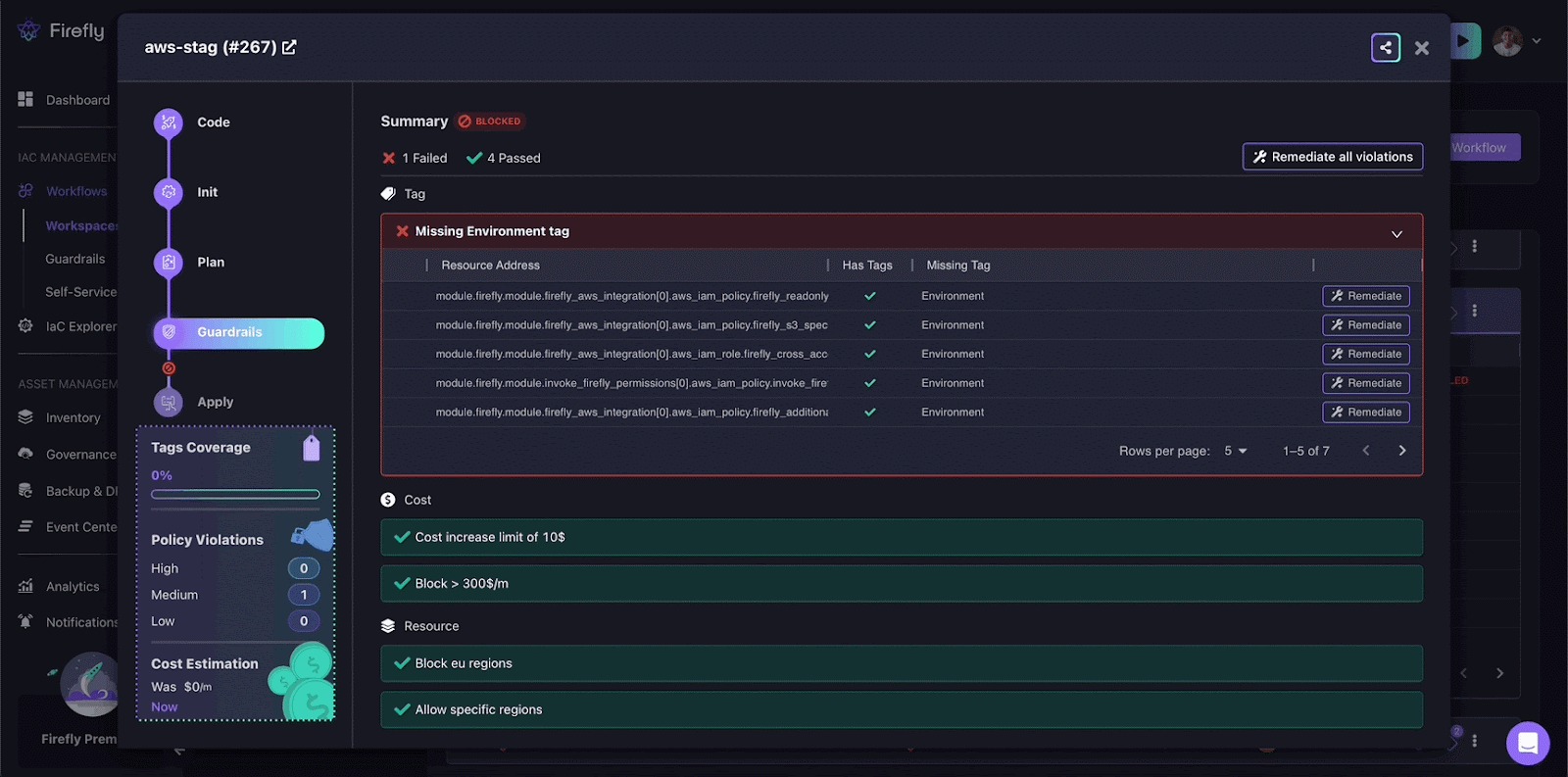
Detecting issues is helpful, but fixing them is transformational. Firefly connects every governance finding to actionable remediation: IaC fixes for Terraform, cloud-native fixes when runtime changes are required, workflows and automations to handle recurring issues at shift-left or post-deploy stages.
With Firefly, governance isn't just a report, because instead, it becomes the path to a clean cloud.
Here’s What Well-Governed Clouds Actually Look Like
Comtech reduced cloud waste by $180,000 annually. Using Firefly's governance policies to identify untagged resources, unused EBS volumes, and idle instances, they discovered waste they didn't know existed. In their words? "We copied and pasted our way to $180,000 in annual savings. For those savings alone to pay for Firefly would be huge. But to pay for it three times over is phenomenal."
Basis Technologies cut cloud waste by 83%. They knew their infrastructure sprawl was bad but didn't know the extent. Firefly's continuous governance gave them visibility into resources violating cost policies, security standards, and tagging requirements. The way they put it? "Without Firefly, we could not have gained this level of visibility or control anywhere else."
ZoomInfo streamlined cloud resource management. Firefly's Backstage plugin created a centralized catalog that let ZoomInfo developers understand what resources are installed, how to manage them, and whether they meet governance standards.
The pattern is clear: governance shifted from manual and periodic to automated and continuous, all thanks to Firefly.
How to Get Started with Firefly: Governance Edition
Implementing continuous governance with Firefly doesn't require ripping out existing tools.
- Connect your cloud accounts (read-only access initially).
- Integrate your IaC backends (Terraform state, CloudFormation stacks).
- Link your version control.
- Select governance frameworks (start with SOC 2, PCI DSS, or CIS benchmarks).
- Configure notifications (Slack, Teams, PagerDuty).
Within hours, Firefly is scanning your infrastructure and flagging violations, so you can prioritize remediation based on risk, cost impact, or compliance requirements.
For teams using CI/CD pipelines, integrate Firefly Workflows to enforce governance at the shift-left stage, catching misconfigurations in Terraform plans before they're applied.
Govern Your Cloud Without Slowing Down
Cloud governance, when done right, gives practitioners the confidence to move quickly without sacrificing safety, compliance, or cost control. Finally, there’s no tradeoff.
Ready to see how continuous cloud governance with Firefly works? Try Firefly yourself or request a demo.

.avif)
.avif)
.webp)
.webp)