Your cloud infrastructure is probably messier than you'd like to admit. Multiple clouds, multiple IaC tools, multiple teams: all moving fast, and all doing their own thing. Somewhere in that chaos, you've got resources running that nobody remembers creating, Terraform states scattered across different backends, and that relentless, anxious feeling that one wrong move could break something critical.
If you’re like most DevOps and Platform Engineering leaders today, the traditional answer (think: "just use better processes" or "document everything") stopped working once your business started scaling. What you need isn't better documentation, but a reliable, secure way to actually tame all that chaos.
The Problem: Your Cloud Is Out of Control
Here's what I hear from platform teams all the time:
"We started with AWS and Terraform. It was clean. Then the data science team needed GCP. Marketing insisted on Azure. Someone spun up Kubernetes. Half the team uses Pulumi now. We've got CloudFormation stacks from 2019 that nobody wants to touch. And honestly? We're not sure what's running anymore."
Sound familiar?
The problem isn't that multi-cloud and multi-IaC environments are inherently bad. They're actually great for innovation.
The problem is that nobody built tooling to manage this reality.
- Your cloud providers don't talk to each other.
- Your IaC tools each have their own state management.
- Your teams work in silos without visibility into what others are doing.
- You're stuck logging into six different consoles, hoping you didn't miss anything.
That ends in cloud sprawl and shadow infrastructure everywhere. Or worse: drift you can’t track and security gaps you don't know about. When something breaks, it’s impossible to figure out who created it or whether it should even exist.
This is what an untamed cloud looks like — and for most of us, it gets worse every day.
What It Means to Tame Your Cloud
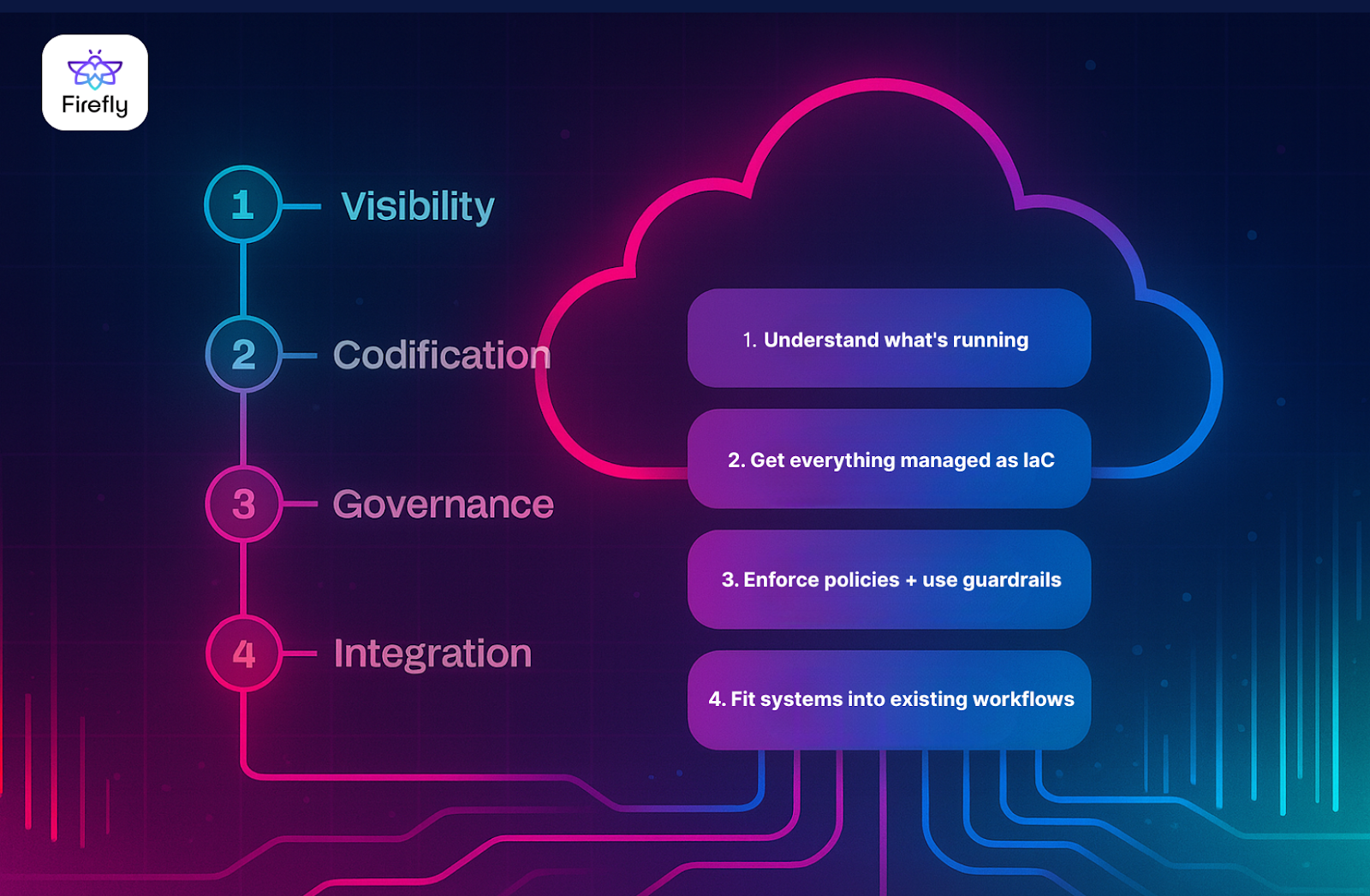
Okay, so what does it mean to "tame" your cloud: to not just see it for what it is, but actually control it. Think about it in four layers.
- Layer #1: Visibility
You need a real understanding of what's running, where it came from, who owns it, how resources connect to each other, and whether it's managed by IaC (or if someone just clicked around in a console and made rogue changes),
- Layer #2: Codification
Everything needs to be IaC, or at least have a path to get there. If it's not code, you can't version it, review it, replicate it, or recover it when disaster strikes.
- Layer #3: Governance
Proactive governance, not just policies that live in Confluence and get ignored, is non-negotiable. Real enforcement across every cloud, every IaC tool, and every team, matters — and should include policies that catch problems before they reach production, not three months later during an audit.
- Layer #4: Workflow Integration
If your governance system requires engineers to context-switch to five different tools, they'll just route around it. For it to work, the system has to fit into their workflow, not the other way around.
That's what taming your cloud infrastructure (no matter the size) looks like. And that's what Firefly was built to do.
How Firefly Brings Order to the Chaos
Firefly is the platform many of our customers say they wish we'd had years ago: the one that’s ready today to prepare them for tomorrow’s cloud management challenges.
Here’s how:
1. See and Inventory Everything Running Across Your Cloud Footprint
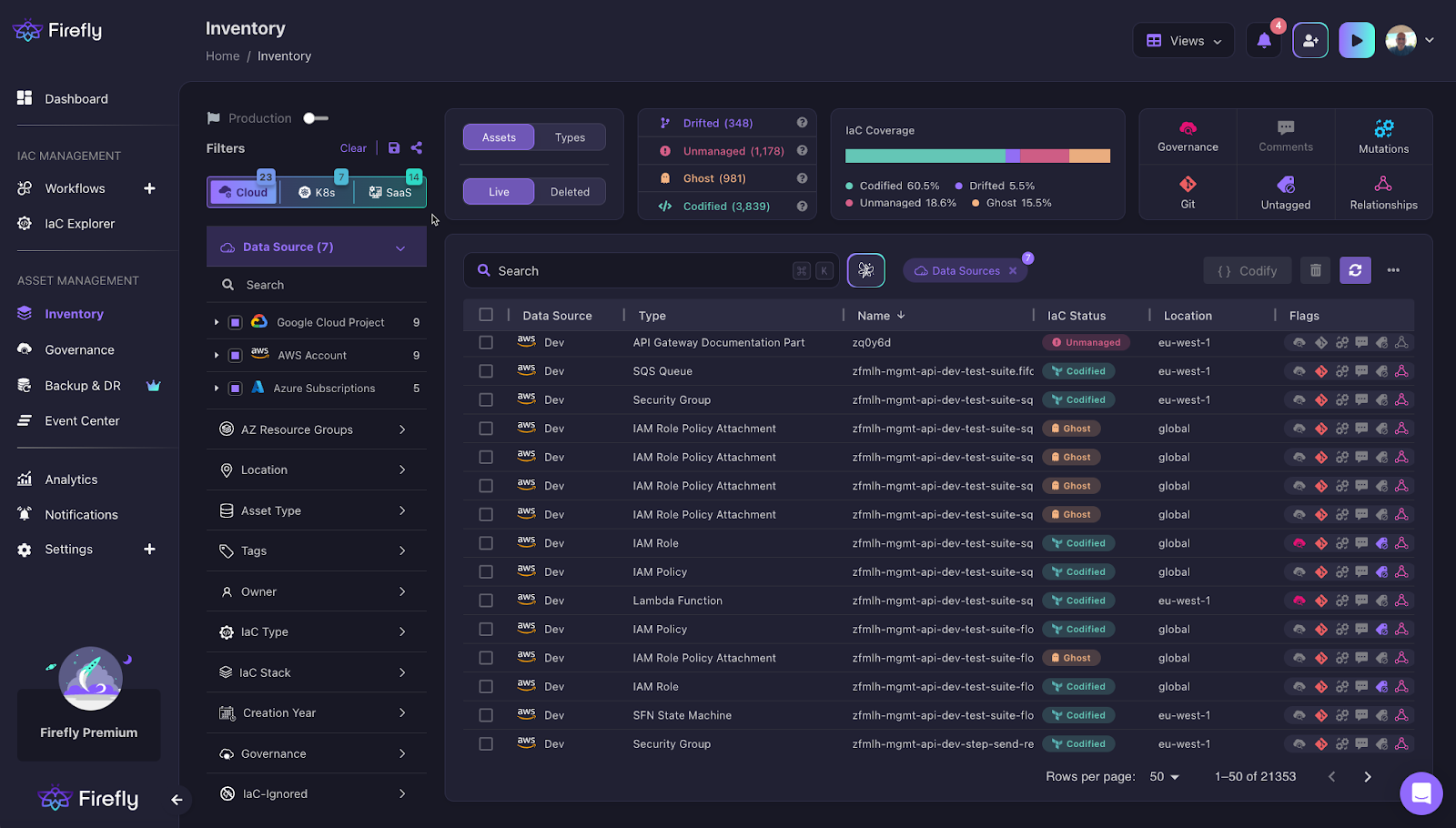
Firefly gives you a unified inventory across AWS, Azure, Google Cloud, Kubernetes, Oracle Cloud, and over a dozen SaaS providers (Datadog, Okta, New Relic, Cloudflare, MongoDB, PagerDuty). Every asset shows you its health status (managed, drifted, orphaned), relationships to other resources, ownership, tags, cost, and governance violations.
You can filter down to exactly what you need: all EC2 instances across every account, Azure resources missing tags, Kubernetes clusters on outdated versions, whatever you're hunting for.
Here's the thing that actually matters: traceability.
- You can trace from any resource back to the IaC managing it (if it exists), or from IaC forward to the resources it creates.
- Firefly understands Terraform, OpenTofu, CloudFormation, Pulumi, Helm, ArgoCD, Kustomize.
- You see state files, backends, modules, providers, versions, and the actual code.
So when something breaks, you're not guessing: you know exactly what's running, who created it, and where the code lives.
Learn more about how Firefly lets you own your cloud through discovery and inventory.
2. Turn ClickOps Into IaC (By Auto-Generating Code in Any IaC Language Using AI)
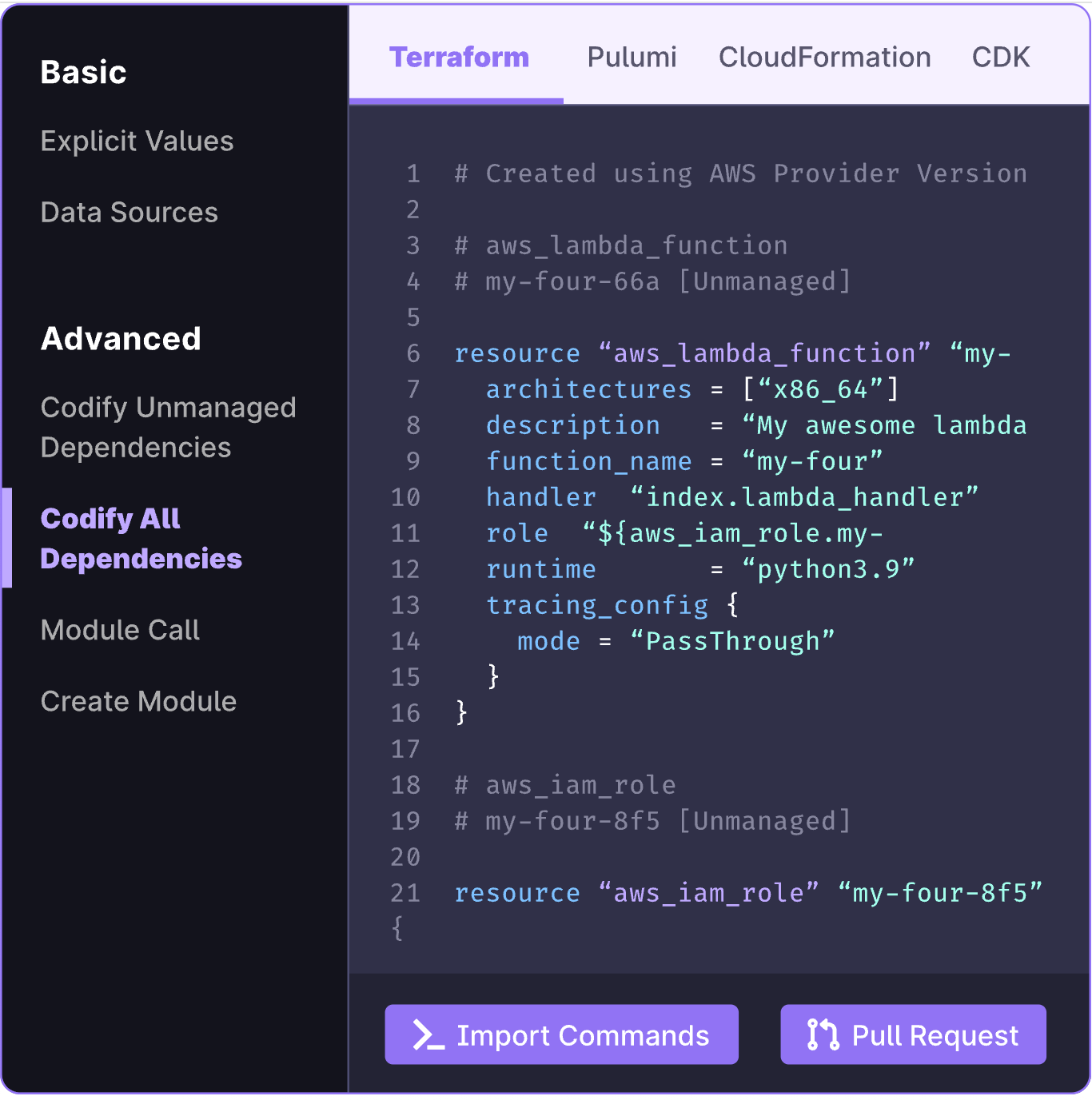
Here’s a scenario I came across recently. One of our customers had 2,350 resources across their AWS accounts. When we scanned their environment, only 40% were managed by IaC. The rest? ClickOps, manual changes, resources nobody remembered creating.
Firefly automatically generates IaC for unmanaged resources, complete with dependencies and modules, whether you need Terraform, Pulumi, or CloudFormation code. For resources that are managed by IaC but have drifted, Firefly detects the drift, shows you exactly what changed, and generates the fix as code ready to commit as a pull request.
This is how you actually get to 100% IaC coverage: by automating the heavy lifting (and decidedly not by asking engineers to spend months codifying everything manually).
3. Enforce Governance Standards And Catch Policy Violations Before They Reach Production
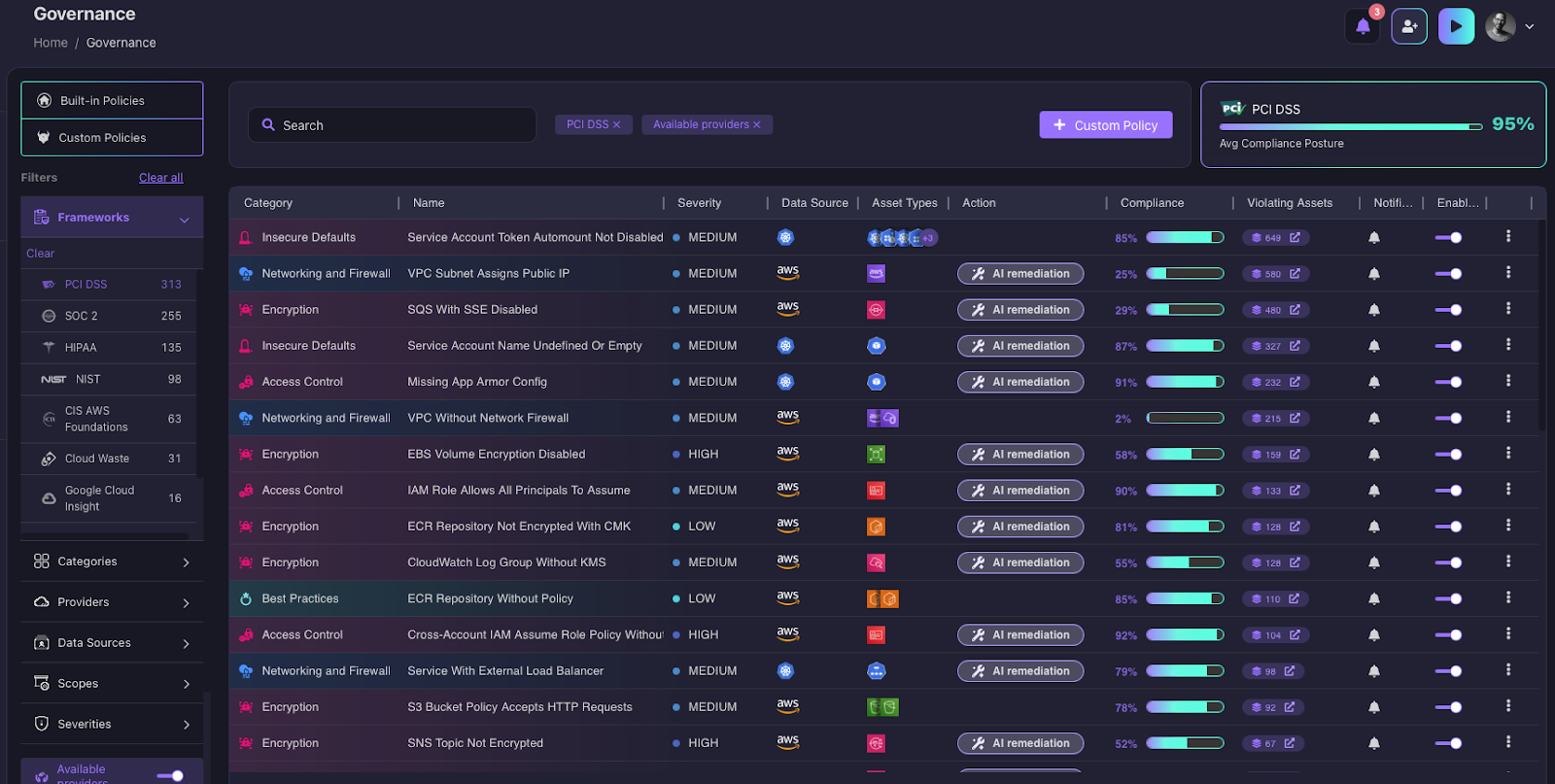
Firefly gives you unified governance that works everywhere. We ship with frameworks for PCI DSS, SOC 2, HIPAA, and CIS benchmarks. You can also create custom policies without learning Rego or becoming a policy-as-code expert.
But here's what makes this actually useful: shift-left governance. Every policy you enforce in production also runs in your CI/CD pipeline. When someone tries to deploy an S3 bucket with public access, Firefly catches it in the Terraform plan before it reaches your cloud.
And when Firefly finds violations, it generates fixes as code. You're not just seeing problems, but also getting actionable solutions you can review and apply.
4. Deploy Your Infrastructure with Built-In Guardrails
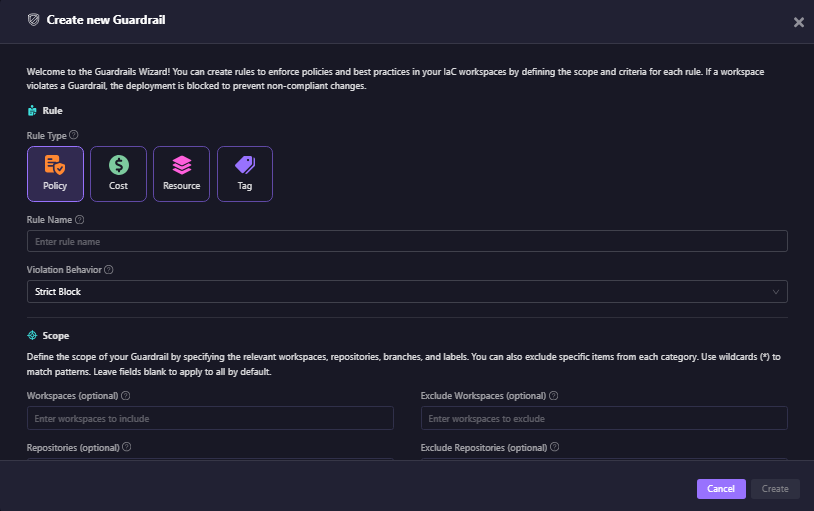
Firefly Workflows give you visibility into every Terraform plan and apply across your entire infrastructure. You see what's being created, modified, or destroyed. You see potential cost impact before deployment. You see policy violations before they reach production.
The platform works with Firefly's native orchestration engine or integrates with your existing CI/CD (Jenkins, GitLab CI, GitHub Actions). You don't have to rebuild your deployment pipeline. Firefly just plugs in and makes it better.
When something goes wrong, you can trace from the alert directly to the affected resource, see the full history in the Event Center, and understand exactly what changed and when.
5. Be Ready for Infrastructure Restoration in Case of Disaster, Not Just Data Backup
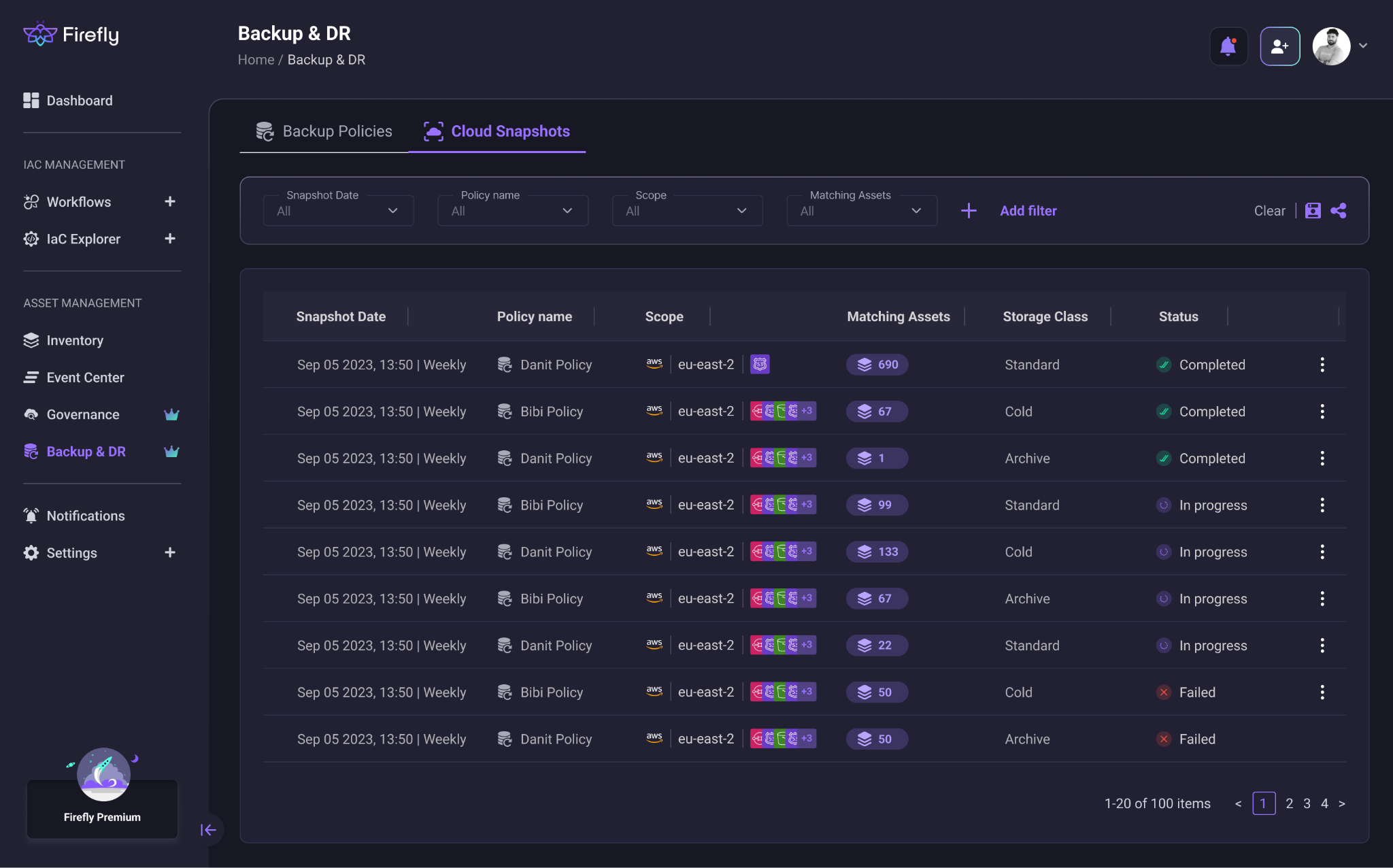
Most organizations have a DR plan that sounds good on paper but hasn't actually been tested. Can you really restore your entire infrastructure in a different region if your primary goes down?
Firefly's backup and disaster recovery capability creates snapshots of your infrastructure as IaC, capturing configurations and dependencies across your entire footprint. If disaster strikes, you can restore environments in different regions or accounts automatically. This is DR-as-Code: and it means you're actually prepared when things go sideways.
How to Get Started with Firefly in 5 Steps
The great thing about Firefly is you don't need to rip and replace your existing tools. The platform integrates with what you're already using.
- Connect your cloud accounts (read-only access to start).
- Integrate your IaC backends and state files.
- Link your version control (GitHub, GitLab, Bitbucket).
- Set up governance policies (start with out-of-the-box frameworks).
- Configure notifications for Slack, Teams, PagerDuty, or email.
Instantly, you'll have comprehensive visibility across your cloud. From there, you can tackle whatever's most urgent: improving IaC coverage, reducing costs, ensuring compliance, or understanding what you actually have running in there.
Your Cloud at Scale: Finally Under Control
Multi-cloud and multi-IaC environments are here to stay, and having the tools to manage them can determine whether you control your cloud, or your cloud controls you.
With Firefly, you get visibility across everything in your cloud, codification for unmanaged resources, governance that enforces standards without slowing teams down, and workflow integration that makes it all actually usable. That means less time spent reactively problem solving, and more time spent building.
Ready to see how it works? Try Firefly yourself or request a demo. (Because cloud infrastructure is complicated enough. Your tooling shouldn't make it worse.)

.avif)
.avif)
.webp)

.webp)