.avif)
TL;DR
- Terraform usually fails not because the config is wrong, but because the data it evaluates changes shape over time. The try() function exists to handle those runtime failures by falling back instead of stopping the plan. Used correctly, it keeps plans stable as providers, modules, inputs, and data sources evolve.
- The right way to use try() is to normalize uncertain inputs once, usually in locals, and let the rest of the module consume predictable values. It should not be used to hide real mistakes or required inputs. Most confusion around try() comes from mixing it up with coalesce(), lookup(), or conditionals, which solve different problems.
- At scale, try() introduces a new risk: silent defaults. Plans can succeed while regions, labels, or other critical settings quietly fall back. Terraform does not surface when that happens.
- Firefly fills that gap by making fallback-driven changes visible and enforceable. It shows which resources ended up using defaults, enforces policies on the evaluated state, and blocks risky fallbacks in CI before apply.
- Together, try() and Firefly allow teams to handle incomplete or evolving inputs without losing control. Terraform stays resilient, fallbacks stop being silent, and governance applies to what actually runs.
Most Terraform failures in production don’t come from invalid configuration. They come from Terraform evaluating data that doesn’t match the shape the code expects. Providers rename or drop attributes; modules add new optional fields over time; different workspaces pass different inputs; and data sources sometimes return partial results. The plan then hits an attribute that isn’t present and stops.
try() exists to handle that class of failure. It evaluates an expression that may throw an error and, if that happens, returns a fallback value instead of halting the plan.
It is commonly mixed up with coalesce() because both appear near defaults. They solve different problems. coalesce() returns the first non-null value. try() works when the expression itself fails during evaluation, such as accessing an attribute that doesn’t exist at all. Treating the two as interchangeable leads to unpredictable behavior.
The goal of try() is simple: keep Terraform plans stable as schemas, inputs, and providers evolve, without hiding real mistakes. The rest of the blog goes deep into how it works, when it is appropriate, and where it causes more harm than good.
How the Terraform try() Function Works
The try() function evaluates expressions from left to right and returns the first expression that succeeds. If every expression fails, Terraform throws an error. In simple terms, Terraform walks the list, and the first expression that works is returned.
The key point is that try() deals with runtime evaluation errors, not syntax problems. It is meant for situations where the data shape is uncertain—attributes may or may not be present.
How Terraform evaluates try()
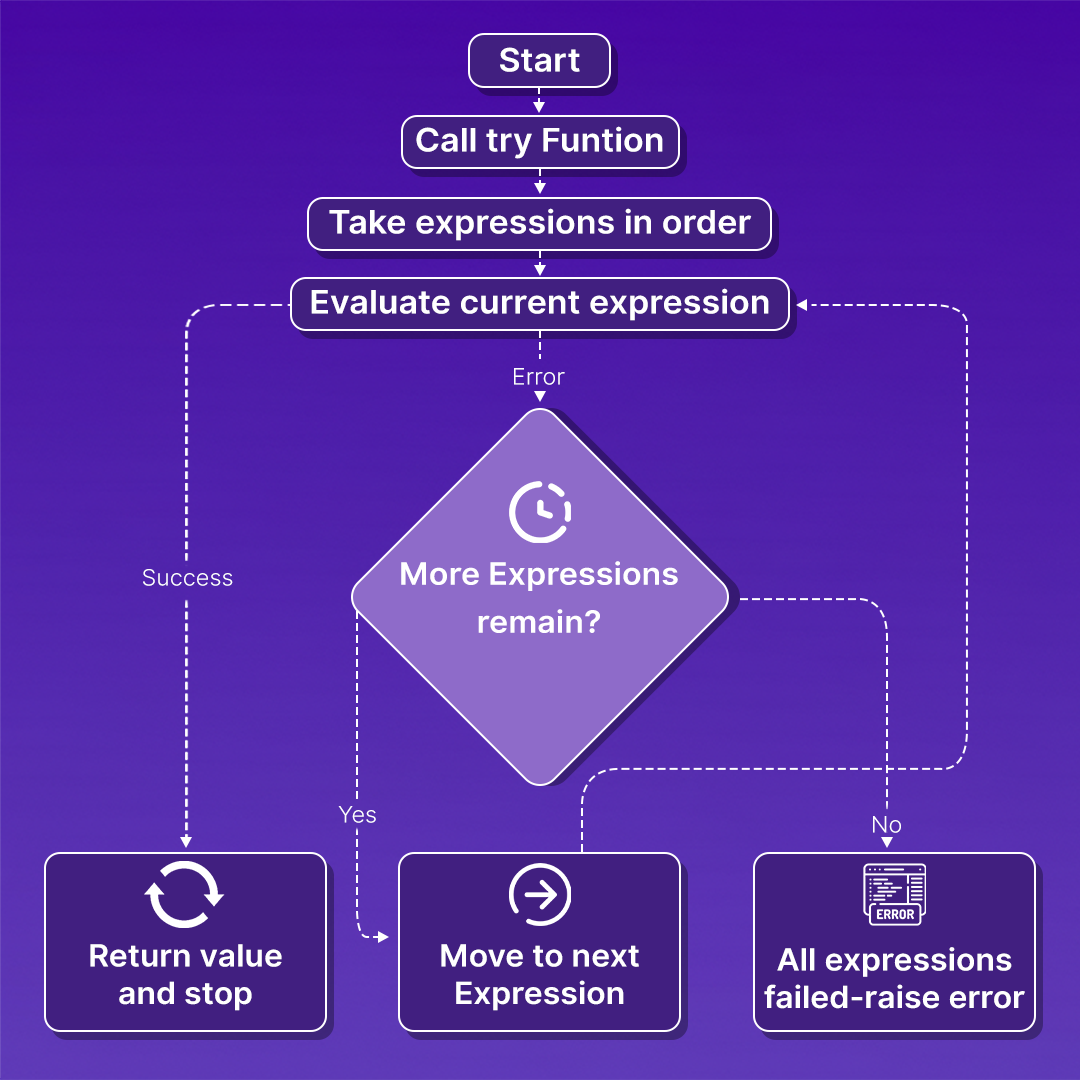
What counts as an error that try() catches
try() catches errors that happen when Terraform is actually evaluating values, such as:
- accessing an attribute that does not exist
- indexing with an invalid index
- failing to decode data into the expected shape
- conversion errors during evaluation
It does not catch syntax errors, undeclared variables, or static type failures that Terraform detects earlier.
Example: safely reading values from a YAML file
Let’s look at a practical case. You are reading configuration from a YAML file. The file may or may not contain all the fields you expect, depending on who authored it or which version is in use. You still want Terraform to plan instead of crashing because one optional field isn’t present.
Here is exactly what is happening.
First, the YAML file is read and decoded:
If the file has a metadata block, good. If not, raw will simply not contain it. Terraform doesn’t know that until evaluation time. Next, we read name in a safe way:
Terraform attempts:
If metadata or name is missing, that expression throws an evaluation error. Instead of failing the plan, try() catches that and returns null. Then we do the same for labels:
If labels do not exist, try() returns an empty map {}.
What you get after this normalization
After these locals are evaluated:
- local.name is always defined (string or null)
- local.labels is always a map (real values or {})
Everything that uses them later in the module can assume a stable data shape. No scattered checks. No repeated can() or lookup() guards. No “attribute not found” surprises. That is the job of try(): make uncertain data safe to consume without turning every resource into defensive spaghetti logic.
When you should use try()
Before using try() everywhere, it is important to be clear about what problem you are solving. try() is meant for expressions that may fail during evaluation because part of the data structure is missing. It is not a default-value helper, and it is not a general error catcher.
This section explains where try() is the right tool and where another function is a better and simpler choice. The comparisons here exist for one reason: in real modules, most confusion comes from mixing up try() with coalesce() and lookup(). If you know the boundary between these, the rest is straightforward.
try() vs coalesce()
These two are often mistaken for each other because both appear near default values. The difference is simple:
- coalesce() works when the expression evaluates successfully, but the value may be null
- try() works when the expression itself may fail during evaluation
If you already know the value exists, but it could be null, coalesce() is the right tool:
That variable exists, Terraform can evaluate it, and only the content may be null. But if the attribute path may not exist at all, try() is required:
Here, the failure can happen earlier in the access chain. metadata may not exist at all, or description may not exist inside it. Terraform fails before coalesce() ever runs, because the attribute access throws an evaluation error.
That is the practical boundary between the two. When Terraform can evaluate the expression and only the value is missing, coalesce() fits. When Terraform may not be able to evaluate the expression at all, try() is the correct tool.
try() vs lookup()
lookup() has a very narrow purpose: safe key lookup in a map when the map itself is valid. Here is what lookup() is designed for:
That assumes:
- var.tags is a map
- The only uncertainty is whether "env" exists in it
When the map itself might not exist, or there are multiple nested attributes, try() fits better:
Any of these may be missing:
- config
- tags
- env
lookup() doesn’t handle missing structures across multiple levels. try() does.
try() vs conditionals
Conditionals are the right tool when the code is expressing intent or choice, not defending against missing structure.
This is not about uncertain data. It is an explicit decision. Using try() here would not make the code safer, only harder to read. Where conditionals break down is when they are used to guard deeply nested access. Multiple contains(), can(), or key checks quickly turn into unreadable logic. In those cases, try() keeps the intent clear by handling evaluation failure directly.
How function choice affects Terraform plan behavior
Choosing the wrong one has real effects:
- Misuse of coalesce() causes hard plan failures when attributes are missing
- Misuse of try() hides problems you actually wanted to see
- Misuse of lookup() leads to long chains of brittle attribute access
The goal is not to suppress errors everywhere. The goal is predictable behavior when schemas and inputs change.
Core design pattern: input normalization with try()
Most good uses of try() follow one pattern: normalize inputs once, then forget about the mess.
In Terraform, the mess usually comes from:
- Optional fields in variables
- Decoded JSON/YAML with inconsistent shapes
- Modules that changed inputs over time
- Provider responses that don’t always include the same attributes
If you try to defend against this everywhere in resources, you end up sprinkling try(), can(), and conditionals all over the module. It becomes unreadable fast.
A better approach is:
- collect raw inputs (variables, data sources, decoded files)
- use try() in locals to normalize them
- only use the normalized locals everywhere else
That way, every resource consumes predictable data types and doesn’t care about the original shape.
Why normalization matters
Normalization solves several real problems:
- Module reuse – different teams pass inputs in slightly different shapes
- Backward compatibility – old and new attribute names both work
- Reduced cognitive load – resources don’t contain defensive logic
- Provider changes – missing attributes don’t instantly break plans
Instead of “defend everywhere”, you “fix it once”.
Normalizing YAML-driven configuration with try()
This setup uses a YAML file as the source of truth for a Google Cloud Storage bucket. The YAML is intentionally flexible. Some fields may be present, some may be omitted, and some may change over time. Terraform should continue to plan and apply without failing when that happens. The configuration starts with a simple file:
This file is decoded in locals and immediately normalized:
This block defines a contract for the rest of the module. Every field has a known type and a defined fallback. If a key is missing or cannot be evaluated, Terraform does not fail. A controlled default is used instead.
The storage bucket resource consumes only the normalized values:
At this point, the resource block contains no conditional logic and no error handling. All uncertainty has already been resolved. With the original YAML, terraform plan succeeds and shows a clean create operation. The bucket name, location, storage class, and labels all come directly from the file. No defaults are used.
The YAML is then changed so that labels do not exist:
After decoding, labels evaluate to null. Without normalization, this would either cause an evaluation error or force defensive checks inside the resource. With the current setup, Terraform falls back to the default label map defined in locals.
The next terraform plan shows an in-place update:
- existing labels are removed
- the fallback label managed_by = terraform is applied
Terraform does not fail. The behavior is explicit and visible in the plan. The bucket continues to exist, and the change is intentional.
This example shows what try() is doing in practice:
- guarding against missing or incomplete input
- keeping behavior predictable as configuration changes
- allowing input files to evolve without breaking plans
- centralizing fallback logic in one place
The important part is not the YAML or the bucket. It is the structure. Inputs are normalized once, resources consume stable values, and Terraform remains resilient as data changes over time.
Enterprise use cases where try() is not optional
At a small scale, missing attributes are an annoyance. At enterprise scale, they become a reliability problem. The larger the Terraform footprint, the more often code is evaluated against inputs it was not originally written for. That is where try() stops being a convenience and starts being a requirement.
The common thread across these cases is not complexity. It is changing over time.
Shared Terraform modules at scale
Shared modules rarely have a single consumer. They are pulled into multiple repos, pinned at different versions, and upgraded at different speeds. Inputs and outputs evolve, but consumers lag.
Typical situations:
- A new optional input has been added
- An existing input is renamed
- An output structure changes slightly
- Defaults are introduced to reduce the required configuration
Without try(), these changes force breaking releases or duplicated modules. With try(), a module can accept both old and new shapes during a transition window. Example pattern:
The module internally uses local.instance_size. Callers using the old name continue to work. New callers use the new name. No forks, no emergency upgrades, no blocked pipelines. This pattern keeps modules evolvable without forcing synchronized upgrades across teams.
Multi-cloud and multi-provider architectures
Providers do not expose identical schemas, even for similar resources. Attributes differ in name, nesting, and sometimes presence.
In a platform module that supports multiple providers, this shows up quickly. One provider may expose a field directly, another may nest it, and a third may not expose it at all.
try() is used to resolve those differences into a single internal value:
The module presents one abstraction. Provider-specific differences are handled internally. The fallback order is explicit and readable. Without this approach, platform modules either explode in conditionals or split into provider-specific implementations.
Dynamic data sources and discovery-based infrastructure
Data sources are another place where Terraform fails at runtime rather than at parse time. Lookups may return zero results, partial objects, or unexpected shapes.
Common examples:
- AMI or image lookups
- DNS records
- remote state outputs
- dynamically discovered resources
A data source returning no results is not always an error condition. Sometimes it simply means “use a default” or “feature not enabled”.
try() allows that intent to be expressed clearly:
The key point here is control. The fallback is intentional and visible. It is not silently swallowing failures across the module.
Regulated and controlled environments
In regulated environments, missing inputs cannot be handled casually. Defaults often have compliance implications. Examples include:
- regions
- encryption keys
- network boundaries
- logging and retention settings
In these cases, try() is used to enforce safe defaults, not to hide errors:
The decision to fall back is explicit. Auditors can see it. Reviewers can reason about it. Policy checks can validate it. The important distinction is intent. Failing open versus failing closed is a design choice. try() provides the mechanism, not the policy.
Why do these cases need try()
Across all these scenarios, the underlying problem is the same:
- Terraform is evaluating real systems
- Those systems do not return stable, complete data forever
- Code lives longer than the assumptions it was written with
try() allows modules to acknowledge that reality without turning every resource into defensive logic. Used this way, it is not masking errors. It is defining behavior.
Governance, testing, and CI implications of using try()
Using try() changes Terraform’s failure behavior. When an expression cannot be evaluated, Terraform no longer stops the plan. It selects a fallback value and continues. From Terraform’s point of view, this is a valid outcome. From a platform perspective, this is a configuration mutation.
The important shift is this: with try(), plans can succeed while quietly moving infrastructure into defaults that teams did not explicitly choose.
How fallback behavior creates real configuration changes
Terraform does not track intent. It only tracks evaluated values. If a value is sourced from a fallback rather than an explicit input, Terraform does not surface that distinction. The plan shows only the final result. Common examples where this matters:
- Region fallback: When a region input is missing, a resource defaults to a provider-level or module-level region.
- Labels / tags fallback: Missing metadata collapses into {} or a minimal default map.
Both outcomes are valid Terraform configurations. Both can violate platform standards. Here, the risk is not failure; instead, it is the silent drift caused by fallback logic.
Why Terraform alone is not enough here
Terraform tooling answers the question, “Is this configuration valid?” It does not answer “did this configuration fall back?”
- terraform validate cannot detect fallback paths
- CI success does not imply explicit configuration
- large plans make fallback-driven changes hard to spot manually
As the number of modules and environments grows, relying on plan review alone stops scaling. This is the gap Firefly addresses.
How Firefly makes try() fallback behavior visible and governable
The moment try() is introduced, Terraform’s failure mode changes. Instead of stopping when an attribute is missing, Terraform can continue by choosing a fallback value. From Terraform’s point of view, the plan is valid and successful.
The problem is not correctness. The problem is visibility.
Terraform does not indicate whether a value was explicitly provided or selected through a try() fallback. It only shows the final evaluated value. Once try() is in use, it becomes hard to answer a basic operational question by looking at Terraform alone:
Did this value come from an input, or did it come from a fallback?
This is where Firefly becomes relevant to try(). Firefly operates on what Terraform actually evaluates and plans, not just on what the code looks like. That makes fallback-driven behavior observable and enforceable.
Visibility into evaluated outcomes
Firefly surfaces the evaluated configuration of resources across environments. If a resource ends up in a default region or loses required labels because a try() fallback was taken, that outcome is visible at the resource level.
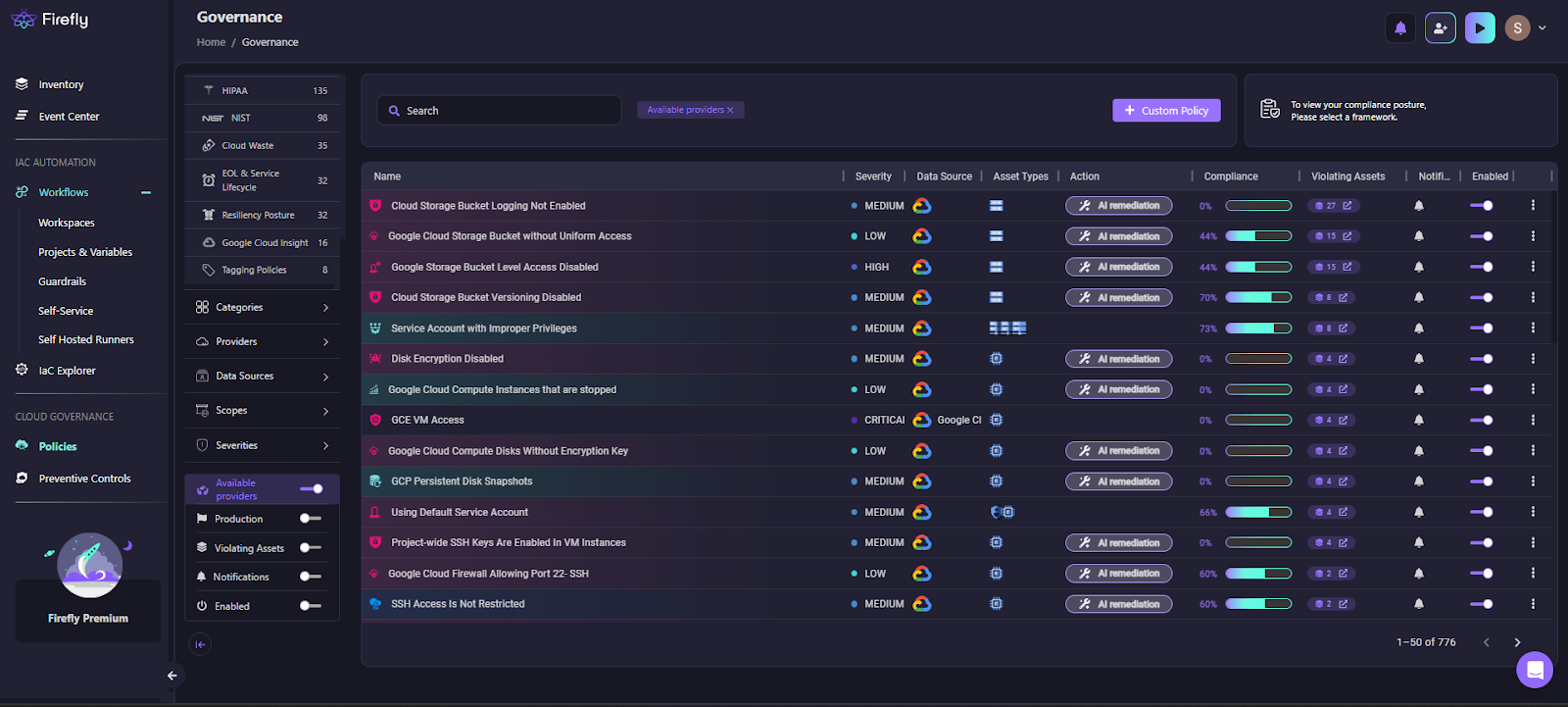
What is visible in this view:
- The list of governance policies (for example, tagging, region, encryption)
- How many assets violate each policy
- The exact resources that are non-compliant
Why this matters for try():
- When try() returns defaults (for example, {} for labels or a default region), those evaluated values show up here as policy violations
- This answers what Terraform alone cannot: which resources are running with fallback-derived values instead of explicit inputs
Instead of scanning large plans, teams can immediately see where fallback behavior has a real impact.
Policy enforcement on fallback results
Firefly policies are evaluated against the final planned or applied state, not against Terraform syntax. This matters because try() decisions only exist after evaluation.
Common policies used alongside try() include:
- The region must be explicitly set in production
- Required labels must always be present
- Resources using default metadata are non-compliant
If a try() fallback causes one of these violations, the policy flags it based on the evaluated result. The policy does not need to know where try() appears in the code. It only checks the outcome. This shifts governance from guessing intent to enforcing results.
Guardrails in CI workflows
Firefly integrates these policies directly into Terraform workflows. During the Plan stage, guardrails evaluate the planned changes before apply. If a fallback selected by try() causes a policy violation, the run can be blocked.
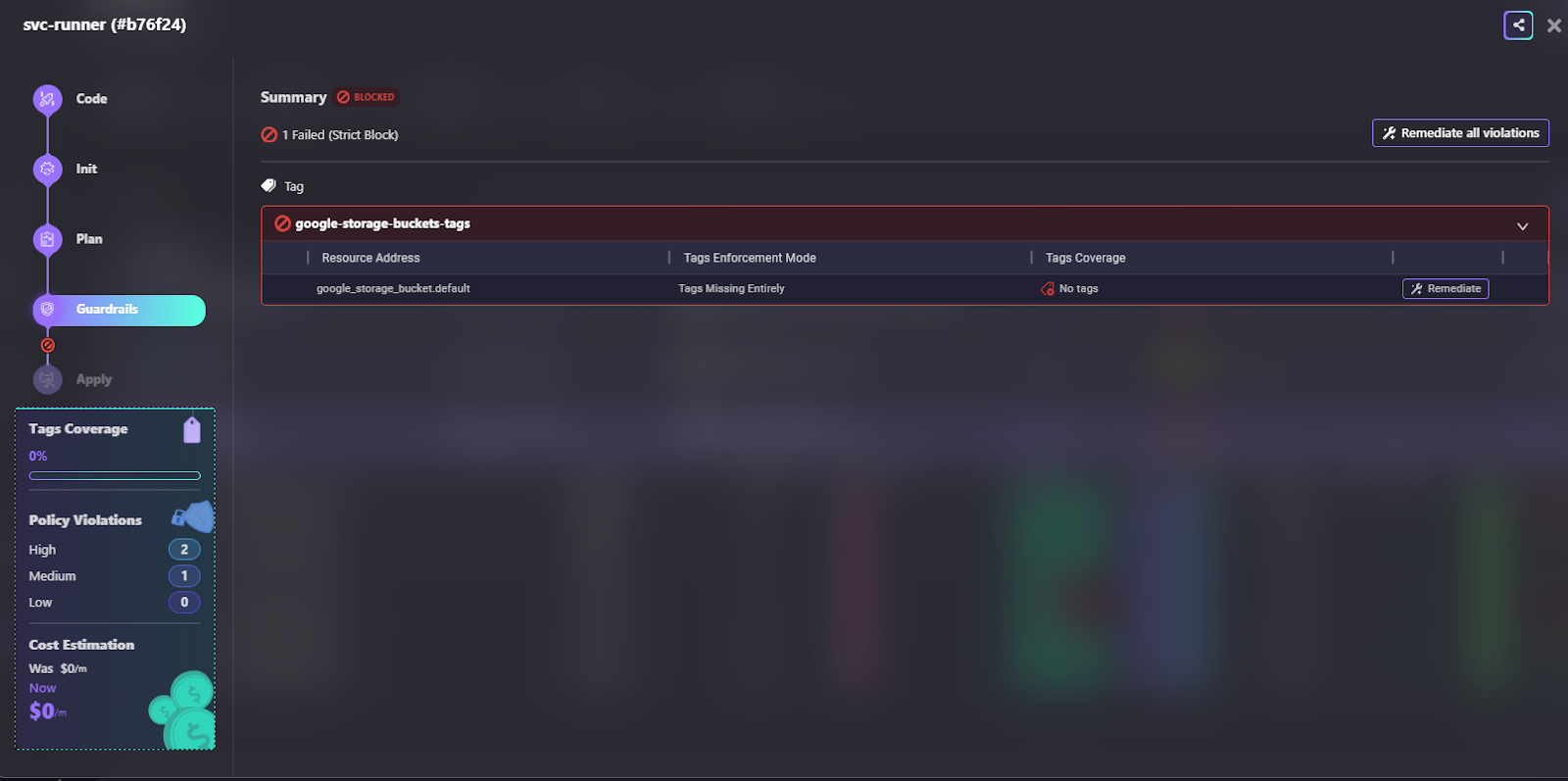
What is visible in this view:
- Which policy failed
- Which resource triggered the failure
- Why the evaluated configuration is non-compliant (for example, tags missing entirely)
This is especially important for tag and region fallbacks, which often look harmless in large plans but cause long-term governance and cost issues.
How does it impact at Scale?
In small setups, fallback behavior is easy to reason about. In larger environments, it is not:
- many shared modules
- Many teams are deploying in parallel
- inconsistent input quality
- very large plans
Fallbacks stop being edge cases. They become systemic behavior. Firefly provides answers to questions that arise specifically because try() exists:
- Which resources fell back to defaults?
- Where are defaults being used in production?
- Which policies are violated because of fallback logic?
The operating model that works
When used together, try() and Firefly form a practical operating model for Terraform at scale. try() allows Terraform to stay resilient when inputs are missing or evolve over time, while Firefly makes the resulting behavior visible and enforceable. This lets teams tolerate incomplete or changing data without losing control of their infrastructure. Fallbacks no longer happen silently, defaults are no longer invisible, and governance is applied to what actually runs in the environment.

.avif)
.avif)
.webp)

.webp)