Firefly has been named a vendor in Gartner's inaugural Market Guide for AI Assistants for Infrastructure as Code, recognized alongside a select group of platforms built for the scale and complexity of modern cloud operations.
We all know that Gartner doesn't define markets early. When they do, it means the shift is already happening, and the market is already established.
But be warned: the window to build the right foundation for AI for IaC is narrower than most teams think.
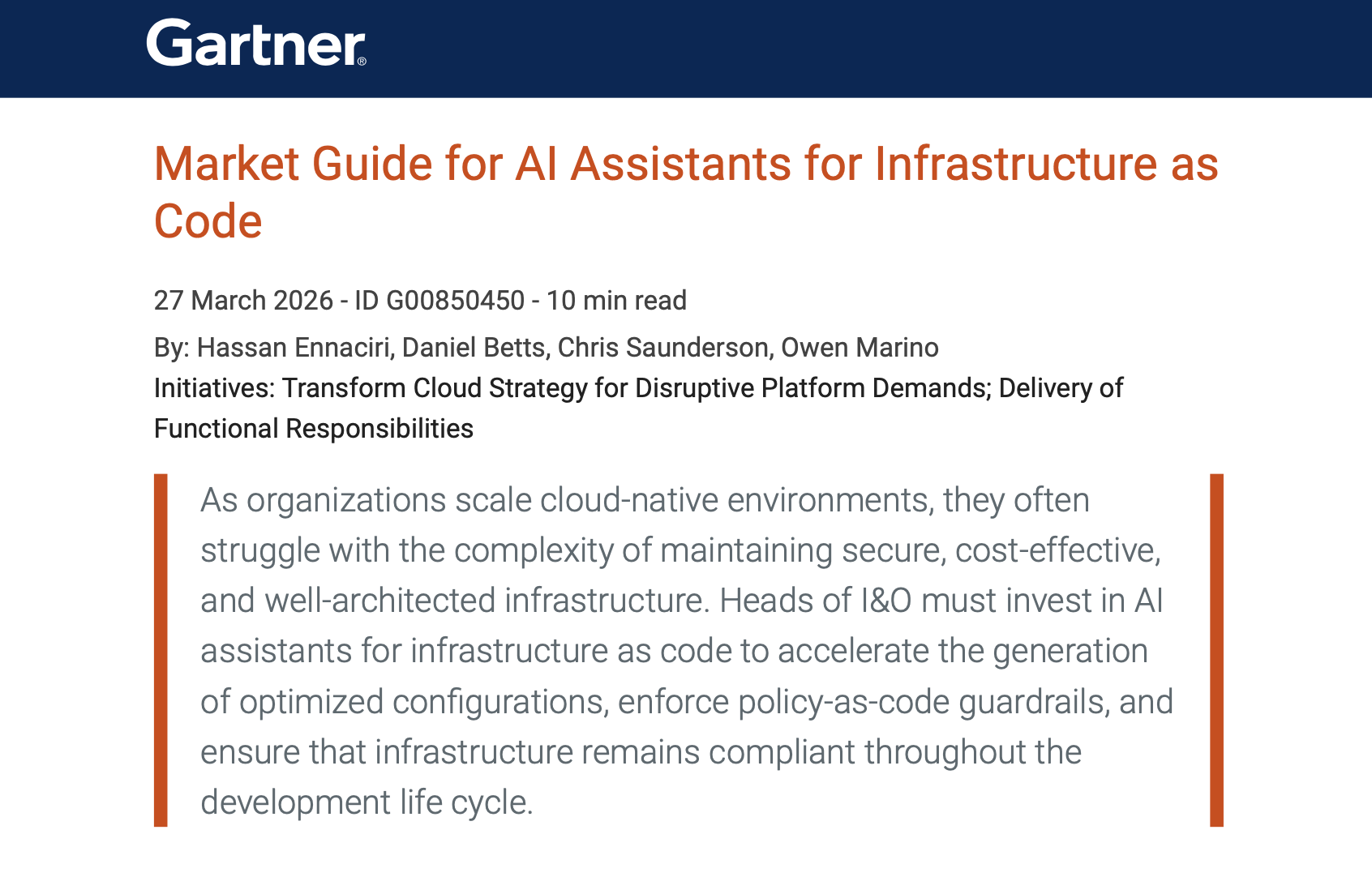
Here’s what Gartner had to say.
The Hard-Hitting Numbers That Should Be on Your Radar
Two Gartner projections anchor the AI for IaC market:
By 2029, 90% of I&O organizations will have integrated context-aware AI assistants into their IaC workflows to bridge specialized cloud-native skill shortages. Today, that number is only 5%.
By 2029, 70% of enterprises will deploy agentic AI for automated IaC generation and drift remediation as a core part of IT infrastructure operations. Today, that number is less than 1%.
These numbers don’t represent gradual adoption. That's a market tipping. Organizations that aren't moving now will be rebuilding their IaC foundation under pressure, with slower delivery cycles, higher remediation costs, and security posture that depends on manual oversight to hold.
AI Assistants for IaC: Why This Market Exists Now
Three key, converging pressures drove Gartner to formally define this category.
The IaC skills gap is structural: Cloud-native infrastructure has outpaced available talent. Engineering teams are expected to manage multi-cloud complexity at scale without proportional headcount growth.
Generic AI creates new risk: LLMs that lack live environmental context generate configurations that look correct but aren't deployable in your specific environment. The result is technical debt, security exposure, and rework that quietly consumes engineering time and budget.
Day 2 has been the blind spot: Most IaC tooling was built for provisioning. But drift, compliance failures, cost overruns, and incident response happen after deployment, and they've historically required manual intervention to resolve. At scale, that's unsustainable.
The Shift Gartner’s Flagging: From Day 1 Generation to Day 2 Resilience
The first generation of IaC tooling solved a Day 1 problem: getting infrastructure provisioned faster. But the harder problem, and the one that compounds quietly until it becomes a crisis, is what happens after deployment.
Gartner explicitly identifies drift remediation as a first-class reliability signal tied to uptime and security, not a maintenance task to be scheduled. When infrastructure drifts from its defined state, it introduces risk: security vulnerabilities, compliance gaps, outages. The longer drift goes undetected, the more expensive it is to resolve.
The same logic applies to cost.
If cloud spend is only visible after the bill arrives, the organization has already lost the opportunity to optimize it. Gartner's framework calls for cost-aware provisioning built into the generation layer itself, not reconciled after the fact by finance.
For engineering teams, this reframes what "good IaC tooling" means. Speed to deploy is table stakes, but continuous resilience is the real differentiator.
For executives, it reframes the ROI conversation. The value of AI-driven IaC isn't just developer productivity. It's fewer outages, lower remediation costs, and infrastructure spend that's predictable rather than reactive.
What Separates Purpose-Built Platforms like Firefly from Generic Tools
Gartner draws a hard line between general-purpose AI coding assistants and platforms designed specifically for infrastructure operations. Importantly, the difference is architectural, not cosmetic.
Generic LLMs generate plausible code in isolation. They don't know your VPCs, your resource IDs, your compliance requirements, or your cost constraints. The configurations they produce look right until they hit your actual environment, and that's where the damage happens.
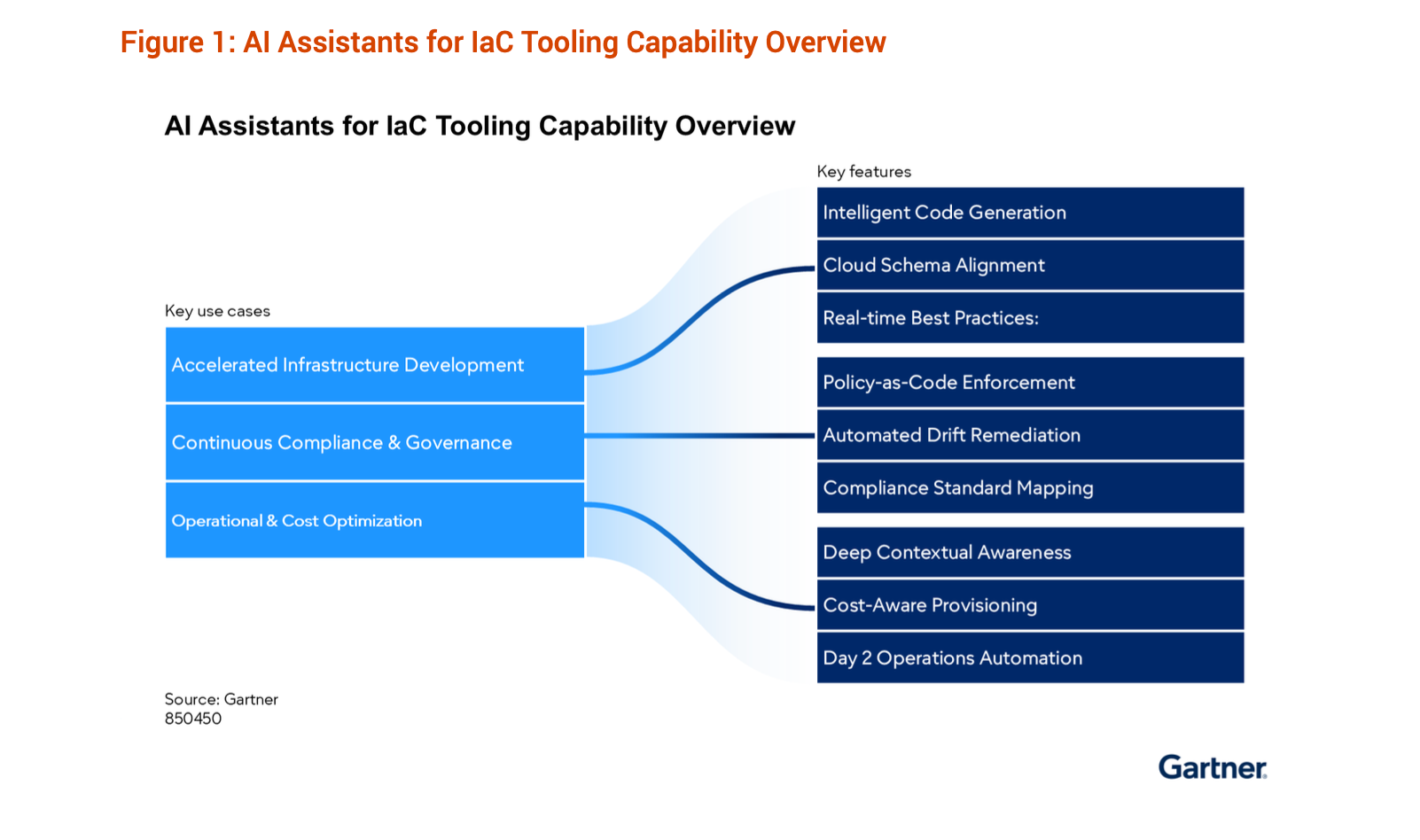
Purpose-built platforms must deliver:
- Context-aware code generation grounded in live cloud state, not generic templates
- Drift detection and remediation as a continuous reliability function, not a scheduled scan
- Shift-left policy enforcement that catches vulnerabilities before code reaches production
- Standard IaC framework support across Terraform, OpenTofu, Ansible, Kubernetes manifests, and more
Gartner's mandatory feature set reads like a description of how Firefly already works.
That alignment’s a consequence of building the Firefly platform around today and tomorrow’s infrastructure challenges, with every release.
The organizations that build the right foundation now will have a compounding advantage in delivery velocity, security posture, and operational resilience. The ones that wait will be closing the gap under pressure.
Get in touch to learn how Firefly can help.
Source: Gartner, Market Guide for AI Assistants for Infrastructure as Code, Hassan Ennaciri, Daniel Betts, Chris Saunderson, Owen Marino, 27 March 2026
Gartner does not endorse any vendor, product or service depicted in its research publications and does not advise technology users to select only those vendors with the highest ratings or other designation. Gartner research publications consist of the opinions of Gartner's research organization and should not be construed as statements of fact. Gartner disclaims all warranties, expressed or implied, with respect to this research, including any warranties of merchantability or fitness for a particular purpose.

.svg)