.avif)
Firefly has been recognized in Gartner's inaugural Market Guide for AI Site Reliability Engineering Tooling: strong validation that positions Firefly as an innovator in a market experiencing a fundamental shift.
Still, the real story isn't about vendor recognition. It's about solving the SRE adoption crisis that has kept reliability practices out of reach for most organizations.
Why SRE Adoption Fails for Most Organizations
Site Reliability Engineering remains aspirational for most companies because the math doesn't work:
- Specialized SRE talent is scarce and expensive
- Training internal teams takes months with uncertain ROI
- Justifying costs to leadership requires proving value upfront
- Traditional approaches can't scale with modern infrastructure complexity
What happens as a result? SRE practices stay confined to tech giants while everyone else struggles with alert fatigue, manual incident response, and reactive problem solving.
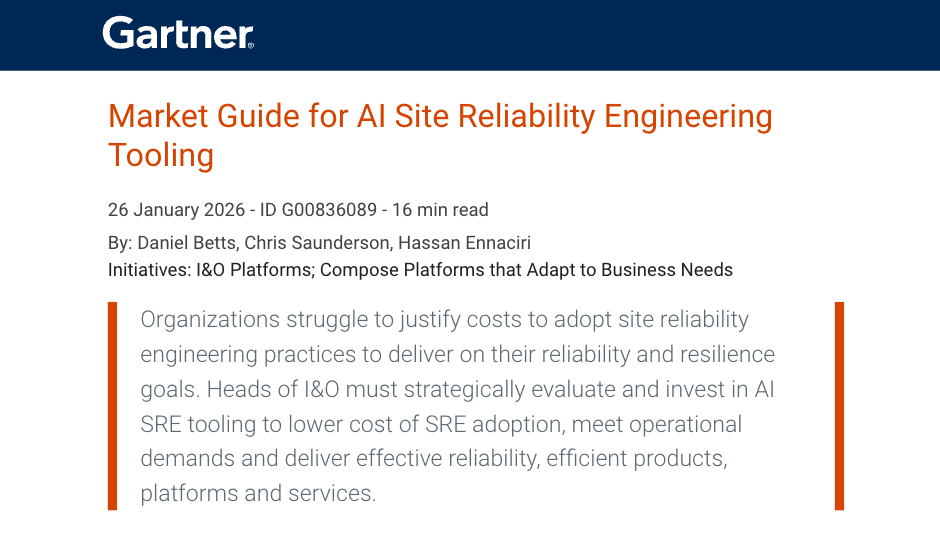
The market shift is dramatic: Gartner predicts 85% of enterprises will use AI SRE tooling by 2029, up from less than 5% in 2025. This isn't a gradual growth trajectory, and that’s because it's a larger, fundamental transformation driven by necessity.
When Better Incident Response Misses the Point
Most AI SRE tools entering the market focus on operational efficiency:
- Faster incident response
- Automated root cause analysis
- Reduced mean time to recovery
- Intelligent alert correlation
These capabilities matter. But Gartner identifies a critical limitation:
"Organizations that select AI SRE tooling focused on operations only will become better at reactively fixing incidents but not at improving system reliability."
The Real Opportunity? Prevention Over Response
Gartner's most significant predictions focus on proactive reliability:
- By 2029: 75% of organizations will integrate AI-distilled SRE lessons into product design and delivery (up from 10% in 2025)
- By 2030: 60% of new infrastructure designs will be validated by AI using historical failure data before development begins
This represents a fundamental shift in where reliability work happens: from incident response to design, deployment, and continuous validation.
What Makes Firefly a Standout Solution in the Market
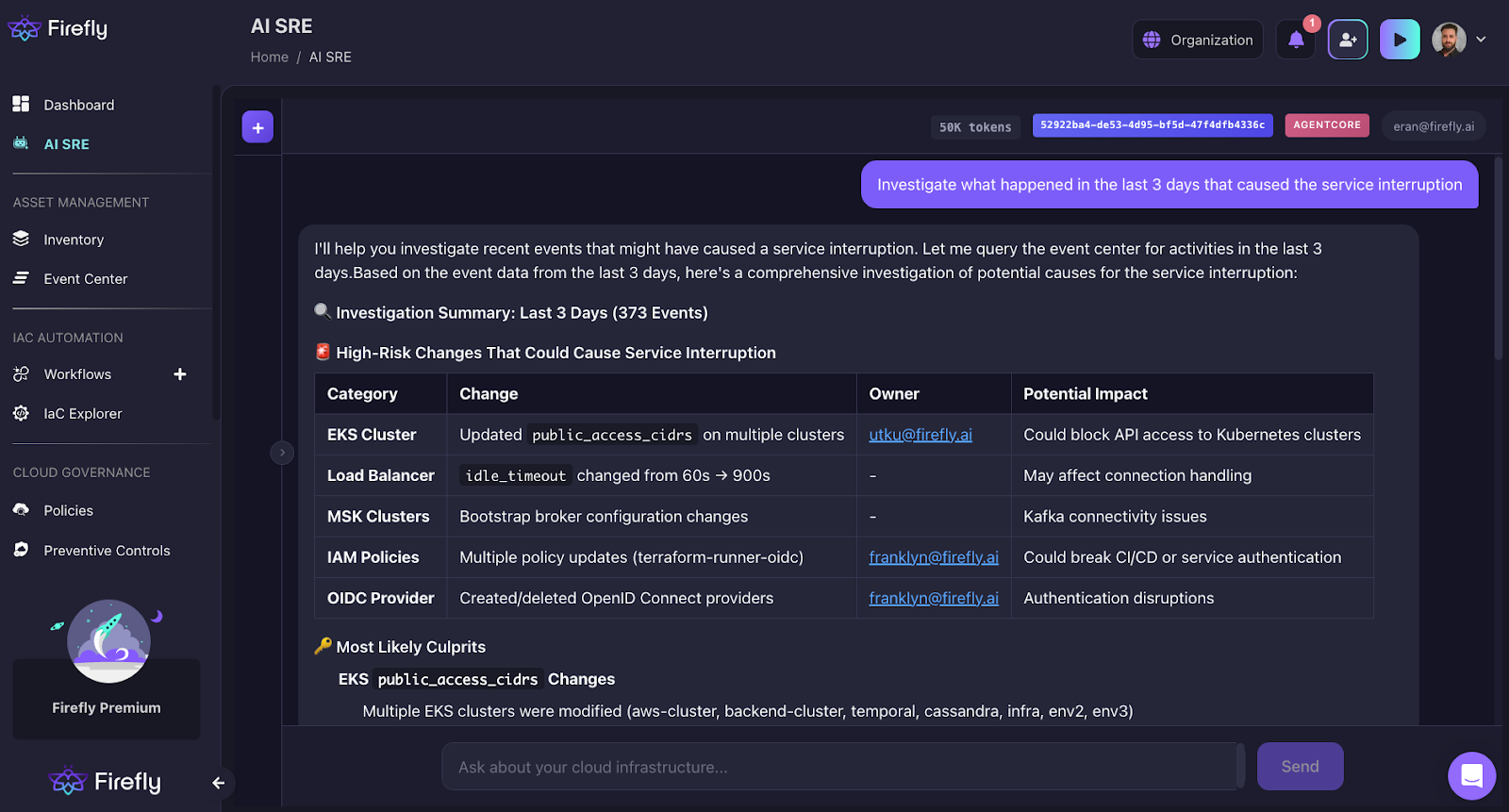
Firefly's AI SRE (Thinkerbell AI) embeds reliability throughout the infrastructure lifecycle, not just during incidents:
- AI SRE Agents acting with full visibility into your cloud infrastructure and codebase, and are able to pinpoint issues faster, slashing the time from alert to resolution
- Proactive detection surfaces configuration issues before they cause outages
- Autonomous remediation fixes problems without waking engineers at 3 AM
- Continuous compliance ensures infrastructure matches reliability requirements at all times
This aligns with Gartner's roadmap of emerging capabilities: proactive incident avoidance, SLO protection, multi-agent architectures, and automated chaos engineering.
What Platform and DevOps Leaders Should Do Next
According to the guide, Gartner's recommendations for evaluating this market include:
- Audit existing tools first. Your observability, automation, or ITSM platforms may already have basic AI SRE capabilities. Understand the gaps.
- Define specific reliability goals. Generic aspirations like "improve uptime" don't guide tool selection. Target metrics like reducing incident count by 40% or achieving sub-15-minute MTTR.
- Think beyond operations. Look for solutions that embed reliability insights throughout delivery lifecycles, not just in production.
- Evaluate integration depth. Tools that embed into existing workflows (CI/CD, IaC, GitOps) drive higher adoption than standalone solutions requiring context-switching.
What’s Coming: The Market Dynamics to Watch
Autonomy requires explainability. Gartner predicts 90% of organizations will experience an AI-caused outage by 2029, yet continue using AI SRE for speed and scale gains. Winners will make AI decision-making transparent and auditable.
Proactive capabilities will differentiate. As reactive features commoditize, the ability to prevent incidents through policy enforcement and predictive analytics separates leaders from followers.
Multicloud coverage is mandatory. Hybrid environments spanning multiple clouds, on-premises, and edge require unified visibility and policy enforcement. Single-cloud point solutions won't scale.
Gartner's inaugural Market Guide maps how organizations will deliver reliability over the next five years.
Being named in this report validates Firefly's approach and positioning as an innovator. More importantly, it confirms the market understands the limitations of purely reactive tools and the necessity of lifecycle-integrated reliability practices.
The future of SRE isn't about hiring more SREs. It's about making SRE practices accessible, scalable, and embedded in how infrastructure gets designed and delivered. AI makes that possible. Organizations that embrace it first will define what reliability means for the next decade.
Source: Gartner, Market Guide for AI Site Reliability Engineering Tooling, Daniel Betts, Chris Saunderson, Hassan Ennaciri, 26 January 2026
Gartner does not endorse any vendor, product or service depicted in its research publications, and does not advise technology users to select only those vendors with the highest ratings or other designation. Gartner research publications consist of the opinions of Gartner's research organization and should not be construed as statements of fact. Gartner disclaims all warranties, expressed or implied, with respect to this research, including any warranties of merchantability or fitness for a particular purpose.

.svg)