TL;DR
- Cloud resilience is the engineering practice of designing, operating, and recovering cloud platforms so that infrastructure failures, human error, and security incidents are handled predictably. It's distinct from availability (staying online right now) and disaster recovery (restoring after a major failure).
- It's built from six capabilities working together: infrastructure, application, data, operational, cyber resilience, and governance/visibility, plus NIST CSF 2.0's six functions (Govern, Identify, Protect, Detect, Respond, Recover) as the reference model most enterprises already report against.
- Resilience planning should start with applications, not individual resources: a complete inventory, grouped into applications, with dependencies mapped before an incident rather than discovered during one.
- A 7-step framework turns that into a strategy: identify critical applications → define RTO/RPO → map dependencies → standardize on IaC → design backup policy → automate recovery → continuously validate.
- Manual, runbook-driven DR doesn't hold up against infrastructure that changes hundreds of times a week. Disaster Recovery as Code, automation, version control, and continuous validation replace it.
- Firefly automates the operational layer underneath this strategy: continuous inventory and IaC-coverage tracking, tag-based application grouping, OPA/Rego-based resiliency policy enforcement, and Terraform-based recovery with a sub-1-hour RTO, instead of manual cloud changes or stale runbooks.
A Terraform pipeline runs a routine deployment and, in the process, deletes a production Virtual Network peering. The deployment itself finishes with a green checkmark. But the AKS cluster behind it can no longer reach Azure SQL, Storage Accounts, or any private endpoint. Rolling back the Terraform change doesn't fix it immediately; downstream resources have already shifted state, so engineers spend the next hour figuring out exactly what the environment looks like before they can touch it.
A different failure, same week, different team: a ransomware attack compromises a production subscription, and security isolates it within minutes. Backups exist. But restoring data is the easy part. Before any workload goes back online, the platform team has to rebuild networking, identities, compute, security policies, and every dependency between them in an environment they trust again.
Different root causes, same lesson: recovering cloud infrastructure is harder than deploying it in the first place.
A cloud resilience strategy is the structured answer to that problem, a way to design, operate, and recover cloud platforms so that infrastructure failures, human error, and security incidents are handled in a predictable, repeatable, and automated way, rather than becoming a fire drill every time.
This guide walks through the engineering capabilities that make a platform resilient, a step-by-step framework for building a resilience strategy, and where practices like Infrastructure as Code, automated recovery, and application-aware infrastructure management fit in.
What is Cloud Resilience
Cloud resilience describes how well a platform is designed to keep functioning when something breaks. A resilient platform isn't one that never fails; every platform fails eventually. It's one where failure doesn't automatically become an outage: a node in an AKS cluster goes down, and Kubernetes reschedules the pods without anyone paging on-call; someone fat-fingers a terraform destroy against the wrong workspace, and the platform rebuilds the deleted resource from Infrastructure as Code instead of an engineer recreating it by hand in the portal.
None of that happens by accident. Each capability is the output of an architectural decision made long before the incident. Resilience is the combination of architecture, operational practices, and automation that enables a platform to keep serving users through failures and to recover quickly when failures can't be avoided.
Resilience is often confused with availability and disaster recovery, but they're not the same thing: availability keeps a service online right now, disaster recovery restores it after a major failure, and business continuity keeps the business running through the disruption. Cloud resilience ties all three together across the full lifecycle of a failure, from limiting the blast radius the moment something breaks to getting the platform back to a known-good state.
NIST's Framework for This Work
The most widely cited anchor for this work is NIST, which defines resilience as the ability to anticipate, withstand, recover from, and adapt to adverse conditions, attacks, or compromises affecting systems that use or are enabled by cyber resources. NIST's Cybersecurity Framework (CSF) 2.0, released in February 2024, organizes that work into six functions. Most enterprises already build compliance reporting around this model, which makes it a useful cross-reference alongside the capability breakdown below:
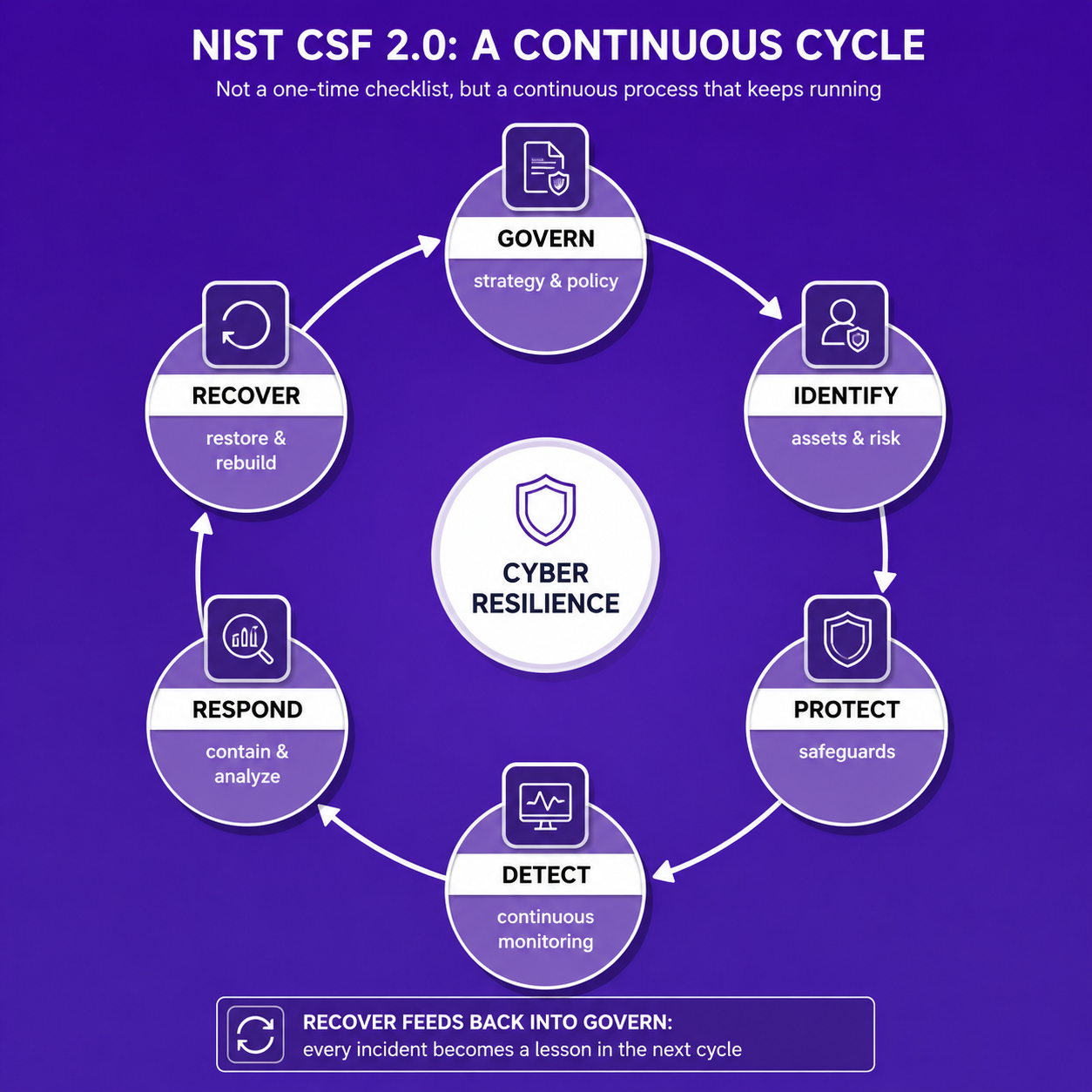
Govern was added in CSF 2.0 specifically because earlier versions treated resilience as a purely technical problem, when in practice it's also a leadership and accountability problem.
Why "We Have Backups" Isn't a Resilience Strategy
Enabling backups, spreading workloads across Availability Zones, and adopting Infrastructure as Code all matter. None of them, on their own, guarantees that an application survives a real production incident.
Modern applications span dozens of services, often across multiple environments. A single business application might depend on Kubernetes clusters, virtual networks, load balancers, managed databases, object storage, DNS, identity providers, secrets management, and CI/CD pipelines, and in hybrid or multi-cloud setups, those dependencies span Azure, AWS, GCP, and on-premises simultaneously.
These components don't fail together, and they don't recover together by default.
A database restores cleanly, and the application still can't start because the managed identity lost its Key Vault access during the restore. A Kubernetes cluster gets recreated from Terraform exactly as written, and workloads stay unreachable because the Private DNS records and route tables that pointed to the old cluster were never restored alongside it. A regional failover kicks in, and for a window of time, compute is running in the secondary region while application data is still being served from the primary, two halves of the same request path now disagreeing with each other.
None of these are failures of the individual cloud service. There are failures in how the platform was designed to come back together.
That's why resilience has to be a platform strategy, not a checklist of technologies. It starts by asking a different set of questions than "do we have backups?" or "are we multi-AZ?":
- Which applications are business-critical, and which aren't?
- What does each application actually depend on, end to end?
- How fast does each application need to come back?
- Can the entire platform be rebuilt from a trusted source rather than patched from memory?
- When was the recovery process last tested, and did it work?
- Can recovery run as an automation, or does someone have to drive it manually?
Answering those before the incident, not during it, is what separates a resilient platform from one that just happens to have some resilient parts.
The Six Capabilities Behind a Resilient Cloud Platform
No single capability covers the gap alone. Multi-AZ prevents a zone outage but not an accidental deletion; backups protect data but not the identities and networking associated with it. A resilient platform stitches six together, each covering a different stage of recovery. The table below maps each one back to the CSF function it primarily serves:
1. Infrastructure Resilience: A single failed VM, AZ, storage service, or network path shouldn't cascade into an outage, which is why resilient platforms spread infrastructure across failure domains on purpose: a Kubernetes cluster spans multiple Availability Zones instead of one, load balancers route only to workloads that pass health checks, and network paths run redundant VPN gateways or ExpressRoute circuits instead of a single line that takes everything down with it. Recoverability is the other half of the equation. Infrastructure as Code recreates a deleted resource in its previous state, as long as the Terraform or Bicep code stays in sync with what's actually deployed.
2. Application Resilience: A flaky dependency can take an application down as surely as an infrastructure failure, so resilient applications are built to expect it. Timeouts let a thread fail fast instead of waiting indefinitely on an unresponsive call. Scoped retries with exponential backoff and a hard limit, only on idempotent operations, never a payment charge, recover from a network blip without piling more load onto a struggling service. Circuit breakers stop hammering a dependency that's still down. Failure isolation closes the loop: a down recommendation engine shouldn't block checkout.
3. Data Resilience: A backup proves data got copied somewhere; recoverable data means it comes back on a defined timeline, with acceptable loss, intact. That timeline gets set per application as an RPO and RTO; a reporting tool can tolerate hours of lost data, a payment platform can't tolerate more than a few seconds, and those numbers should drive the backup design, not the other way around. Backups guard against accidental deletion and ransomware; snapshots enable fast rollbacks, and replication keeps a live copy elsewhere, though it copies an accidental DELETE just as quickly as anything else. None of it counts until it's tested: a backup that's never been restored is an assumption, not a fact.
4. Operational Resilience: The outcome of an incident isn't determined by whether it happens; it's determined by how quickly the team detects it, scopes its impact, and fixes it. That starts with observability that correlates metrics, logs, and traces across the actual request path, and alerts that carry context ("checkout failing because database timeouts crossed 5 seconds") instead of raw thresholds ("CPU above 90%"). None of it holds up without testing on a schedule, DR rehearsed, backups restored, failovers practiced before they're needed.
5. Cyber Resilience: Modern platforms assume an attacker eventually gets in, which turns the real question into whether the platform can recover safely once one does. That means rebuilding from trusted Infrastructure as Code into new infrastructure instead of repairing a compromised one, restoring identities without inheriting broader privileges than they had originally, and protecting the backups themselves, immutability and isolated access, from the same compromise, since backups become the next target if the same identities that manage production can also delete them.
6. Governance & Visibility: Knowing that resources exist isn't the hard part; knowing how they connect is. That starts with an infrastructure inventory where every resource is discoverable, owned by a named team, and classified by criticality, followed by an application inventory that groups resources by the business application they support. Dependency mapping traces the networking, identity, and storage on which an application depends before an incident, not during one.
Why Resilience Planning Should Start With Applications, Not Resources
Most teams treat cloud resources as independent units rather than as pieces of something bigger. But a VM isn't just a VM, and an AKS cluster isn't just a Kubernetes cluster. A typical production app spans compute, a managed database, secrets in a vault, object storage, private endpoints, identity, and networking tied together. If you recover the compute layer and stop there, the application still doesn't come back.
That's why planning starts with applications, in three steps. First, a complete infrastructure inventory: a continuously updated view of every resource that answers what exists, who owns it, and whether it's covered by IaC or a backup policy. Second, grouping that inventory into applications, nine separate resources behind an order-processing app (AKS cluster, database, storage, Key Vault, networking) are, functionally, one thing, and recovery objectives should be defined at that level, not negotiated resource by resource. Third, mapping the dependencies between them, so the team isn't spending the first hour of an outage figuring out how the application is actually wired together.
The payoff isn't only during incidents; the same inventory and dependency map make it faster to spot infrastructure missing backup coverage, catch untracked resources, and estimate the blast radius of a change before it ships.
A 7-Step Framework for Building the Strategy
A resilience strategy isn't something deployed in a single sprint; it grows with the platform. But the sequence below isn't arbitrary; each step produces the input the next one needs, which is why skipping ahead (writing a backup policy before defining RTOs, for instance) tends to yield a strategy built on guesswork.
Step 1: Identify critical applications. Start with applications, not infrastructure. An internal reporting portal, a dev environment, and a customer-facing payment service don't carry the same business risk if they go down, so they shouldn't get the same recovery investment. Classify applications by business impact and operational importance; that classification determines which workloads justify a multi-region deployment, an aggressive RTO, continuous replication, or more frequent backup testing, and which ones don't need any of that.
Step 2: Define recovery objectives. For each critical application, set an RTO (how fast it has to come back) and an RPO (how much data loss is acceptable). These require sign-off from business stakeholders because they directly drive architectural decisions, infrastructure spending, backup frequency, and replication strategy. An application with an RPO of zero needs continuous synchronous replication; one that can tolerate thirty minutes of loss can run on a much simpler and cheaper architecture.
Step 3: Map infrastructure dependencies. For every critical application, map what it actually depends on to function: compute platforms, Kubernetes clusters, virtual networks, identity providers, DNS, databases, storage, load balancers, private connectivity, external APIs, and shared platform services. This is what turns a recovery plan from "restore this database" into "restore this application."
Step 4: Standardize infrastructure with IaC. Recovery shouldn't depend on someone manually recreating infrastructure from memory. Production environments managed through Terraform or Bicep, with changes reviewed in pull requests and deployed through CI/CD, give recovery a repeatable starting point. The deployed environment has to stay in sync with that code; recovery becomes significantly harder the moment the IaC repo no longer matches what's actually running in production.
Step 5: Design backup and recovery policies. Once infrastructure and applications are mapped, define how each gets protected: what gets backed up, how often, where it's stored, how long it's retained, and which workloads need replication on top of backups. Infrastructure configuration and the dependencies discovered in Step 3 need to be recoverable too, not just the database.
Step 6: Automate recovery. Manual recovery doesn't scale past a handful of resources, and it's the slowest, most error-prone path available. Infrastructure should be recreated from IaC through an automation pipeline, not a runbook someone follows by hand. Validation should also be automated to confirm that the recovered environment is healthy before traffic is routed back to it.
Step 7: Continuously validate resilience. A resilience strategy is only as good as the last time it was actually tested. Restore backups on a schedule. Rehearse DR procedures. Validate regional failover. Run infrastructure recovery in non-production environments to confirm the IaC is still deployable and still matches production. Every incident, drill, and postmortem should feed changes back into the strategy.
Why a Six-Month-Old Runbook Won't Save You
Disaster recovery plans used to be built for relatively static infrastructure, a fixed set of servers, network configurations that changed rarely, and recovery steps documented as a runbook that stayed accurate for years at a time.
Modern cloud platforms don't sit still. Infrastructure changes continuously through CI/CD. Kubernetes clusters scale up and down on their own. Resources get created and torn down automatically. In many environments, hundreds or thousands of infrastructure changes happen in a given week.
Documentation doesn't keep pace with that rate of change. A runbook written six months ago is likely no longer aligned with the production environment it claims to describe. Teams usually discover the gap the hard way: mid-recovery, when a step in the runbook references something that no longer exists.
Traditional DR also tends to recover individual resources instead of complete applications. Restoring a VM or a database doesn't restore the application sitting on top of it if that application also depended on networking, DNS, identity, certificates, secrets, storage, or external services the recovery process never touched. And every manual decision an engineer makes mid-incident, creating a resource through the portal, hand-editing a configuration, working through a long runbook line by line, adds time and adds a chance for the outcome to depend on who happened to be on call, rather than on a process that produces the same result every time.
That shift has a name: Disaster Recovery as Code. It applies the same engineering discipline used to build the platform in the first place, automation, version control, IaC, and continuous validation, to the process of recovering it.
In practice, most platforms still do this by hand: someone runs a script or clicks through the console to figure out what actually exists; someone else maintains a spreadsheet mapping which database, storage account, and Key Vault belong to which application; drift between Terraform and production gets caught when something breaks, not before; and recovery after an incident means an engineer reconstructing infrastructure from memory, a stale runbook, and whatever the last person to touch the environment can recall.
How Firefly Automates Cloud Resilience
Firefly positions itself as an Automated Cloud Resilience platform, built around three pillars, Automate, Govern, and Recover, that map cleanly onto the CSF functions and capabilities above. Two capabilities do most of the heavy lifting for a resilience-specific use case: Cloud Resilience Posture Management (CRPM) for visibility and Cloud Application Infrastructure Recovery (CAIRS) for the actual rebuild. Firefly has been recognized by Gartner in the CAIRS category.
Firefly currently doesn't replace database replication, storage backups, load balancing, monitoring, or application-level resilience patterns; those still have to be built and maintained on their own. What it adds is the operational layer underneath the strategy above: continuous discovery instead of manual scripts, application grouping by tags instead of spreadsheets, policy-as-code enforcement instead of spot checks, and Terraform generated from a snapshot instead of an engineer rebuilding the environment from memory.
Building a Unified Infrastructure Inventory
The first problem in any resilience effort is knowing what actually exists. Firefly continuously discovers cloud resources across supported environments and builds a centralized inventory, replacing spreadsheets and stale documentation with a view that updates as the environment changes.

The IaC Coverage bar splits the environment into Codified (18.6%), Drifted (3.7%), and Unmanaged (77.6%). Out of 5,746 resources in this example, most still aren't defined in code, exactly the gap an inventory has to surface before it can be closed.
Defining Applications by Tags, Not Guesswork
Applications Backup & DR identifies an application as a tagged group of cloud resources, not a manually maintained list. A policy targets an application, and Firefly automatically captures the dependencies it needs to restore correctly, VPC, subnet, IAM instance profile, and similar relationships, on a schedule that can be on-demand, daily, weekly, or monthly.

Each row is an application policy with its own data source, region, tag-based scope filter, snapshot count, and last backup time, not a flat list of unrelated cloud resources. In one example, an Nginx workload on AWS in us-east-1 has 47 retained daily snapshots, each capturing the same 18 dependent resources, every one already marked "Restore ready", meaning the Terraform for that snapshot is generated ahead of time, rather than built from scratch once an incident happens.
Detecting Drift Before It Becomes a Recovery Problem
IaC only reflects production if nothing changes outside of it, and changes made through the console or outside the approved pipeline widen that gap over time. Firefly continuously detects drift between deployed infrastructure and the IaC repository, with configurable notifications so the right team is alerted the moment drift occurs, rather than discovering it mid-recovery. It can also bring existing unmanaged resources under version control, closing the gap for good.
Enforcing Resiliency Policy as Code
Separately from backup scheduling, Firefly's Policy & Governance engine runs OPA/Rego-based compliance checks continuously against the environment, including a dedicated Resiliency framework that checks for the specific gaps that turn an incident into a prolonged outage: missing snapshots, disabled object lock, short backup retention.

Resiliency sits alongside CIS, SOC 2, PCI DSS, NIST, HIPAA, EOL, and Cloud Waste as one of the built-in policy categories teams filter by. Policies like "EBS Volumes Must Have Snapshots," "RDS Cluster Skips Final Snapshot on Deletion," and "S3 Bucket Without Object Lock" each show a severity, compliance percentage, and count of violating assets, with AI remediation available directly on the ones currently failing. This turns "are we recoverable?" from a guess into a number. A team with a 68% resilience posture knows exactly which 32% of the environment would fail to recover and can close that gap before an attacker or an outage does.
Restoring Through Terraform, Not Direct Cloud Mutation
When an application needs to be recovered, Firefly doesn't reach into the cloud account and start making changes. Opening a snapshot, selecting resources, and clicking Restore Selected generates Terraform for that recovery point first, reviewable before anything is applied, and consistent with how the rest of the platform's infrastructure is already managed as code.
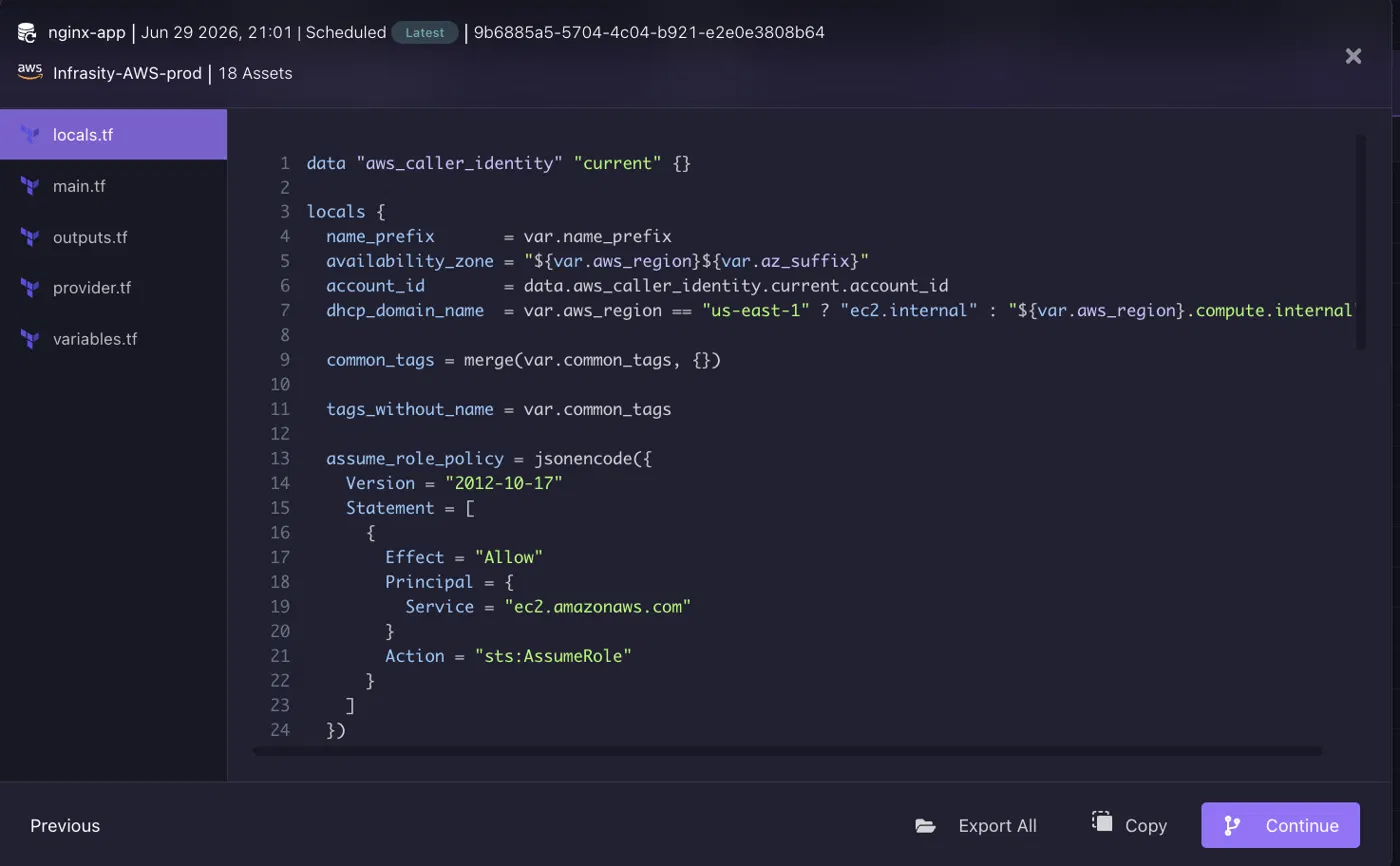
The recovered state exists as reviewable code first, not as a live change applied directly to the account.
When ransomware corrupts an environment, restoring it to the same compromised account or region often means restoring it to the attacker's reach. Firefly rebuilds infrastructure into a clean, isolated region or account instead, using immutable, versioned IaC snapshots ransomware can't encrypt or corrupt after the fact. Recovery is designed to meet an RTO of under one hour, even mid-incident, and every step generates audit-ready evidence for frameworks such as DORA, SOC 2, ISO 27001, and PCI DSS.
Traditional stacks (EDR, SIEM, SOAR) stop at containment, leaving a manual rebuild that can drag on for days or weeks. Firefly's CAIRS picks up right where it left off, automating the rebuild from trusted IaC into a clean environment, bringing that same gap down to under an hour.
This is the gap traditional security tooling was never built to close: EDR, SIEM, and SOAR detect and contain an incident, but stop there. What happens after containment, the actual rebuild, is where Firefly's CAIRS takes over.
Fixing Policy Violations Through Generated Pull Requests
This is the governance side closing the loop on what it finds: an IaC Patch remediation doesn't just flag a non-compliant resource; it generates the actual Terraform fix and opens a pull request against the repository where that resource is defined, turning a compliance gap into a normal code review instead of a manual console edit.

The fix ships via a Create Pull Request action, not a manual apply.
Conclusion: Where Should You Start With Cyber Resilience?
A cloud resilience strategy comes down to knowing three things at all times: what's running in the environment, whether it's actually recoverable, and how fast it can be rebuilt if something goes wrong. Frameworks like NIST CSF 2.0 provide structure, but the practical work lies in visibility, IaC coverage, drift detection, and application-level backups that restore via code rather than manual steps. None of this replaces existing security tooling; EDR, SIEM, and SOAR still detect and contain incidents the way they always have. What closes the gap is the piece those tools were never built for: rebuilding infrastructure fast, cleanly, and with evidence to show for it, so detection isn't followed by weeks of manual reconstruction.
The fastest way to know where an environment actually stands is to check its resilience posture score rather than assume it. Firefly builds exactly this kind of visibility into its platform, so if you're curious what your own environment's score would look like, it's worth trying out.
FAQs
What is the difference between cybersecurity and cyber resilience?
Cybersecurity focuses on preventing attacks or breaches in the first place through controls such as access management, encryption, and monitoring. Cyber resilience assumes prevention will eventually fail and focuses on whether the business can keep operating and recover quickly once it does.
What is cloud resiliency?
Cloud resiliency is how well a platform is designed to keep functioning when something breaks, not the absence of failure, but failure that doesn't automatically become an outage. It combines architecture (failure domains, redundancy), operational practice (monitoring, testing), and automation (IaC, automated recovery). It's broader than availability (staying online now) or disaster recovery (restoring after a major failure); resilience ties both together across the full failure lifecycle.
What is RTO and why does it matter for a cyber resilience strategy?
RTO, or recovery time objective, is the maximum acceptable time an organization can be without a system after a disruption. It matters because it turns resilience from an abstract goal into a measurable target against which infrastructure, backup, and recovery processes are built.
What is AWS resiliency?
AWS resiliency means applying the Reliability pillar of the Well-Architected Framework: Multi-AZ redundancy across compute (EC2 Auto Scaling), data (RDS Multi-AZ), networking (ELB, Route 53 failover), and storage (S3 replication), so losing one AZ doesn't take the workload down. Beyond a single region, AWS defines four DR strategies that trade cost for speed: backup and restore, pilot light, warm standby, and multi-site active-active, chosen based on the workload's RTO and RPO.
What is the difference between Terraform and OpenTofu?
Terraform is HashiCorp's IaC tool for provisioning cloud infrastructure using HCL, while OpenTofu is an open-source fork created after HashiCorp changed Terraform's license in 2023. Both use largely compatible syntax, and most IaC automation and governance platforms support both engines side by side.
What is a CSPM tool, and how is it different from CNAPP?
CSPM (cloud security posture management) tools scan cloud environments for misconfigurations and compliance violations across accounts and regions. CNAPP (cloud-native application protection platform) is a broader category that bundles CSPM with workload protection, IAM risk analysis, and container or Kubernetes security into a single platform.
What is GitOps and how does it relate to infrastructure automation?
GitOps is a practice in which a Git repository serves as the single source of truth for infrastructure and application configuration, with automated pipelines that sync the live environment to match what's defined in code. It matters for infrastructure automation because it makes every change reviewable, versioned, and reversible through standard pull request workflows.

.avif)
.avif)
.webp)

.webp)