
TL;DR
- The 2026 threat model has shifted: encryption has slid down attackers' priority list, with extortion increasingly built on data theft and disclosure threats instead, sometimes skipping encryption entirely, compressing the timeline from initial access to business impact from weeks to hours.
- Only 37% of organizations have an incident response plan that's actually been tested in the last 12 months; the gap between having a plan and having a proven one is where most real incidents go sideways.
- A recovery plan needs five roles named and backed up in advance: Incident Commander, Scribe, Communications Lead, Legal Liaison, and Technical Lead. Deciding who's in charge during a crisis is the worst possible moment to figure it out.
- The pay-or-not-to-pay decision needs escalation thresholds and authority defined before an incident, including OFAC sanctions-list considerations and cyber insurance notification requirements, not improvised on a 2 AM bridge call. There is a real precedent for claims being denied over unproven controls, not just missing ones.
- Firefly's AI SRE and continuous posture scoring close the exact gap that turns a documented plan into a proven one, verifying the technical assumptions a plan depends on rather than trusting a document that says they're true.
Getting Started: What a Ransomware Recovery Plan Actually Is
Consider a mid-sized freight and logistics company with a few thousand employees, warehouse and routing systems running across two cloud regions, and customer and carrier data flowing through a handful of core applications. They have a ransomware recovery plan. It's a real document, reviewed annually, with a section on backup restoration and a rough sense of who gets called. It has never been tested against anything other than the scenario for which it was written: an attacker who encrypts files and demands payment for the decryption key. That gap, between having a plan and having a plan that matches the actual threat, is where this piece starts, and it's worth following this same company through every section ahead, since the gap looks different at each stage.
A ransomware recovery plan gets used loosely enough that it's worth separating it from three things it often gets conflated with. Current guidance from the Canadian Center for Cyber Security draws this distinction explicitly:
- An incident response plan contains the threat itself
- A business continuity plan keeps essential services operating while that's happening
- A disaster recovery plan restores the technology and data underneath both
A ransomware recovery plan spans all three; it's the governing document that names who's in charge, what triggers activation, how the pay-or-not-to-pay decision is made, and how the organization communicates throughout. The freight company's plan was really only a disaster recovery plan wearing a bigger title, strong on backup restoration, silent on almost everything else this piece covers.
Why 2026 Changed What This Plan Needs to Cover
For years, ransomware incident response followed a fairly predictable sequence: get the call, isolate the infected hosts, stop the spread of encryption, restore from backup, and decide whether to negotiate. Recovery from encryption was the hard part, and it's exactly what the freight company's plan was built around. That sequence still happens, but it's no longer the whole story.
Here's how it actually played out for them. An attacker had been inside the routing platform's cloud environment for nine days before anyone noticed anything, not encrypting files, just quietly exporting carrier contracts, customer shipment data, and internal pricing models to external storage. On day nine, the company received an email: pay within 96 hours, or the data goes to a set of named regulators and three trade publications. No files were encrypted. No ransom note appeared on a server. The plan's activation criteria, all written around detecting encryption, never fired, because there was nothing to detect by that definition. The first anyone at the company knew something was wrong was the extortion email itself, arriving during the dwell-time window the plan assumed it would already have fully closed.
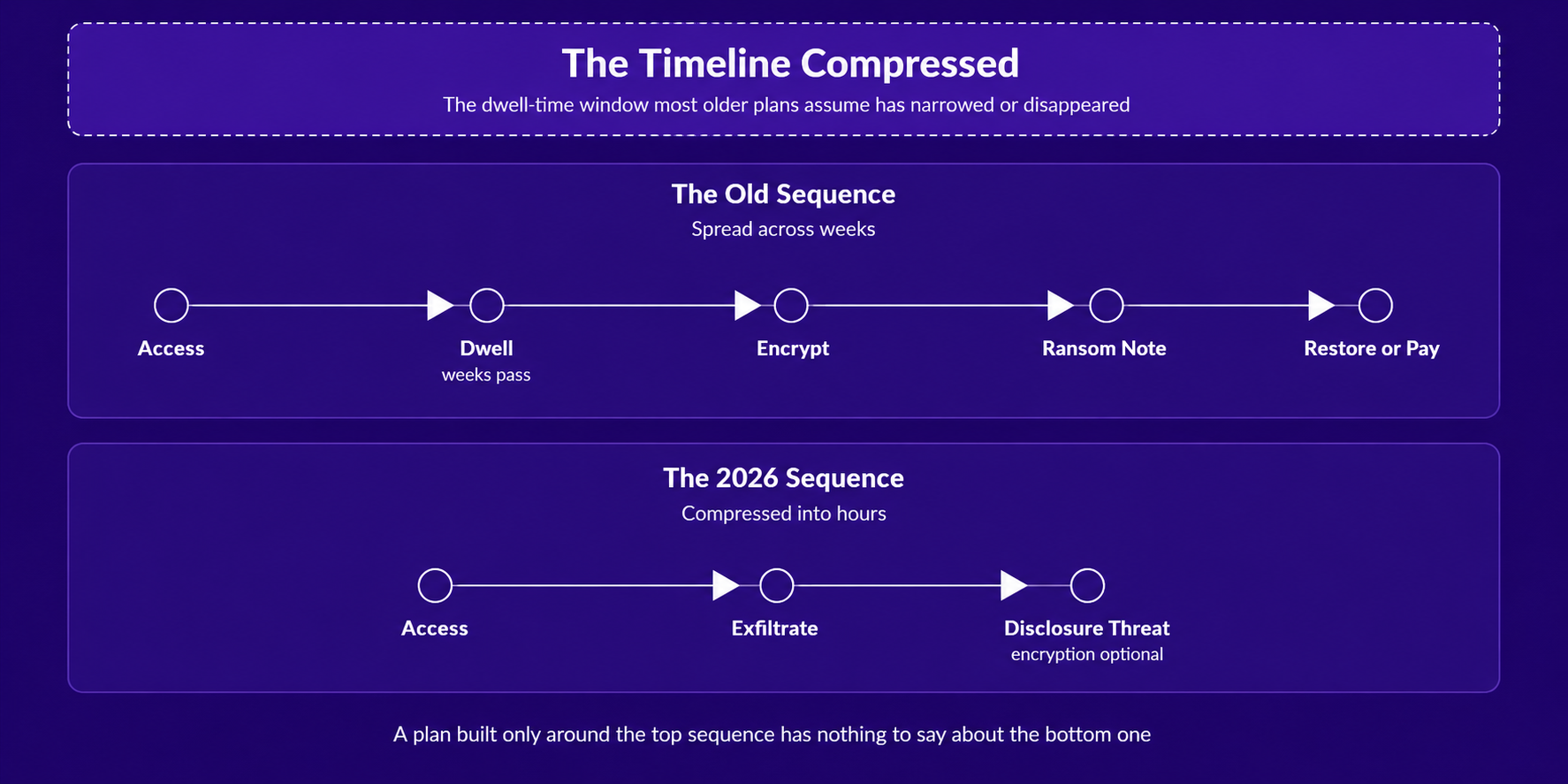
That's the specific shift worth naming plainly: extortion increasingly runs on data theft and disclosure threats rather than encryption, sometimes skipping encryption entirely, exactly what happened here. Disclosure requirements meant to protect investors and customers have become a second source of leverage for attackers rather than just a compliance obligation. In one widely cited case, a ransomware group reported its own victim to a securities regulator for failing to disclose a breach within the required window, turning a transparency rule into extortion pressure. The freight company's board was now facing the same dynamic: not "pay to get data back," but "pay to control the disclosure timeline before the attacker controls it instead," a scenario their plan had literally nothing written about.
The Five Roles Every Plan Needs Named in Advance
A recovery plan that names roles by job title rather than by person, and names a backup, is a plan that stalls during the first hour of a real incident while it figures out who's actually available. The freight company's plan named "the VP of Engineering" as incident lead, with no backup, no name. When the extortion email arrived at 6 AM on a Saturday, the VP of Engineering was on a flight and unreachable for four hours. Nobody else in the building had the authority to act in his absence, because the plan had never said anyone else could.
Five roles come up consistently across current incident command frameworks, adapted from the same structure used in broader emergency response:
- Incident Commander: owns the decisions and the timeline. Not automatically the most senior person in the room; whoever has the authority and availability to make fast calls without escalating every one, with a named backup in case the primary is unreachable, which is precisely the gap that cost the freight company its first four hours.
- Scribe: maintains the defensible record, every decision, every notification, every timestamp, a record that carries real weight later for the post-incident review and any regulatory or legal scrutiny that follows.
- Communications Lead: drafts and sends internal, customer, and regulatory messaging, a role that can't function well if improvised from scratch mid-incident.
- Legal Liaison: owns privilege, notification decisions, and law enforcement contact, including the sanctions and disclosure-law questions covered later in this piece.
- Technical Lead: directs containment, forensics, and recovery engineering, coordinating with whatever internal or external DFIR resources are available.
Naming these roles on paper is the easy part. The freight company's plan had names on paper too, just not backups, and the difference between those two things was four hours nobody could get back.
Setting Activation Triggers and Severity Tiers
A recovery plan that activates too late loses the exact time advantage preparation was supposed to buy. The freight company's activation criteria were written entirely around encryption indicators:
- Partial encryption detected on a subset of systems
- A ransom note appearing anywhere in the environment
- Files renamed with known ransomware extensions
- A mass file deletion event outside of a scheduled process
None of those fired during the actual incident, because the attacker never encrypted anything. What should have triggered a Tier 2 investigation, and didn't, because it wasn't even on the list, was an EDR agent going silent on one routing server six days before the extortion email arrived, logged by the security team as a routine agent-update failure and closed without escalation. Security tool tampering, an EDR agent disabled, logging paused, backup jobs silently failing, deserves its own explicit trigger category, since disabling defenses is frequently the step immediately before an attacker moves to exfiltration or encryption, and it's often more reliably detectable than either of those events themselves. Tier 1 triggers, active encryption or a visible ransom note, warrant immediate activation. Tier 2 triggers, a single suspicious file extension, one unusual privilege escalation, or exactly the kind of tampering event the freight company dismissed, warrant a short, defined investigation window rather than being closed as routine.
The Pay-or-Not-to-Pay Decision Belongs to Governance
Whether to pay a ransom is a governance decision, not a technical one. The freight company's board had never discussed a dollar threshold, an authority structure, or an insurance carrier's role in that decision, so when the extortion demand landed at $2.8 million, the first two hours of the board call were spent arguing about who actually had authority to respond at all, not about the demand itself. A simplified version of the structure they should have had in place already:
Once negotiation actually starts, it moves fast: initial contact, a counteroffer typically well below the demand, several rounds over hours to a few days, with a deadline the attacker controls throughout. The freight company's 96-hour window meant that every hour spent arguing about authority was an hour not spent on the FBI notification that, in this case, turned out to matter: the IC3 had prior intelligence on the group behind similar disclosure-threat campaigns, intelligence the company only received after their outside counsel made the call on day two instead of day one. Law enforcement engagement belongs in this decision specifically, not as an afterthought, and any payment discussion should never proceed without first receiving and testing a proof file demonstrating the attacker can actually do what they're threatening, since a non-functional decryptor or a bluffed data set is a documented, recurring outcome. One preparation step that consistently separates a fast decision from a slow, chaotic one: pre-negotiated retainers with DFIR firms, breach counsel, dark web intelligence services, and ransom negotiators, arranged before an incident so they can be activated immediately rather than sourced while the clock is already running, exactly what the freight company didn't have, costing them another half-day just identifying and contracting a negotiation firm.
Building Cyber Insurance Requirements Into the Plan
A recovery plan that treats cyber insurance as a financial cushion sitting outside the plan tends to discover the gap at the worst possible moment. The freight company's policy had a headline cyber coverage figure everyone assumed applied broadly. It didn't. The ransomware and extortion sub-limit buried in the policy's schedule was less than a third of the headline figure, a detail nobody had checked since the policy was purchased three renewal cycles earlier. The insurer also required notification before any payment discussion, which the company technically satisfied, but only after outside counsel found the requirement mid-incident rather than the plan already accounting for it.
The stricter version of this risk is misrepresentation on the policy application itself, and it has real legal precedent behind it. In Travelers v. International Control Services (2022), an insurer moved to rescind a cyber policy entirely after discovering that the policyholder had represented that MFA was deployed across all systems when it was only protecting the firewall. The court sided with the insurer. The policy was voided, and the ransomware claim went unpaid; critically, it didn't matter that the misrepresentation was unintentional. The freight company's own backup configuration turned out to have a version of the same problem: their documented DR policy claimed backups were isolated from production, but the nightly job actually wrote to a network share sitting on the same domain the exfiltration path had already touched. The control existed on paper. Nothing had ever been verified in practice, which is exactly the gap insurers are increasingly probing for: not whether a control exists, but what the policyholder can actually produce to prove it was in place on the day the attacker got in.
Preparing Communication Templates for the Incident
Crafting accurate, calm, legally sound messaging while systems are down and phones are ringing is close to impossible. The freight company had no templates at all, so the first customer-facing statement went through four rounds of legal review before it was sendable, burning six hours during a 96-hour window while carriers who'd heard rumors were already calling the sales team directly for answers nobody was authorized to give them.
Each template needs the same basic structure regardless of audience: what's confirmed, what's still under investigation, what the organization is doing about it, and what the recipient should or shouldn't do in response, with mandatory legal review built into the template's approval chain rather than discovered as a bottleneck live. Internal employee messaging deserves its own version, distinct from external ones, with practical guidance like not discussing the incident externally and routing media questions to the Communications Lead, which customer-facing messaging doesn't need. This isn't about having one canned message for every scenario; the specifics will always need to be adjusted. It's about removing the blank-page problem the freight company's Communications Lead was stuck with for six hours that mattered.
Testing the Plan on a Defined Cadence
A plan that's never been rehearsed carries the same risk as a backup that's never been restored: it looks complete on paper and is genuinely unproven in practice. Only 37% of organizations currently report having an incident response plan tested within the last 12 months. The freight company had tested theirs once, two years earlier, and the scenario used was encryption on a single file server, the exact case their actual incident never matched.
A useful tabletop exercise runs on a specific, evolving scenario rather than a generic prompt, something closer to what actually happened to this company: a disabled EDR agent dismissed as routine, followed six days later by a disclosure-threat email with a 96-hour deadline and no encrypted files anywhere. Walking the named roles through that exact sequence surfaces the problems a document review never catches: an Incident Commander with no backup, activation triggers written for the wrong threat, a communication template that doesn't exist. Mixing scheduled exercises with occasional unannounced ones tests different things, and a mature program uses both rather than only the easier, scheduled version. The deeper technical side of this, actually testing whether backups restore cleanly and whether a rebuilt environment passes validation, is its own discipline covered in more depth in this site's guides to ransomware disaster recovery and cyberattack recovery.
How Firefly Supports Plan Execution When It's Actually Needed
Almost every gap that cost the freight company time in this piece was a verification gap, not a documentation gap. The plan said backups were isolated; nobody had verified it. The EDR tampering event was logged; nobody escalated it because nothing flagged it as significant. The Scribe role existed on paper; there was no system actually capturing a timestamped, attributable record while three other things were on fire.
Firefly addresses that verification gap directly. Cloud Resilience Posture Management (CRPM) scores an environment continuously against the resiliency gaps that would defeat a clean recovery: missing snapshot policies, backup vaults sharing IAM roles or network paths with the production account they're meant to protect, the exact configuration issue the freight company's insurer would have flagged as unproven the moment a claim was filed. That score updates continuously, so the gap is visible before a claim is denied, not after.
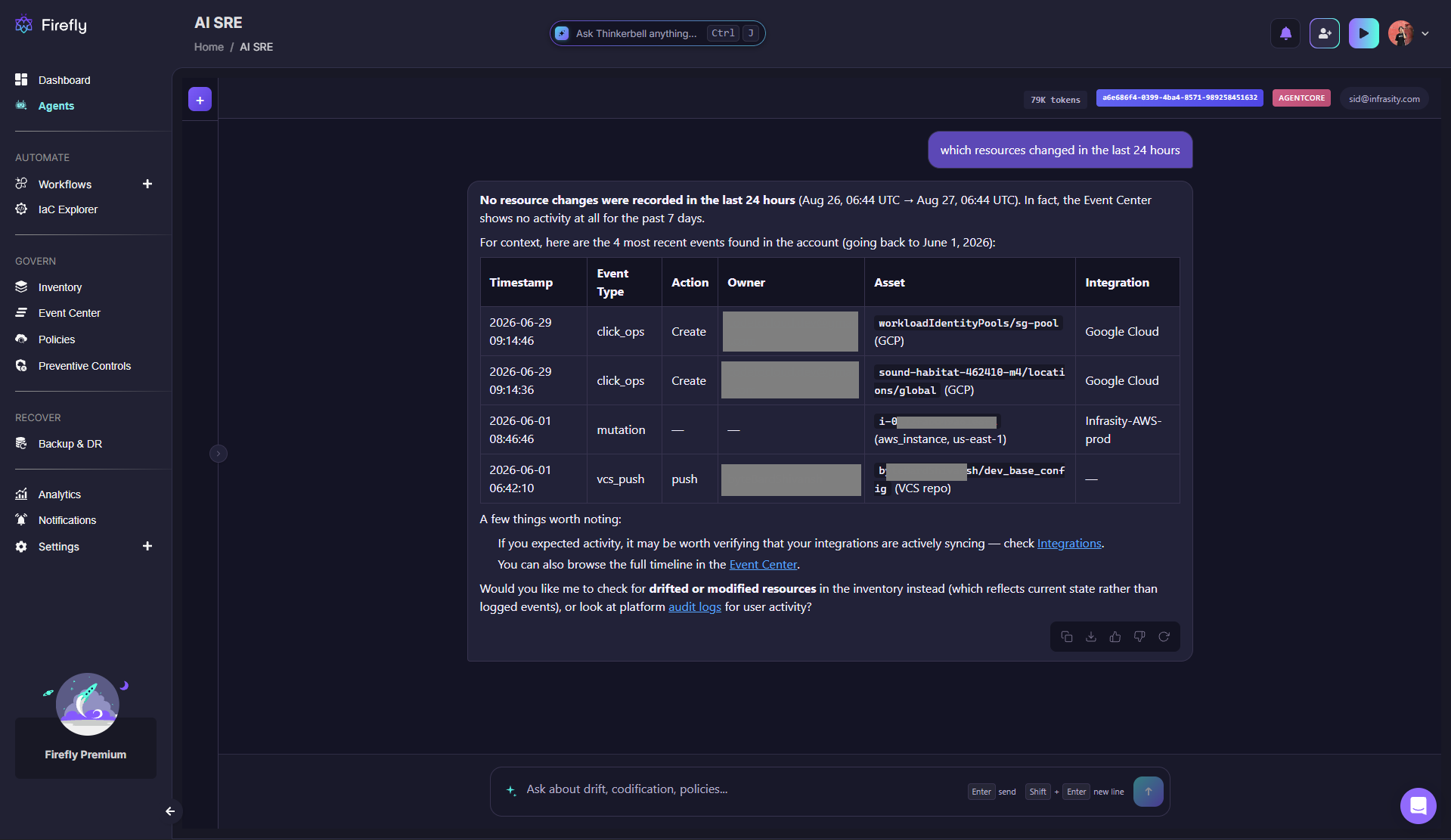
For the specific moment that cost the freight company six days, a security tool going silent and getting dismissed as routine, Event Center logs every mutation across the environment, whether it came through the console, the CLI, a pipeline, or an AI agent connected through MCP, with the identity responsible and a timestamp attached automatically rather than depending on someone remembering to escalate it. That continuous record is directly useful for the two governance decisions this piece has spent the most time on: the pay-or-not-to-pay decision and any subsequent regulatory notification; both benefit from being able to show, precisely, what happened to the infrastructure and when, rather than reconstructing a timeline from memory during the post-incident review. AI SRE handles exactly that kind of question directly: "Which resources changed in the last 24 hours and what changed?" cross-referencing Inventory, Governance, and Event Center in a single response, instead of the six-day gap that let a real trigger get closed as routine.
Where Should You Start With This
Most ransomware recovery plans don't fail because a section is missing from the document; they fail the same way the freight company's did: the specifics within the existing sections were never actually settled, or were settled for a threat model that's since shifted. A role named by job title instead of a person with a backup, an activation trigger list written for encryption when the real incident involves neither encryption nor a ransom note, a backup control that's documented but never verified, these are the gaps that surface during the incident itself, not during a document review.
Start by checking whether your own plan's roles have named, available backups; whether your activation triggers account for disclosure-threat scenarios, not just encryption; and whether the backup isolation your plan assumes has actually been verified rather than just documented. From there, explore Firefly's Governance page to see whether the technical capability your plan assumes, clean backups, isolated recovery, tested restores, actually holds against a live environment right now. For the architecture and execution sides of the same problem, this site's guides on ransomware disaster recovery and cyberattack recovery cover what this piece deliberately left to them.
FAQs
What is the difference between a ransomware recovery plan and a disaster recovery plan?
A disaster recovery plan restores technology and data, the infrastructure side of recovery. A ransomware recovery plan is broader: it's the governing document that names who's in charge, defines activation triggers, sets the framework for the pay-or-not-to-pay decision, and coordinates communication, tying incident response, business continuity, and disaster recovery together into one response rather than three separate documents.
Why has ransomware extortion shifted away from encryption?
Because data theft and disclosure threats have become a more reliable pressure tactic than encryption alone. Attackers increasingly exfiltrate data before, or instead of, encrypting it, then threaten disclosure, sometimes to regulators directly, to force payment, which compresses the response timeline and shifts the ransom decision from "pay to get data back" to "pay to control the disclosure timeline."
Who should decide whether to pay a ransom?
That should be defined in advance through escalation thresholds, typically management authority up to a defined dollar amount, with anything above it requiring board sign-off, alongside the CEO, General Counsel, CFO, and the cyber insurance carrier before any payment discussion opens. Legal counsel needs to be involved regardless of the amount, since OFAC sanctions restrictions can make paying certain threat actors illegal independent of the business case for doing so.
Does cyber insurance actually cover ransomware payments?
Often, but subject to real conditions: the insurer typically must be notified before any payment decision, will often require using a pre-approved negotiation firm, and can deny coverage for delayed reporting or misrepresented security controls on the policy application. A real legal precedent backs this: a 2022 case saw an insurer successfully rescind a policy and deny a ransomware claim after discovering that MFA had been misrepresented as fully deployed, even though the misrepresentation was unintentional.
What roles does a ransomware recovery plan need to name?
Five roles come up consistently: an Incident Commander who owns decisions and the timeline; a Scribe who maintains the defensible record; a Communications Lead for internal and external messaging; a Legal Liaison who owns privilege and notification decisions; and a Technical Lead who directs containment and recovery engineering. Each needs a named, available backup, not just a job title.
How often should a ransomware recovery plan be tested?
At minimum, annually, though only 37% of organizations currently report testing their plan within the last 12 months. Tabletop exercises that reflect current attack patterns, including data theft and disclosure scenarios rather than only encryption, surface gaps that a document review alone won't catch.
How does Firefly support the execution of a ransomware recovery plan?
Firefly's Event Center automatically logs and attributes every infrastructure mutation during an incident, closing the same kind of gap that let a real warning sign get dismissed as routine, while AI SRE answers real-time questions about what changed and when. CRPM continuously verifies that the recovery capability the plan assumes actually exists, rather than trusting a document that hasn't been recently checked against live infrastructure.

.avif)
.avif)
.webp)


.webp)