.png)
TL;DR
- A recent Quest Software survey found that 24% of organizations never test their disaster recovery plans, and only 24% test on the recommended six-month cadence, leaving most plans unverified until an incident forces a test.
- Most cloud resilience efforts fail not from a lack of tooling but from skipping a defined sequence: teams jump to automation before establishing governance, or set recovery time objectives without tying them to actual business impact.
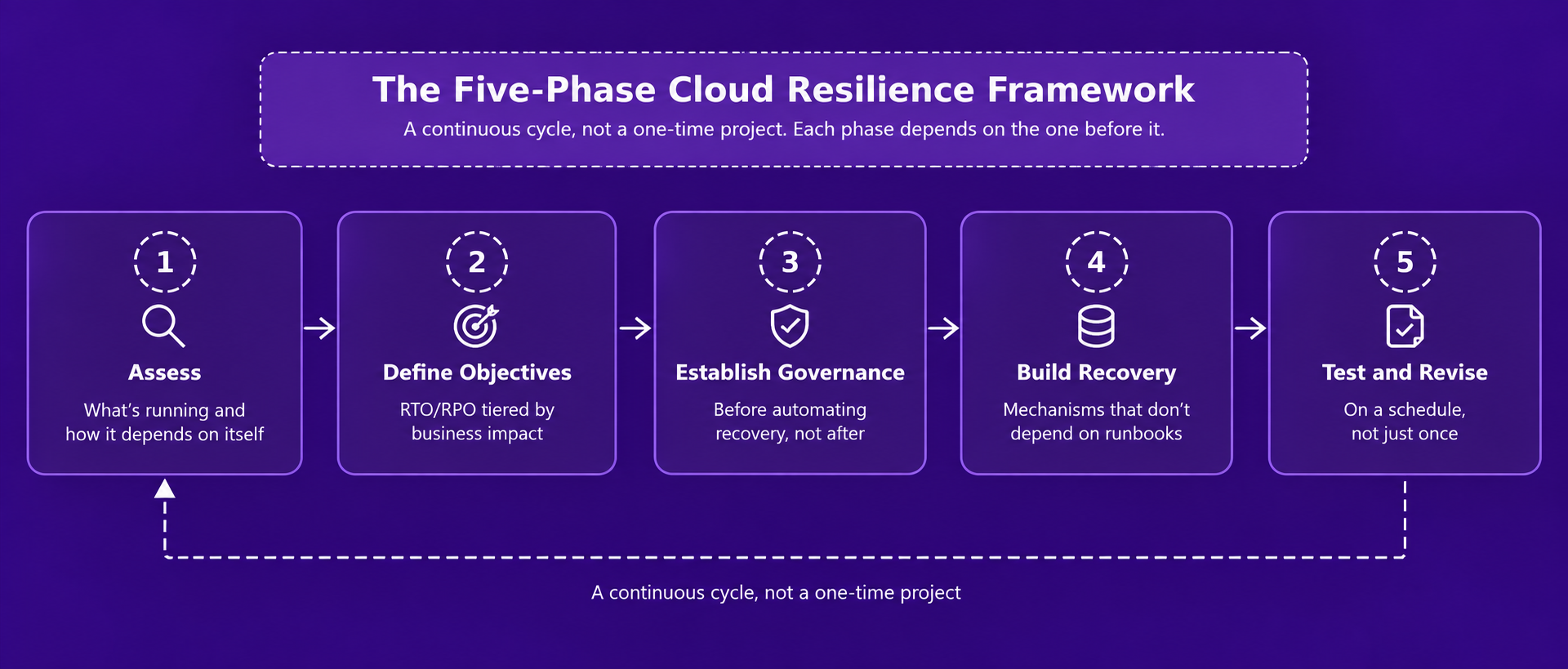
- This piece lays out a five-phase practical framework: assess what's running, define recovery objectives by business impact, establish governance, build automated recovery mechanisms, then test and revise on a schedule.
- Automating recovery on ungoverned, drifted infrastructure doesn't speed recovery; it reproduces the wrong configuration faster, which is why the framework puts governance before automation.
- Each phase maps to a specific, verifiable capability rather than a generic best practice, closing with how Firefly's Automate, Govern, and Recover pillars operationalize the full sequence.
Cloud resilience has become a boardroom-level concern over the last few years, referenced in board decks, cited in compliance frameworks, and named as a priority in nearly every infrastructure team's roadmap. What it rarely becomes is something a team actually executes in a defined, repeatable order. Most "strategies" exist as a paragraph in a compliance document or a slide in a planning deck, restating the goal (recover quickly, minimize downtime) without specifying the sequence of steps that gets an organization from where it is today to that outcome.
This piece lays out that sequence as five concrete phases, in the order they need to happen, starting with an honest assessment of what's actually running and ending with a testing cadence that keeps the whole thing from going stale. It covers what each phase requires, why skipping ahead to automation before governance is a common and costly mistake, and how the sequence holds up against the pitfalls that most often derail a rollout partway through. It does not re-cover multi-cloud-specific governance gaps, backup coverage limitations, or the broader compliance-framework mapping already covered in companion pieces on this site; this is the execution sequence itself.
Cloud Resilience Strategy Versus Disaster Recovery Planning
A cloud resilience strategy is the repeatable process an organization follows to assess, prepare for, and recover from disruption, not the mechanism it uses to do so. Disaster recovery is a mechanism, specifically the backup, replication, and restoration tooling that executes recovery once it's triggered. A team can have a well-configured disaster recovery tool and still have no strategy if nobody has defined which resources need to recover first, how quickly, or under what governed conditions.
This distinction has a practical consequence worth stating plainly: strategy comes first, and the tooling underneath it is chosen to serve a sequence that's already been defined, not the other way around. An organization that buys a backup tool and calls that its resilience strategy has skipped the assessment, prioritization, and governance work that determines whether the tool actually produces a working recovery when it's needed.
This piece focuses on that sequence for a single cloud environment, or a set of environments treated uniformly. A separate companion piece on this site, covering multi-cloud resilience specifically, addresses what changes when policy and tooling need to hold the same shape across multiple providers with different native controls; that's a distinct problem from the sequencing question this piece answers.
Why Ad Hoc Resilience Efforts Break Down During Real Incidents
Most organizations don't lack resilience tooling. They lack a defined order of operations for using it, which means the tooling gets applied unevenly, tested rarely, and trusted more than it's earned. The result is a gap between what leadership believes is true about recovery readiness and what would actually happen during an incident.
That gap shows up clearly in testing data. A recent Quest Software survey found that over 75% of organizations are not testing disaster recovery frequently enough, with only 24% testing on the recommended six-month cadence and 24% never testing at all. A plan that has never been tested is a set of assumptions, not a verified capability, and the first real test of those assumptions is often an actual outage.
The financial stakes of getting this wrong keep climbing. Uptime Institute's 2026 Annual Outage Analysis found that 57% of major outages in the prior year's survey exceeded $100,000 in cost, and for the second consecutive year, 1 in 5 outages exceeded $1 million. These aren't primarily failures of technology existing; they're failures of readiness: an organization that had never rehearsed its response, or never mapped which resources depended on which other resources, discovering both facts in real time during the incident itself.
A handful of warning signs tend to precede this kind of breakdown, and they're worth checking against your own environment before reading further:
- Recovery time objectives exist on paper but were never validated against an actual test
- No one can name, without checking, which resources are considered highest priority to recover first
- The last disaster recovery test (if one happened) predates the last major infrastructure change
- Backup coverage is tracked and reported, but drift and unmanaged resources are not
Step 1: Assess What's Running and How It Depends on Itself
A resilience strategy built on an incomplete or outdated inventory is unreliable before it's tested, because every later phase, prioritization, governance, automation, inherits whatever gaps exist in this first one. Assessment has to answer two separate questions: what resources exist, and how do they depend on each other.
The first question is more difficult than it sounds. Resources provisioned manually during an incident, created by a script that ran once, or inherited from an acquisition without full documentation are common in nearly every environment, and none of them show up in a resource list built only from Infrastructure-as-Code state files. An assessment that only looks at what's codified will systematically miss exactly the resources most likely to cause problems during a real recovery.
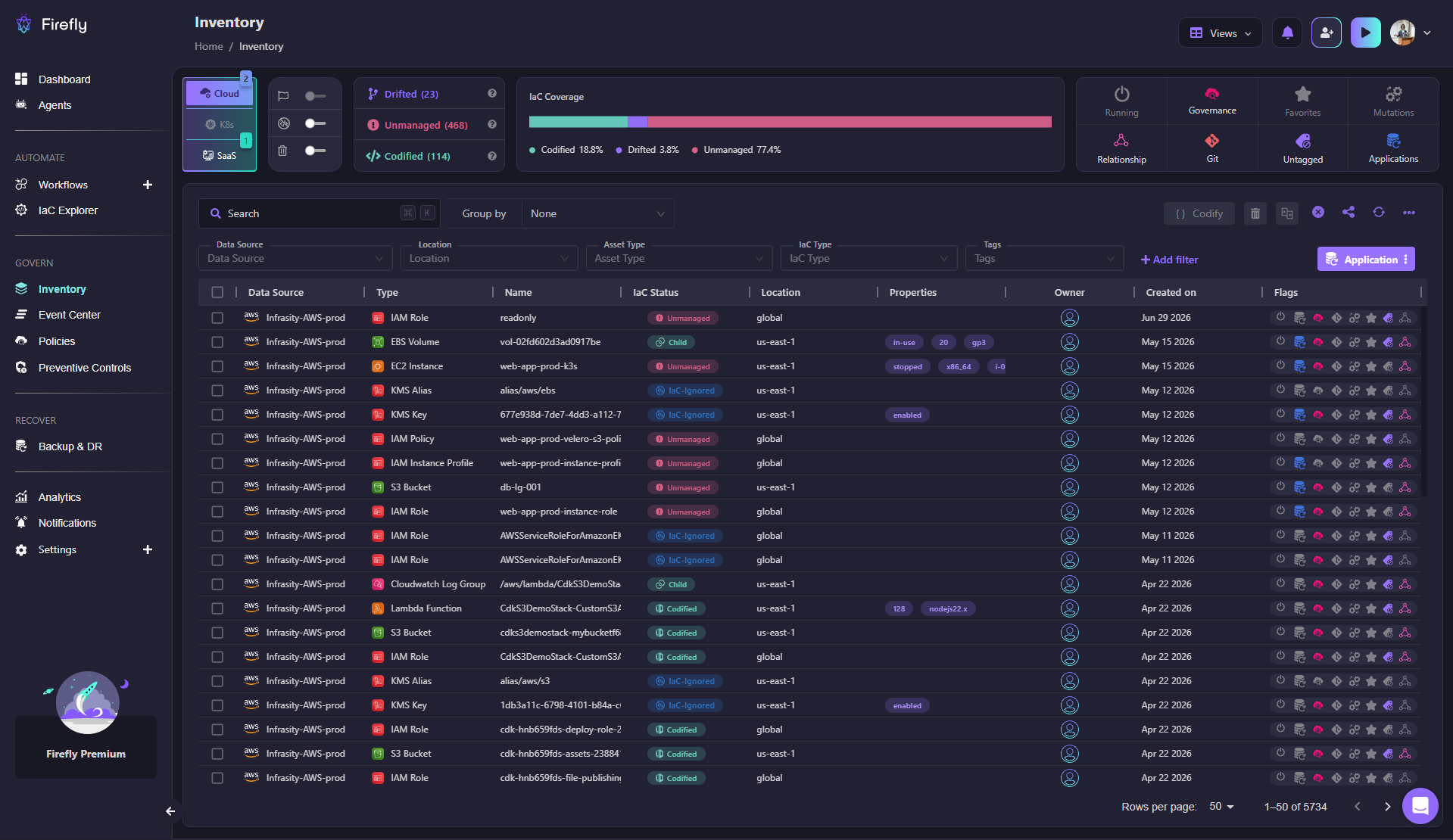
Dependency mapping is the second, often skipped, half of this phase. A database can be perfectly inventoried and still fail to recover cleanly if the IAM role, security group, or VPC peering connection it depends on isn't mapped as a dependency. This is where a single missed relationship turns a straightforward restore into a multi-hour investigation, precisely because nobody knew to check for it until the resource came back non-functional.
Step 2: Define Recovery Objectives Tied to Business Impact
A flat recovery time objective, applied uniformly across every resource in an environment, wastes effort in two directions at once. It over-invests in recovery speed for resources where a few hours of downtime is genuinely tolerable, and under-invests in resources where even a few minutes of downtime is unacceptable. Neither outcome reflects the actual business impact of that resource being unavailable.
Recovery objectives should be tiered by criticality, with the tier assignment coming from a conversation with the business stakeholders who understand what failure of that resource actually costs, not from an infrastructure team's assumption about which systems seem important. A customer-facing payment system and an internal reporting dashboard warrant different recovery time objectives, and setting them without that conversation often produces the wrong tier for both.
A tiering exercise like this also surfaces a second, less obvious value: it forces an explicit conversation about which systems the organization has never asked this question about, where the most dangerous assumptions often hide.
Step 3: Establish Governance Before Automating Recovery
The order of these first three steps carries more weight than any individual step's content, and this is where most rollouts go wrong. It's tempting to move straight from assessment to building automated recovery, since automation is the visible, demoable part of a resilience program. Skipping governance to get there faster is a mistake that doesn't show up until the automation actually runs.
Automating recovery on top of infrastructure that hasn't been checked for drift or policy violations doesn't make recovery faster. It reproduces whatever configuration currently exists, including a misconfigured security group, an over-permissioned IAM role, or a resource that was never brought under policy in the first place, just faster and with less human judgment in the loop to catch the problem before it ships.
Governance in this context means two things working together, not one:
- Policy defined once, enforced consistently. A rule about encryption, tagging, or network access should apply the same way regardless of which team or pipeline touches a given resource.
- Enforcement at more than one point in the lifecycle. A check that only runs before a deployment catches new violations but misses resources that already exist outside that pipeline. A check that only runs periodically catches existing violations, but with a delay during which a misconfiguration sits exposed.
Establishing this before building recovery automation means the thing getting automated is a governed, verified baseline, not whatever happens to be running at the moment automation gets switched on.
Step 4: Build Recovery Mechanisms That Don't Depend on Manual Runbooks
A runbook is a document describing what a person should do during an incident. It's better than nothing, and it's also the least reliable recovery mechanism available, because it depends on a specific person being available, remembering the current state of a system that may have changed since the runbook was last updated, and executing a multi-step process correctly under pressure.
Infrastructure-as-Code changes this equation by making recovery a function of code execution rather than human memory. A resource fully defined in code can be recreated deterministically, with its configuration guaranteed to match what's intended, rather than whatever a person under pressure manages to reconstruct from a document that may already be out of date.
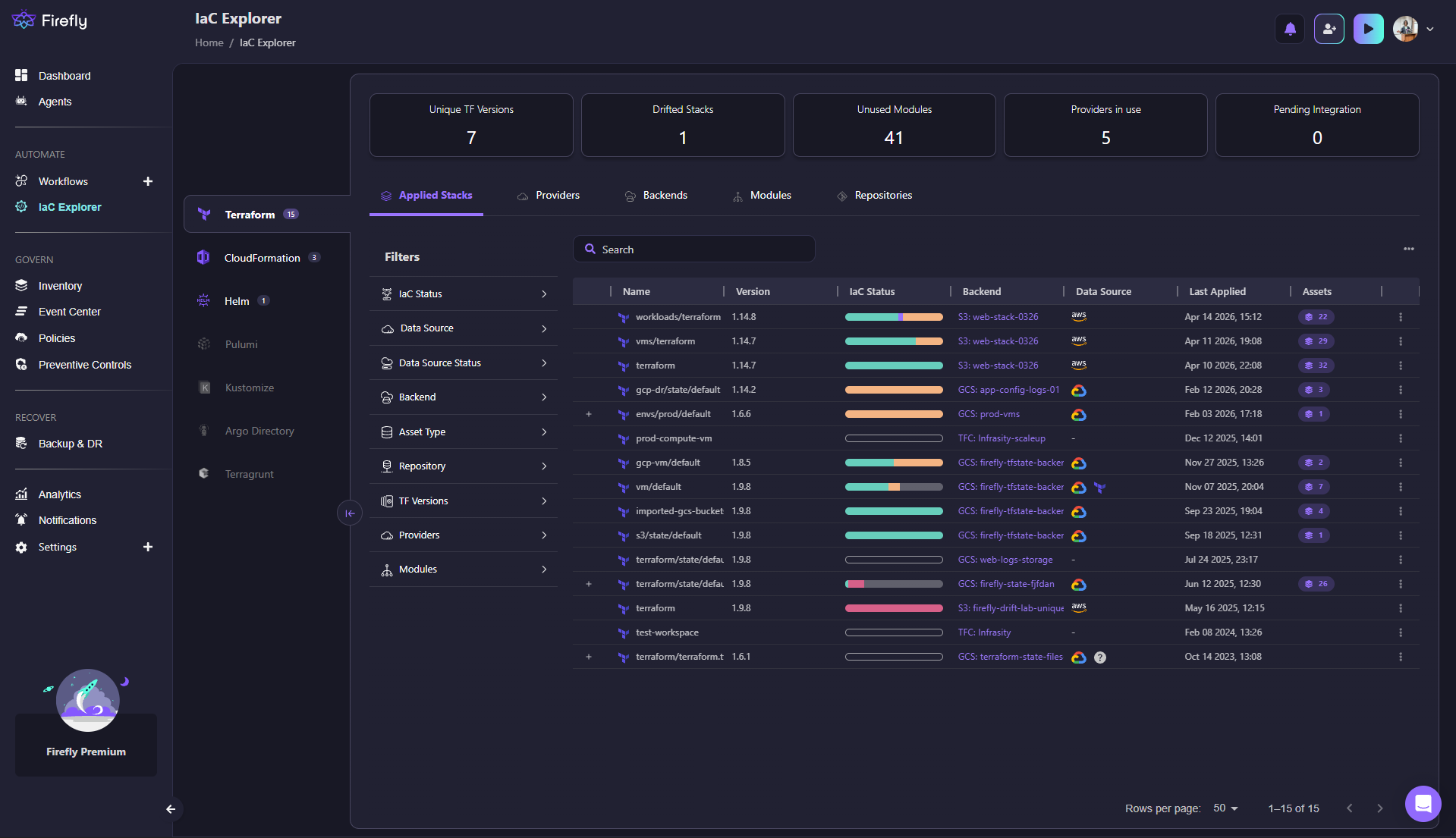
The resources most likely to still depend on a manual runbook are usually the ones that were provisioned manually in the first place, exactly the unmanaged resources identified back in the assessment phase. Converting those into Infrastructure-as-Code, a process generally called codification, is what closes the gap between what the strategy says should happen automatically and what actually would happen today if that resource failed.
Step 5: Test, Measure, and Revise on a Schedule
An unexecuted recovery plan is an untested hypothesis, and the gap between hypothesis and verified capability only becomes visible when something forces the test. The Quest Software survey figure cited earlier, roughly a quarter of organizations never testing at all, means a quarter of resilience strategies are hypotheses their owners have simply chosen not to examine.
Chaos engineering deliberately injects a failure into a controlled environment and observes the response, turning testing into something scheduled rather than something that only happens by accident. A useful exercise doesn't need to be elaborate: simulate the loss of an availability zone, forcibly terminate a resource with known dependents, and measure detection time, response time, and whether the recovered resource matches its intended configuration.
The output a test actually needs to prove isn't whether the resource came back. It's whether it came back correctly configured, with dependencies intact, on a timeline that matches the tier assigned to it in Step 2. A test that confirms existence without confirming correctness validates the mechanism without validating the outcome the strategy was built to produce.
How Firefly Operationalizes Each Phase of This Framework
The five phases above describe what a resilience strategy requires in sequence. Firefly's platform is organized around three pillars, Automate, Govern, and Recover, that map directly onto specific phases of that sequence rather than existing as a separate, parallel product.
The assessment phase depends on knowing what's actually running, not what's documented. Firefly's Cloud Asset Inventory scans AWS, Azure, Google Cloud, Oracle Cloud Infrastructure, Kubernetes, and supported SaaS providers continuously, tagging every discovered asset by its current IaC status. A resource that exists only because someone provisioned it manually shows up as Unmanaged the moment Firefly's scan finds it, closing exactly the assessment gap described in Step 1, where a resource list built only from IaC state files misses the resources most likely to cause problems later.
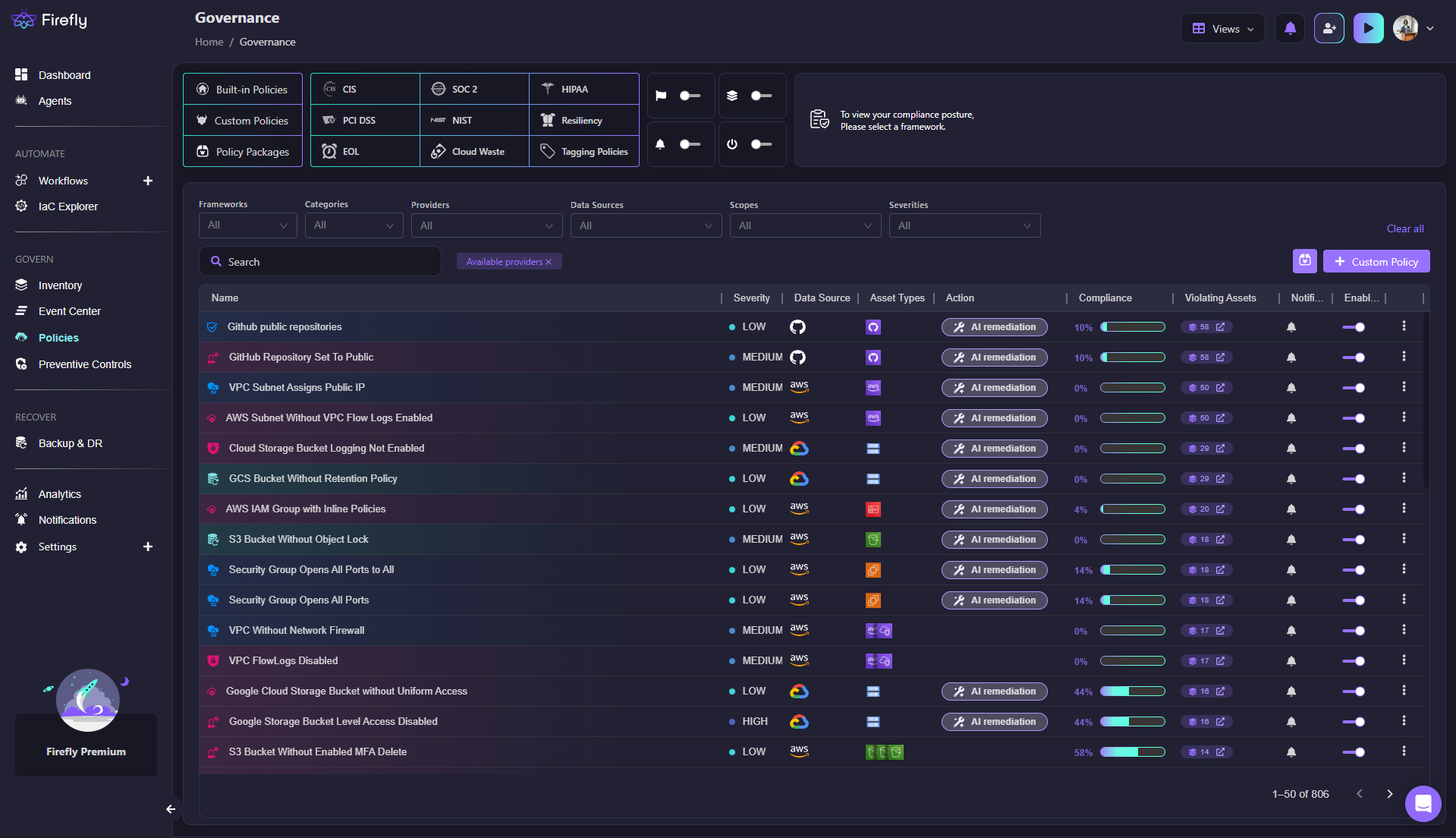
Governance, the phase most often skipped in favor of jumping straight to automation, runs through Firefly's Policy & Governance engine. A policy authored once through the No-Code Policy Builder, generated from a plain-English description, or written directly as Rego, or written directly in Rego, evaluates consistently regardless of which pipeline or team touches a given resource. Guardrails check a Terraform plan against four rule types, Cost, Policy, Resource, and Tag, before a deployment goes live, while continuous evaluation against the live inventory catches resources that exist outside any pipeline entirely. Running recovery automation on top of infrastructure already governed this way is what Step 3 in this framework is protecting against skipping.
Recovery mechanics tie directly back to Step 4's argument against manual runbooks. Firefly's Applications Backup & DR defines backup scope through Application Policies that target resources by tag. Dependencies implicitly created alongside a targeted resource, such as a VPC, subnet, or IAM instance profile, aren't backed up as separate snapshots. Restoration generates the actual Terraform code needed to recreate the resource and those dependencies together, previewable before it runs, rather than depending on a person executing a runbook under pressure or discovering a missing dependency only after the primary resource is already back online.
Common Pitfalls That Derail a Strategy Mid-Rollout
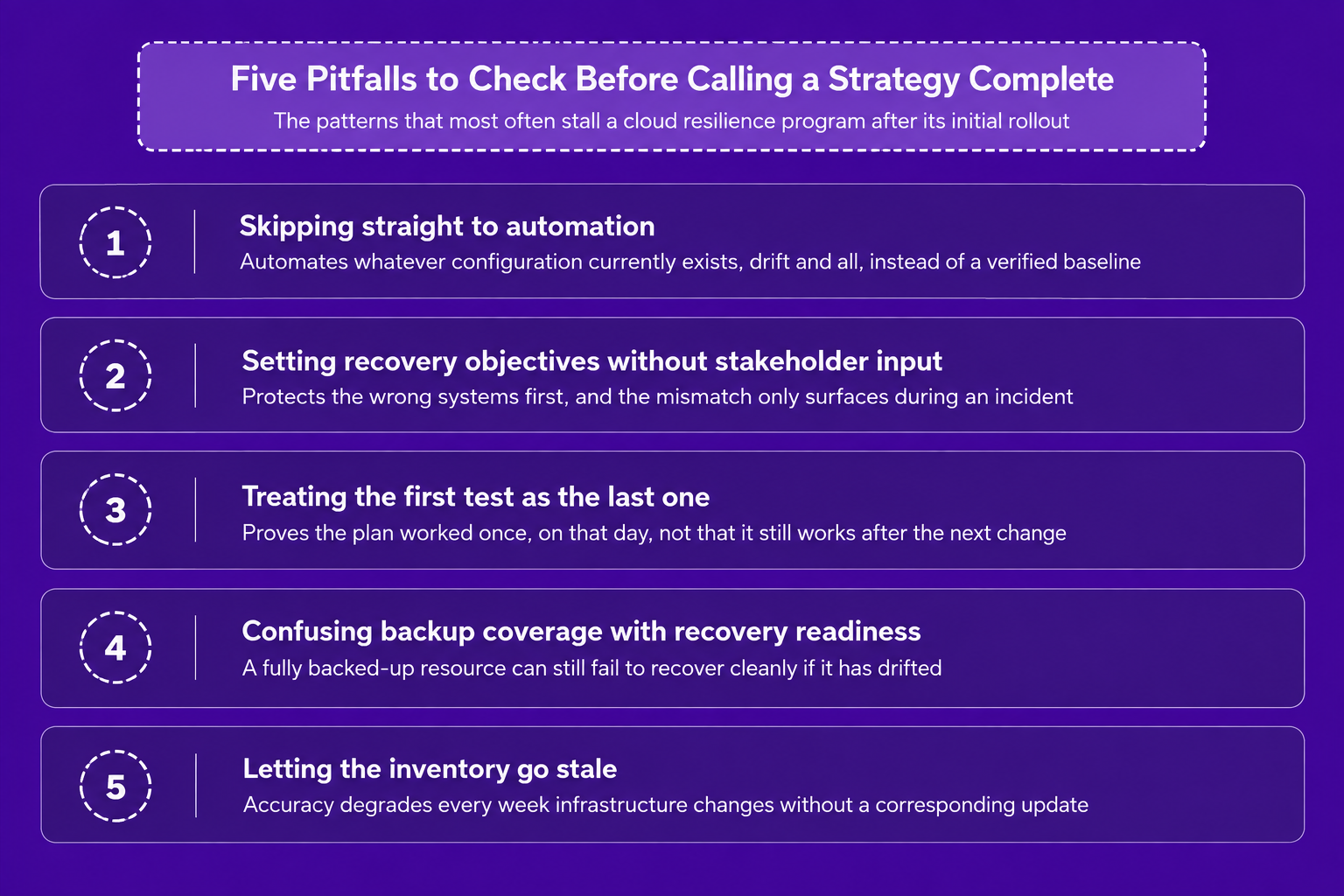
A handful of patterns account for most resilience strategies that stall or quietly fail after an initial rollout, independent of which tools an organization has chosen:
- Skipping straight to automation. Building automated recovery before establishing governance means automating whatever configuration currently exists, drift and all, rather than a verified baseline.
- Setting recovery objectives without stakeholder input. An infrastructure team's guess at which systems are critical rarely matches what the business actually depends on, and the mismatch only surfaces during an incident.
- Treating the first test as the last one. A single successful chaos engineering exercise proves the plan worked once, on that day, against that specific failure, not that it still works after the next infrastructure change.
- Confusing backup coverage with recovery readiness. A resource can be fully backed up and still fail to recover cleanly if it has drifted or depends on an untracked resource, a gap covered in more depth in this site's companion piece on multi-cloud resilience.
- Letting the inventory go stale. An assessment done once, at the start of the program, degrades in accuracy every week infrastructure changes without a corresponding update to what's tracked.
Where Should You Start With a Cloud Resilience Strategy
The sequence carries more weight than any single tool choice. Assessment without accurate visibility produces a strategy built on guesses. Recovery objectives set without business input protect the wrong systems first. Automation built before governance reproduces whatever's currently broken, just faster. And a plan tested once, then never again, is a snapshot of readiness on one specific day, not an ongoing capability. Each phase depends on the one before it, which is why treating this as a sequence, not a checklist to complete in any order, is the difference between a strategy that holds up during an incident and one that only looked complete on paper.
Firefly's platform is built to support this sequence directly, from the Cloud Asset Inventory that makes Step 1 possible, through the Policy & Governance engine that makes Step 3 enforceable, to Applications Backup & DR that makes Step 4 real rather than aspirational. Book a demo to see how much of your own environment is currently assessed, governed, and recoverable against this sequence, not just backed up.
FAQs
What's the difference between a cloud resilience strategy and a disaster recovery plan?
A cloud resilience strategy is the repeatable process an organization follows to assess, prioritize, govern, and test its recovery capability. A disaster recovery plan, or the tooling behind it, is the mechanism that executes recovery once triggered. An organization can have disaster recovery tooling in place and still lack a strategy if it hasn't defined recovery priorities, established governance, or tested the plan.
Why does governance need to come before automating recovery, rather than after?
Automating recovery on top of infrastructure that hasn't been checked for drift or policy violations reproduces whatever configuration currently exists, including misconfigurations, rather than a verified baseline. Establishing governance first means automation recreates a known-good state rather than automating a problem that would otherwise require manual discovery.
How does Firefly identify resources that were never brought under Infrastructure-as-Code?
Firefly's Cloud Asset Inventory continuously scans connected cloud providers and tags every discovered resource by its IaC status. A resource with no corresponding Infrastructure-as-Code definition is tagged Unmanaged, surfacing it for review or codification rather than leaving it invisible to a resource list built only from state files.
How often should a cloud resilience strategy be tested?
There's no universal number, but a plan that's never tested provides no real confidence, and a survey by Quest Software found that roughly a quarter of organizations fall into exactly that category. Testing frequency should scale with how often the underlying infrastructure changes; an environment with frequent deployments needs more frequent validation than one that's largely static.
Does a cloud resilience strategy need to be different for a single cloud provider versus multiple providers?
The five-phase sequence in this piece, assess, define objectives, govern, automate recovery, test, applies regardless of how many providers are in use. In a multi-cloud environment, each phase becomes harder because policy, tooling, and visibility must stay consistent across providers with different native controls, which this site's companion piece on multi-cloud resilience covers in more detail.

.avif)
.avif)
.webp)

.webp)