.png)
TL;DR
- Multi-cloud has become the default operating model for most enterprises, but according to Flexera's 2026 State of the Cloud Report, multi-cloud adoption is rising largely unintentionally, through mergers, siloed teams, and inherited architecture rather than deliberate design.
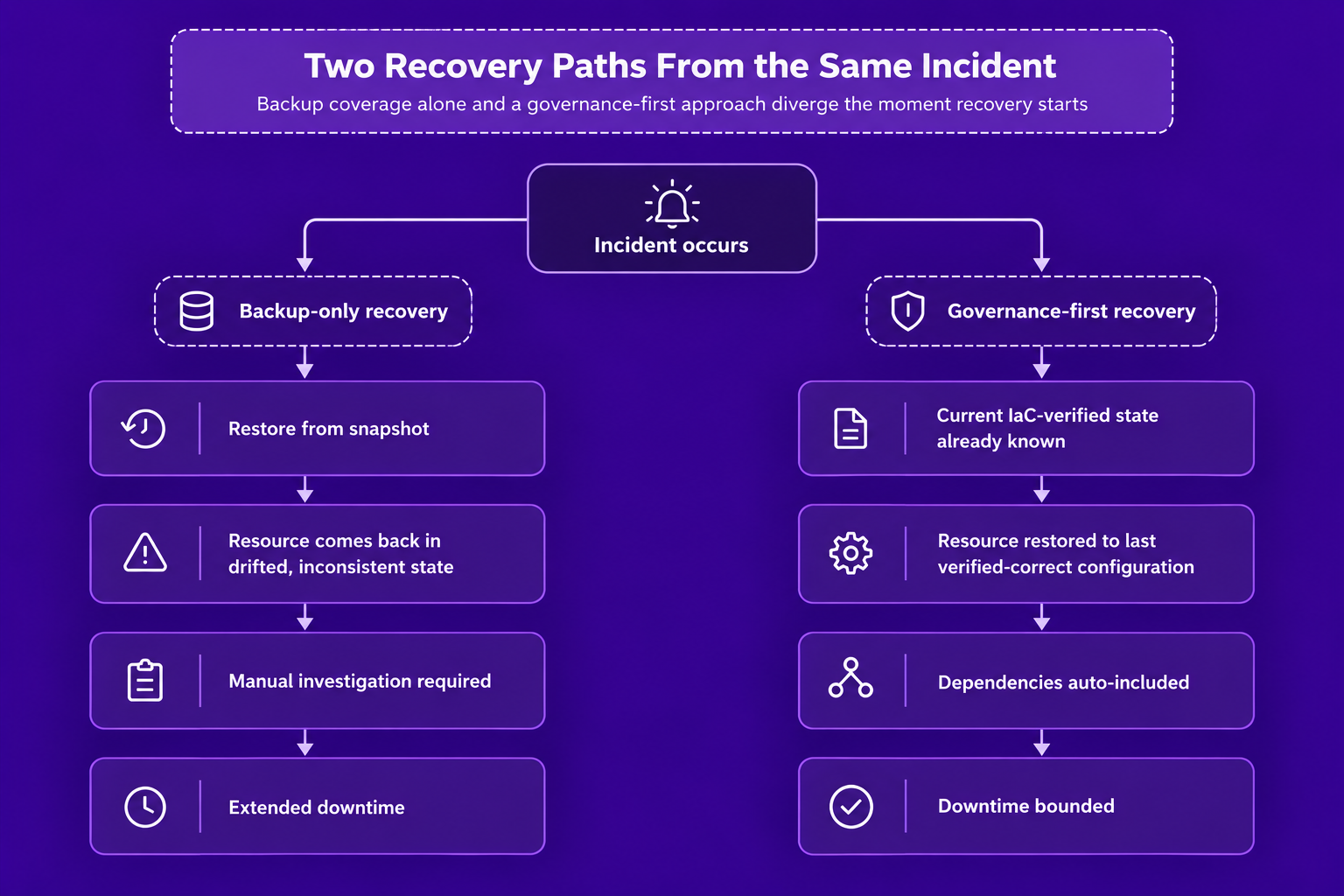
- Backup coverage percentage is a false signal of recovery readiness on its own: a backed-up resource that has drifted from its Infrastructure-as-Code definition, or that depends on an unmanaged resource nobody tracked, restores into a configuration that no longer matches what's actually deployed around it.
- Veeam's 2026 Data Trust and Resilience Report found that 90% of organizations are confident in their ability to recover from a cyber incident, while only 28% of ransomware victims recovered all of their data, a gap that widens further once recovery has to happen consistently across more than one cloud provider.
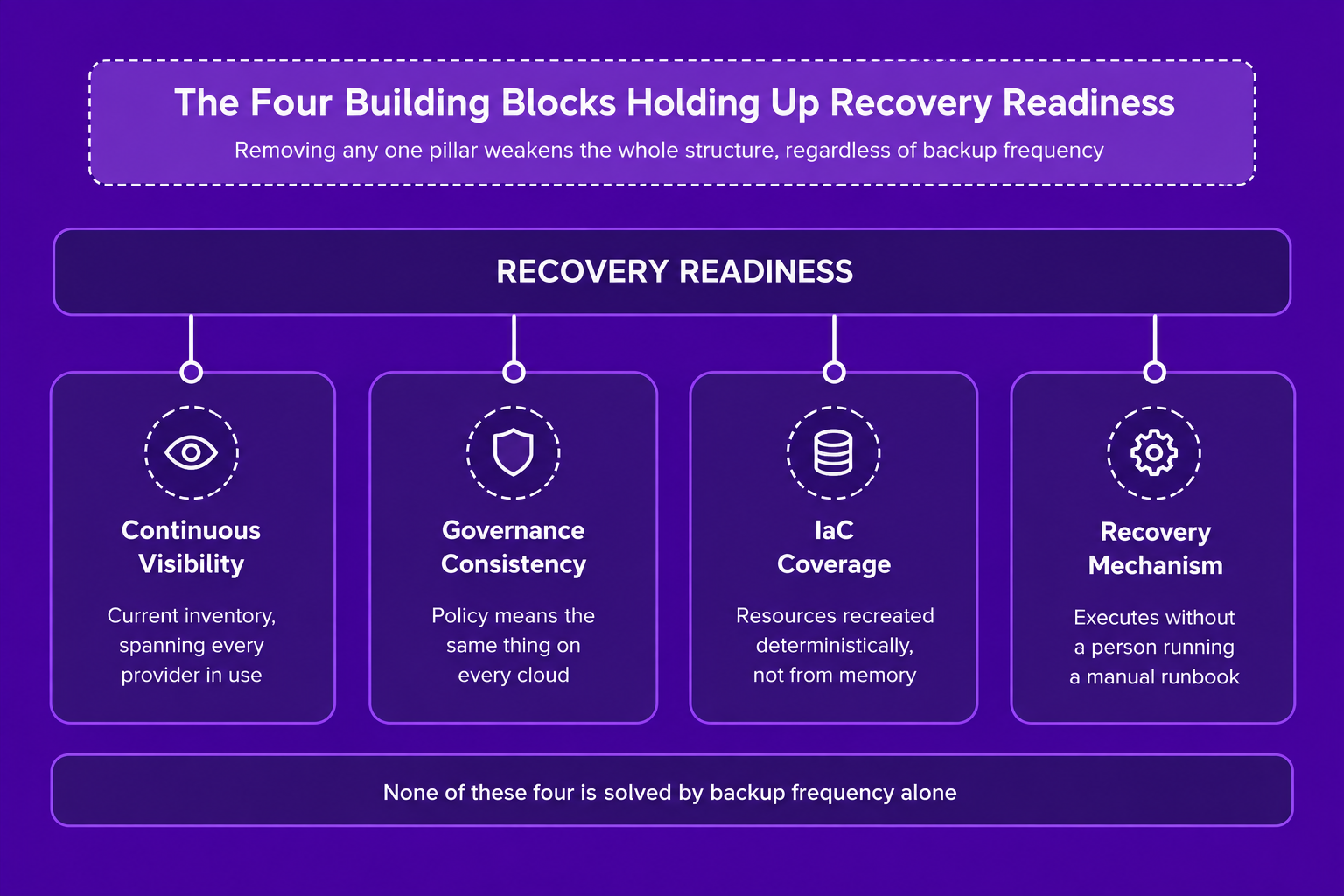
- Real multi-cloud resilience rests on four building blocks that have nothing to do with backup frequency: continuous visibility into what's actually running, governance that holds the same shape across every provider, high Infrastructure-as-Code coverage, and a recovery mechanism that doesn't depend on someone remembering a runbook.
- Closing that gap starts with an honest measurement of Infrastructure-as-Code coverage and drift across every cloud provider in use, not with how often backup jobs run, since a governance-first approach determines whether a restored resource actually matches what should be running.
Running production workloads across two or more cloud providers used to be a strategic choice a platform team made deliberately, weighing latency, pricing, and vendor lock-in before committing to a specific mix. For most organizations today, that decision never happened in any single meeting. An acquisition brings in a team standardized on a different provider. A data science group picks GCP for its machine learning tooling while the rest of the company runs AWS. A compliance requirement pins certain workloads to a specific region a primary provider doesn't serve well. Each of these is a reasonable decision in isolation, and together they create an infrastructure footprint that spans providers without anyone designing it that way.
The instinctive response to "what happens if something breaks" is usually backups. Back up the data, replicate it somewhere else, and recovery becomes a restore operation. That instinct isn't wrong, but it's incomplete in a way that only becomes visible during an actual incident. This piece covers why backup coverage percentage alone doesn't predict whether a resource actually recovers cleanly, what four building blocks make multi-cloud resilience real rather than theoretical, how governance has to work when policy needs to hold the same shape across providers with different native tooling, and how to test recovery readiness before an outage forces the test on you.
What is Multi-Cloud Resilience?
Multi-cloud resilience is the ability to detect, withstand, and recover from a disruption without its blast radius being determined by which cloud provider was affected. It's a narrower concept than multi-cloud management, which typically covers cost visibility, tagging discipline, and governance broadly. It's also broader than backup and disaster recovery, which narrowly focuses on the mechanics of copying data and restoring it after loss.
This distinction has a practical consequence: a team can have excellent backup coverage and still have poor multi-cloud resilience. Backup answers the question "do we have a copy of this data somewhere else?" Resilience answers a harder question: when this specific resource, and everything it depends on, needs to come back online in a consistent, working state, does that actually happen, and does it happen the same way regardless of which provider that resource lives on?
A useful way to separate the two: backup and DR is a mechanism. Resilience is an outcome. A mechanism can exist, run on schedule, and pass every health check, while the outcome it's supposed to produce, a clean recovery, still fails, because the mechanism was never operating on an accurate picture of what needed to be recovered in the first place.
A useful way to separate the two: backup and DR is a mechanism. Resilience is an outcome. A mechanism can exist, run on schedule, and pass every health check, while the outcome it's supposed to produce, a clean recovery, still fails, because the mechanism was never operating on an accurate picture of what needed to be recovered in the first place.
The Trade-Off Multi-Cloud Resilience Asks Teams to Accept
Everything above assumes multi-cloud resilience is worth building toward, and for most organizations running production across more than one provider, it is. It isn't free, though. The same consistency that makes governance and recovery work across providers, policy holding the same shape everywhere, infrastructure defined in a common IaC pattern, recovery mechanics that don't care which cloud a resource lives on, comes from designing against what AWS, Azure, and GCP all offer similarly, not against what makes any one of them distinct.
That has a real cost. A team that standardizes on portable compute, storage, and networking primitives to keep governance consistent is, by the same move, stepping back from the native services each provider built specifically to be hard to replicate elsewhere: a managed ML pipeline tuned to one provider's own hardware, a serverless integration that only works cleanly inside one ecosystem, a compliance certification tied to a region or service a competitor doesn't offer. Multi-cloud resilience, taken seriously, pushes a team toward the common denominator across providers, and the common denominator is, almost by definition, more generic than any single provider's best capability looked at in isolation.
Multi-cloud resilience is a deliberate trade, not an upgrade with no downside. A workload that genuinely benefits from a provider-specific capability, and has no real requirement to survive a provider-level outage, may be better served staying on that provider and accepting the risk directly, rather than being redesigned around portability it doesn't need. The building blocks in the next section describe what resilience costs once a workload's failure mode actually justifies paying for it, not a default every workload should adopt regardless of what it stands to lose.
Why Backup Coverage Percentage Isn't the Same as Recovery Readiness
Backup coverage is usually reported as a single number: what percentage of resources have an active backup policy applied to them. It's a useful metric, and it's also one of the easiest metrics in cloud operations to make look better than it is. A resource can have 100% backup coverage and still fail to recover cleanly, for reasons that have nothing to do with the backup job itself.
Two failure modes account for most of that gap:
- Drift gets backed up faithfully. A security group originally provisioned through Terraform gets an inbound rule opened manually during an incident, and never reverted. It still gets backed up every night, because the backup policy operates on whatever the resource currently is, not against its intended baseline. Restoring it later recreates the drifted, insecure configuration, not the one the team believes is deployed.
- Untracked dependencies don't travel with the backup. A database instance can be fully backed up while the IAM role or VPC peering connection it depends on was created manually and was never captured anywhere. Restoring the database into a fresh environment doesn't restore what connects to it. The backup succeeded. The recovery, meaning the database working correctly again inside its actual operating environment, did not.
This gap between confidence and outcome shows up clearly in Veeam's numbers: 90% of organizations report confidence in their cyber recovery capability, but among those who experienced a ransomware attack, only 28% recovered all affected data, and the average organization recovered 72%. Confidence is measured before an incident. Outcome is measured after one. Backup coverage percentage sits on the confidence side of that line.
How Unmanaged and Drifted Resources Undermine Recovery Across Providers
Every cloud environment accumulates resources that exist outside its Infrastructure-as-Code workflow. Someone provisions something manually to unblock a deadline. A script run once during an incident creates a resource nobody remembers afterward. A separate team's automation writes directly to a resource a different team's Terraform configuration also claims to own. None of this is unusual, and none of it becomes a problem until recovery depends on knowing it exists.
In a single-cloud environment, this problem is bad enough. In a multi-cloud environment, it compounds, because most tooling built to catch drift or track unmanaged resources is scoped to one provider or one Infrastructure-as-Code tool. A team running Terraform against AWS and a separate Pulumi stack against a GCP project inherited through an acquisition typically has two disconnected views of infrastructure health, neither of which sees what the other is doing. A security audit or a real recovery event is often the first time anyone gets a combined view, and by then it's too late to fix the gap calmly.
The risk isn't evenly distributed either. Resources tied to identity and networking, security groups, IAM roles, VPC peering connections, tend to be the ones touched manually most often during incident response, because they're also the fastest way to unblock a production problem at 2 a.m. Those same resource types are disproportionately likely to be silent dependencies for other, better-managed resources, which means the highest-risk drift often sits exactly where a recovery plan is least likely to look.
Multi-cloud outages tend to arrive in clusters rather than in isolation, which turns this compounding risk into an operational problem, not just an architectural one. None of the incidents below were caused by drift or unmanaged resources directly, but they illustrate the same underlying point: recovery plans get tested by real outages on a schedule nobody controls, and an inaccurate picture of what's actually deployed turns a contained incident into a longer one.
A team whose recovery plan assumed only one provider would fail at a time had nine days between the first two incidents to notice that assumption was wrong, and then lived through the second failure anyway.
The Four Building Blocks of Real Multi-Cloud Resilience
Backup and disaster recovery is one piece of a larger system, not the whole system. Four building blocks, taken together, are what actually determine whether an environment recovers cleanly, and none of them are specific to any single cloud provider.
- Continuous visibility. A resilience plan is only as accurate as the inventory it's built on. That inventory needs to be current, meaning it reflects what's actually running right now, not what was documented when the environment was first built, and it needs to span every provider in use, not just the primary one.
- Governance consistency. Policy has to mean the same thing regardless of which cloud a resource lives on. A tagging standard, an encryption requirement, or a network access rule that's enforced on AWS but only loosely followed on Azure because the tooling differs isn't really a consistent policy; it's two policies that happen to share a name.
- Infrastructure-as-Code coverage. A resource that's fully defined in code can be recreated deterministically. A resource that exists only because someone clicked through a console has no such guarantee, and the further a fleet drifts from full IaC coverage, the more its recovery plan depends on someone's memory than on a repeatable process.
- A recovery mechanism that doesn't depend on manual runbooks. Even with perfect visibility, consistent governance, and full IaC coverage, recovery still has to actually execute during an incident, when the people who best understand the environment may be unavailable, asleep, or already stretched across multiple fires.
None of these four building blocks is optional in a genuinely multi-cloud environment, and none of them is solved by backup frequency alone. A team can back up hourly and still fail on all four if what's being backed up is an inaccurate, drifted, partially documented picture of the environment.
Building Governance Consistency When Policy Differs by Cloud Provider
Cloud providers don't expose the same native controls in the same way. AWS, Azure, and GCP each have their own console, their own IAM model, their own default settings for encryption and network access, and their own audit logging format. A policy written for one provider's native tooling usually doesn't transfer to another without being rewritten from scratch, which is how organizations end up with three separate, drifting versions of what should be one security standard.
Policy-as-code addresses this by defining rules once, independent of the underlying cloud provider's specific console or API shape, and evaluating every resource against the same rule regardless of where it lives. A rule requiring encryption at rest, or a specific tag before a resource can exist in production, can be written once and applied uniformly, rather than maintained as three parallel checklists that inevitably drift apart over time.
The mechanics matter here as much as the intent, and a single enforcement point isn't enough on its own:
- Deployment-time enforcement (checking a Terraform plan before it's applied) catches new violations but says nothing about resources that already exist, including ones provisioned manually outside that pipeline entirely.
- Periodic scanning catches existing violations, but on a delay measured in hours or days, during which a misconfigured resource sits exposed.
Real governance consistency across providers needs both enforcement before a change goes live and continuous evaluation of what's already running, using the same rule set in both places.
Testing Recovery Readiness Before You Need It
A recovery plan that has never been executed is a hypothesis, not a capability. The gap between the two only becomes visible when something forces the test, and the worst time to discover that a runbook is outdated, that a dependency was missed, or that a restored resource doesn't match its expected configuration is during an actual incident with customers watching.
Chaos engineering, deliberately injecting a failure into a controlled environment and observing how the system responds, is the standard way to close that gap on purpose rather than by accident. A useful exercise doesn't have to be dramatic: simulate the loss of a single availability zone, or forcibly terminate a resource other services depend on, and measure how long it takes to detect, respond to, and fully recover from that specific failure. Running the same exercise across each cloud provider in use, rather than only on whichever one hosts the most visible workloads, validates multi-cloud readiness instead of single-cloud readiness dressed up as the whole picture.
The output that a recovery test needs to prove isn't whether the resource came back. It's whether it came back in the correct configuration, with its dependencies intact, and whether the team can say with confidence what would have happened if the failure had occurred on a different provider, at a different time, or with a different resource in the blast radius. A test that only confirms the resource exists again, without confirming its configuration matches what should be running, validates a mechanism, not an outcome, in exactly the way backup coverage percentage does.
How Closing the Visibility and Governance Gap Changes What Recovery Delivers
The four building blocks above describe what resilience requires in principle. Firefly is built around closing the specific gap each one describes, across every cloud a team actually runs, rather than treating backup and disaster recovery as a standalone workflow layered on top of infrastructure nobody can fully see.
Firefly's platform is organized around three pillars that map directly onto the gaps described above: Automate, Govern, and Recover. Automate standardizes infrastructure delivery through GitOps with built-in guardrails across Terraform, OpenTofu, and Terragrunt deployments. Govern continuously scans the full cloud footprint, maintaining a real-time System of Record with event streaming, dependency mapping, and drift detection. Recover rebuilds environments with their dependencies intact, without manual runbooks, while keeping the evidence trail required for frameworks like DORA, SOC 2, and ISO.
The visibility gap described earlier, where a team running infrastructure across AWS, Azure, GCP, and other providers has no single accurate picture of what's actually deployed, is addressed through Firefly's Cloud Asset Inventory. It tags every discovered asset by its current IaC status: Codified (fully managed by IaC), Drifted (originally managed by IaC but since modified outside it), Unmanaged (created manually and untracked), or Ghost (still recorded in a state file but no longer present in the cloud). That distinction directly answers the drift scenario from earlier: a security group opened during an incident and never reverted shows up as Drifted the moment Firefly's continuous scan picks up the discrepancy between its live configuration and its Infrastructure-as-Code definition, rather than surfacing only when someone happens to run a manual comparison.
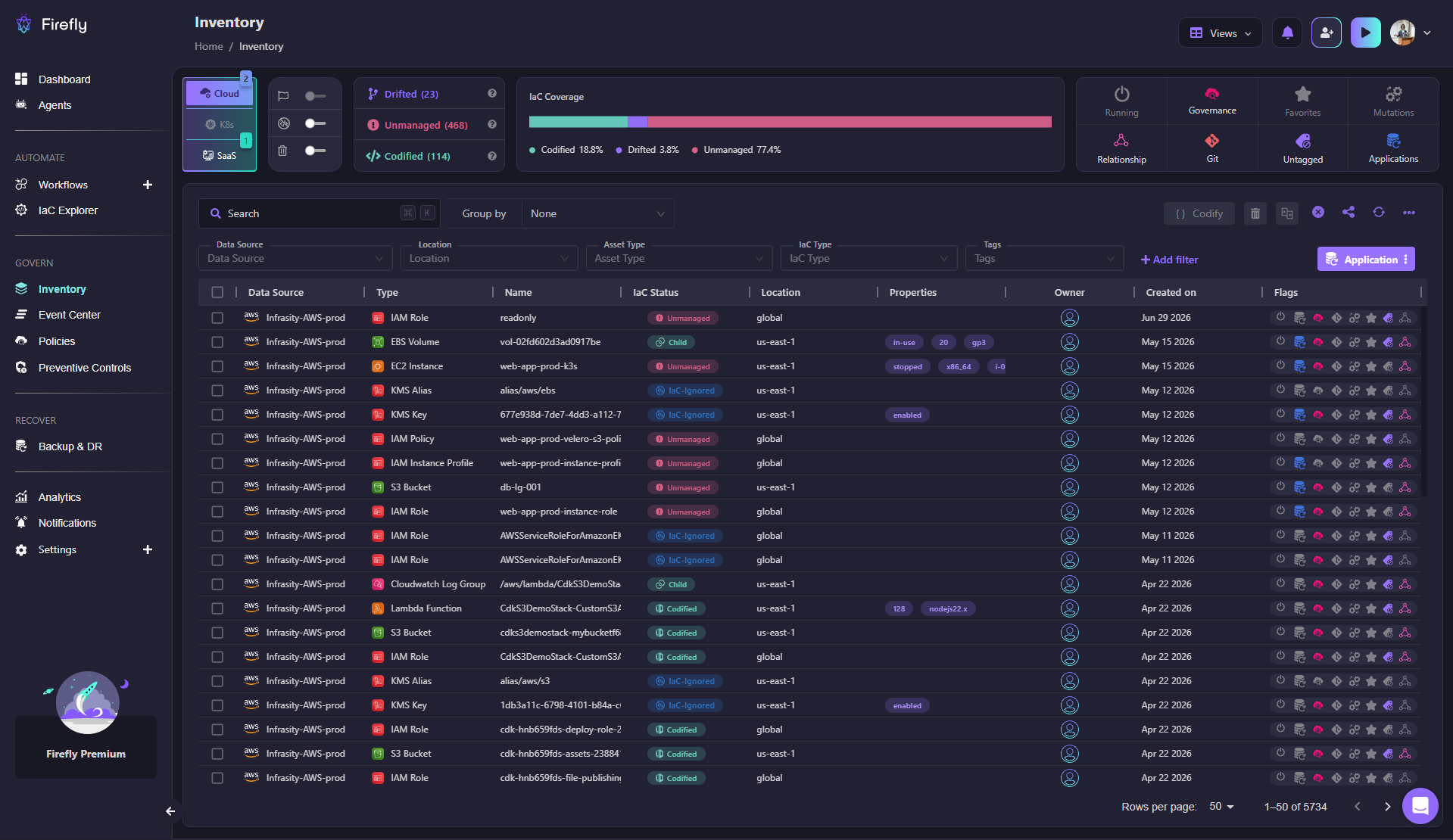
Governance consistency across providers is handled through Firefly's Policy & Governance engine, built on Open Policy Agent and written in Rego. A policy defined once, whether authored through the No-Code Policy Builder, generated from a plain-English description, or written directly as Rego, evaluates against resources regardless of which cloud they live on, closing the exact gap described earlier where a rule enforced natively on one provider doesn't automatically transfer to another. Guardrails, which run against a Terraform plan before it's applied, cover four rule types: Cost Rules, Policy Rules, Resource Rules, and Tag Rules, catching a violation before deployment. Continuous policy evaluation against the live Cloud Asset Inventory covers what Guardrails structurally cannot: resources that already exist, including ones provisioned outside any pipeline entirely. Running both against the same underlying policy set, rather than maintaining separate pre-deployment and post-deployment rule definitions, keeps the two checks from drifting apart.

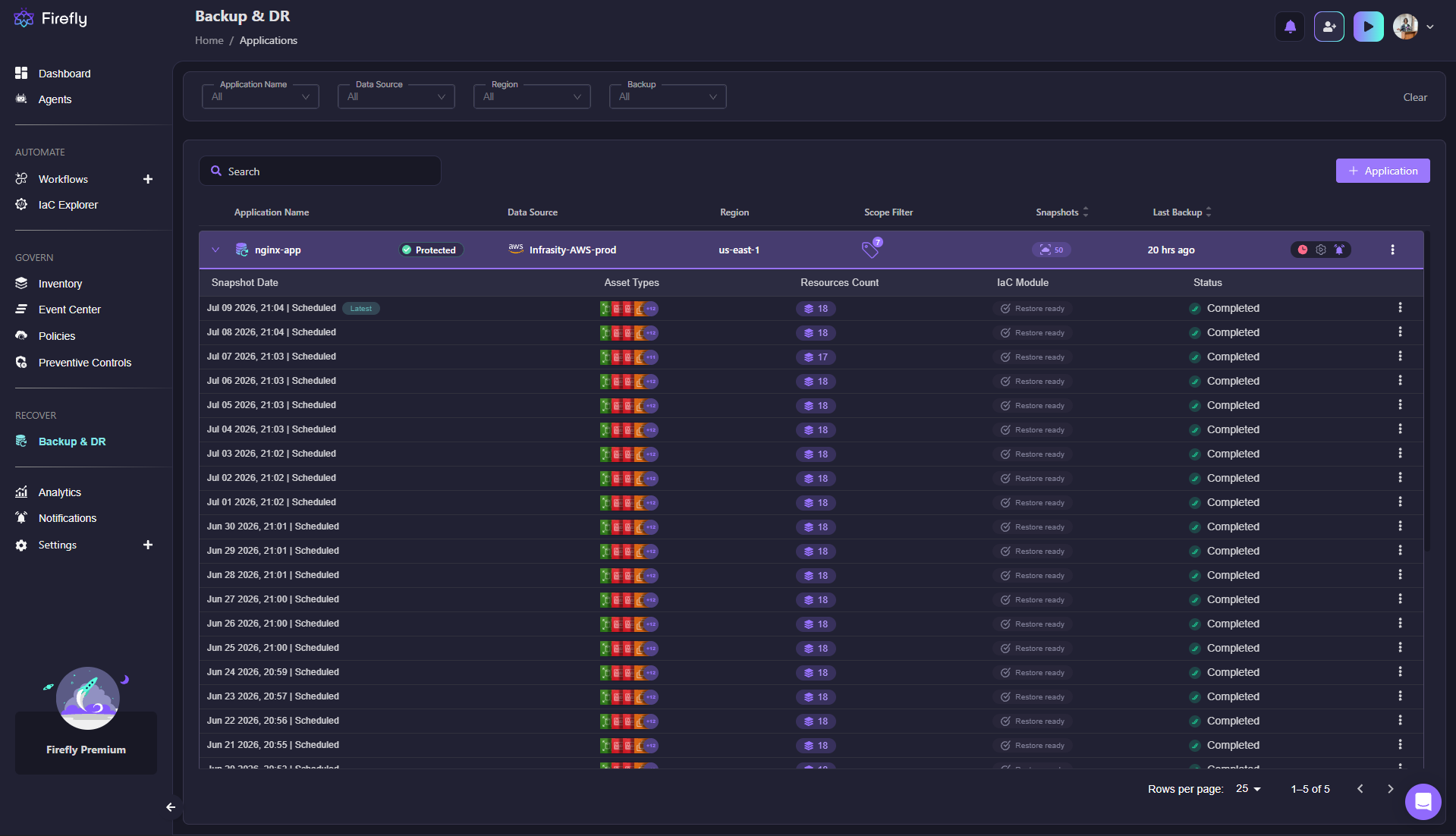
Recovery works differently from a traditional backup-and-restore model by directly addressing the dependency problem described earlier. Firefly's Applications Backup & DR defines backup scope through Application Policies that target resources by tag. Dependencies implicitly created alongside a targeted resource, such as VPC configuration, subnet assignments, or IAM instance profiles, aren't backed up as separate snapshots. Restoration doesn't perform a direct cloud-level mutation. It generates the actual Terraform code needed to recreate the primary resource and those dependencies together, which a team can preview before it runs, and which flows through the same IaC orchestration and Guardrail evaluation as any other deployment. That's the mechanical difference between a database restoring successfully and a database restoring into a working environment: the dependencies come back because the restore regenerates them from the same policy definition, not because someone remembered to provision them separately afterward.
Measuring Whether Your Multi-Cloud Environment Is Actually Recoverable
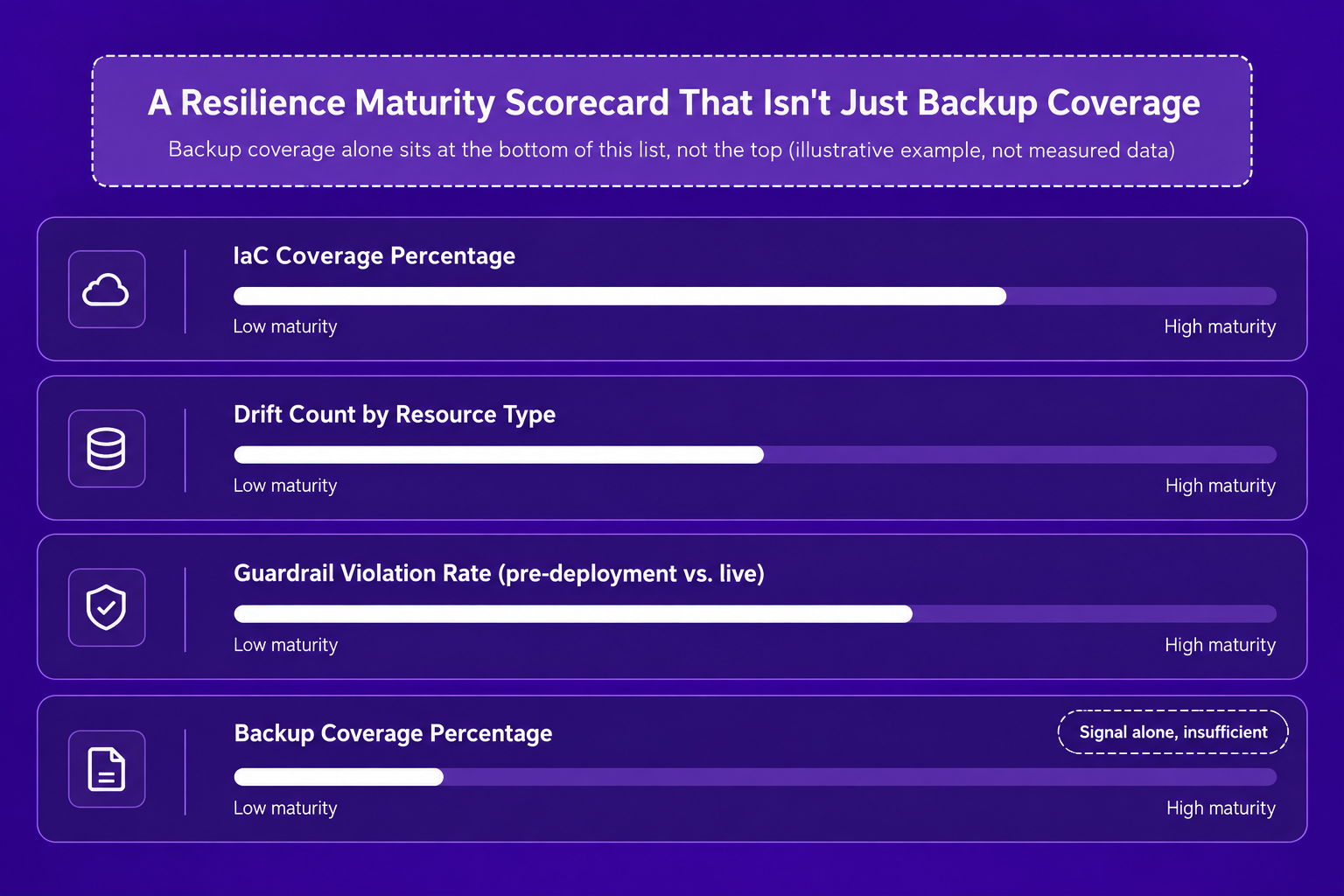
Backup coverage percentage isn't a wrong metric to track, it's an incomplete one. Pairing it with a small set of additional numbers gives a much more honest picture of whether an environment would actually recover cleanly if it had to:
- IaC coverage percentage. The proportion of resources with a confirmed, current Infrastructure-as-Code definition. Predicts recovery quality better than backup coverage does, because it determines whether a resource can be recreated deterministically or depends on someone's memory.
- Drift count by resource type. Surfaces the pattern described earlier, where identity and networking resources drift more often and carry disproportionate downstream risk.
- Guardrail violation rate. Tracked separately for pre-deployment blocks versus violations caught on already-running infrastructure, this shows whether governance is actually catching problems before they ship or only after they're already live.
None of these numbers replace backup coverage. Together, they answer the harder question backup coverage alone can't: not just whether a copy exists somewhere, but whether what gets restored from that copy actually matches what should be running, across every provider in the environment, not just the one a team happens to be watching most closely.
Where Should You Start With Multi-Cloud Resilience
Backup coverage answers a narrower question than most recovery plans assume. It confirms a copy exists somewhere else, not that the resource being copied reflects an accurate, current, correctly-configured version of what's actually supposed to be running, and not that everything that resource depends on will come back with it. In a multi-cloud environment, where policy, tooling, and visibility rarely stay consistent across providers without deliberate work, that gap between backup coverage and actual recovery readiness only gets wider, and it tends to surface at the worst possible time, during an incident that's already testing every other part of the organization at once.
Closing that gap starts with an honest answer to a question most teams haven't measured directly: across every cloud provider in use, what percentage of resources are actually codified, current, and free of drift, right now. Firefly's platform answers that question continuously, not only at the time of an audit or incident, and makes recovery a function of an accurate, governed inventory rather than a backup schedule running against an unverified view of the environment. Book a demo to see what percentage of your own multi-cloud footprint is actually recoverable today, not just backed up.
FAQs
What's the difference between backup and disaster recovery versus multi-cloud resilience?
Backup and disaster recovery is a mechanism: copying data and infrastructure definitions so you can restore them after a loss. Multi-cloud resilience is the outcome that mechanism is supposed to produce: a resource and everything it depends on coming back in a correct, working configuration, consistently, regardless of which cloud provider it runs on. A team can have strong backup coverage and still have weak resilience if what's being backed up doesn't reflect an accurate, current state of the environment.
Why does Infrastructure-as-Code coverage matter more than backup frequency for recovery?
A resource fully defined in Infrastructure-as-Code can be recreated deterministically, from code, with its configuration guaranteed to match what's intended. A resource that exists only because someone provisioned it manually through a console has no such guarantee, no matter how often it's backed up, because the backup captures whatever state the resource happens to be in, drifted or not, rather than a verified correct baseline.
How does Firefly detect a security group or IAM role that drifted after a manual change?
Firefly's Cloud Asset Inventory continuously scans the connected cloud accounts and compares each resource's live configuration against its Infrastructure-as-Code definition. A resource whose live configuration no longer matches its IaC source is tagged Drifted the moment that discrepancy is detected, rather than surfacing only when someone manually compares the two.
Can policy enforcement really work the same way across AWS, Azure, and GCP given how different their native tools are?
Policy-as-code frameworks like Open Policy Agent evaluate infrastructure independent of any single cloud provider's native console or API shape, which lets one policy definition apply consistently across providers. The alternative, relying on each provider's native security tooling separately, tends to produce three parallel rule sets that drift apart from each other rather than one consistent standard.
Why do multi-cloud outages tend to expose recovery plans that single-cloud testing didn't catch?
A recovery plan tested against a single provider's failure modes often assumes only one provider fails at a time, or that failures are spaced far enough apart to recover fully between them. Real incidents don't cooperate with that assumption. AWS's us-east-1 outage on October 20, 2025, and Azure Front Door's separate outage on October 29, 2025, landed nine days apart, and a plan built around single-provider assumptions has no additional protection against a second, unrelated failure arriving on a short timeline.

.avif)
.avif)
.webp)

.webp)