.png)
TL;DR
- A DR plan is a document. Resilience testing is what tells you whether that document is still true, and most teams only find out it isn't during a real incident, not before one.
- Testing methods sit on a spectrum from tabletop discussions to full production fault injection, and each level catches a different class of problem: a tabletop exercise tests decision rights; a chaos experiment tests whether the infrastructure actually survives.
- The most commonly skipped test isn't the dramatic one. Backup and restore testing, actually running a restore end to end, not just confirming a backup job completed, catches a failure mode that chaos engineering never touches.
- The current chaos engineering tooling landscape splits cleanly by scope: AWS Fault Injection Simulator and Gremlin operate at the infrastructure layer, while Chaos Mesh and LitmusChaos, both CNCF Incubating projects, are built specifically for Kubernetes.
- None of this holds between test cycles without continuous visibility into drift, which is the specific gap Firefly's CRPM is built to close, turning resilience from a quarterly test result into a live, always-current score.
Cloud infrastructure fails in ways that don't show up until something actually breaks. A region goes down, a dependency times out, a backup that's run successfully every night for a year turns out to be unrestorable, and the gap between what a team assumed would happen and what actually happens only becomes visible once it's too late to plan around it. Every team with production infrastructure has some version of a disaster recovery plan on file, but a plan that's never been exercised is a hypothesis, not a fact, and the cost of finding out it was wrong tends to land during the exact incident it was supposed to prevent.
This piece covers what resilience testing actually means in a cloud context, the spectrum of methods available from tabletop exercises through full production chaos engineering, and the tools teams use to run each one, including a practical look at AWS Fault Injection Simulator, Gremlin, Chaos Mesh, and LitmusChaos. It also covers how to build these individual tests into an actual program with a defined cadence, and where periodic testing, however well it's run, still leaves a gap that only continuous visibility into infrastructure drift can close.
What Resilience Testing Verifies in Cloud Environments
Resilience testing is the practice of deliberately checking whether a system holds up under a real failure condition, rather than assuming it does because a runbook says it should. That distinction matters more than it sounds. A disaster recovery plan documents intent: which region fails over to which, who's responsible for triggering it, what the expected recovery time is. None of that intent is verified until someone triggers the failover, restores a backup, or intentionally kills a production dependency and watches what happens.
This is a narrower topic than operational resilience as a whole, which also covers regulatory scope, dependency mapping across people and process, and the "severe but plausible" standard UK and EU regulators now require testing against. That broader ground is covered in the companion piece on operational resilience and regulatory dependency mapping. This piece stays specifically on the methods and tools teams actually use to run that testing: chaos engineering platforms, DR failover drills, backup validation, and where each one's coverage stops.
Why Untested Resilience Plans Fail Silently
An untested DR plan doesn't announce that it's broken. It sits in a wiki page, gets reviewed once a year during an audit, and looks complete the entire time, right up until the moment someone actually needs it. The failure modes that testing catches are specific and recurring: a runbook that references a load balancer that was decommissioned eight months ago, a failover region that was never actually provisioned with the same IAM policies as production, a backup that's been running successfully every night for a year but has never once been restored, and would fail the first time anyone tried.
None of these are exotic. They're the ordinary byproduct of infrastructure changing faster than documentation does, and they're specifically what separates a resilience plan that exists from a resilience plan that works. Testing is how a team finds out which one they actually have, before a real outage does it for them.
The Resilience Testing Spectrum, From Tabletop to Production Chaos
Resilience testing isn't one activity. It's a spectrum of methods, each trading cost and risk for a different level of confidence, and mature programs run several of them rather than picking one.
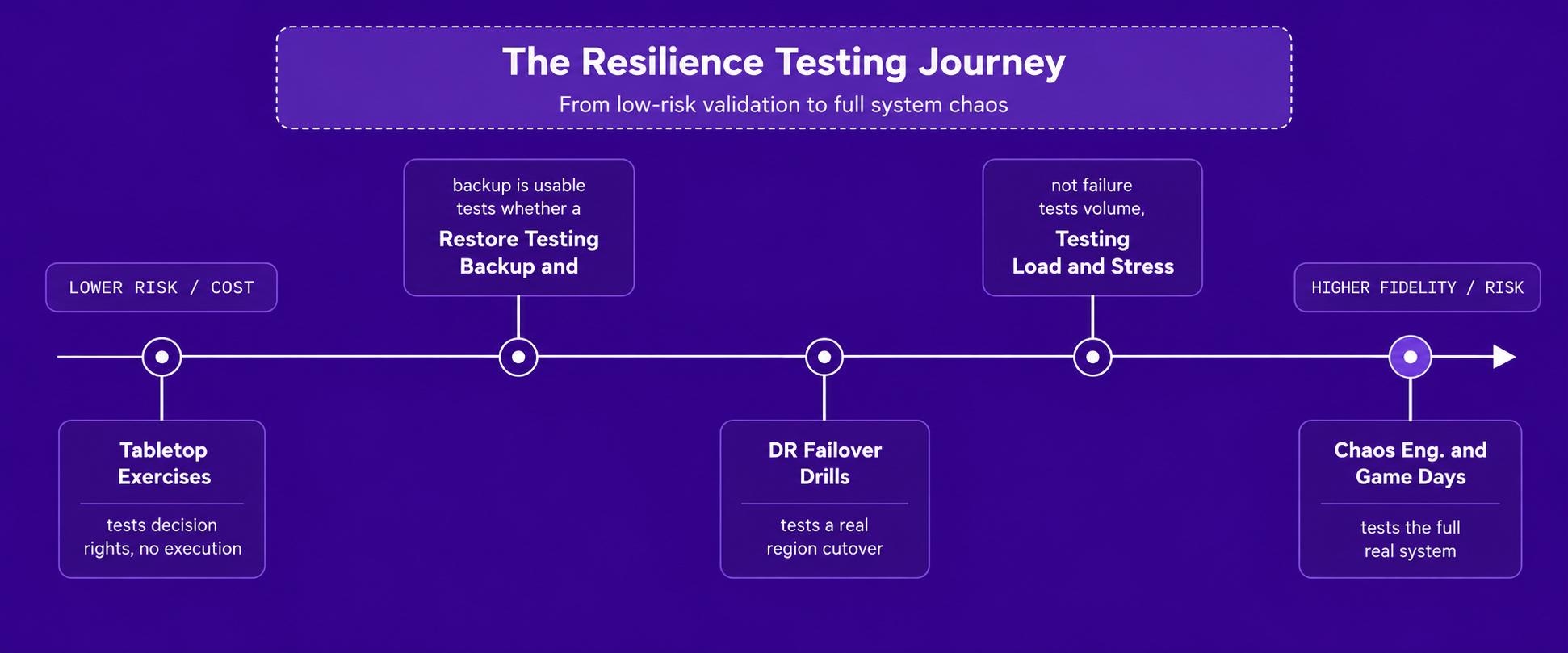
Tabletop exercises are discussion-based. A facilitator walks the team through a hypothetical scenario, a region outage, a ransomware incident, and the team talks through who does what, without touching any real system. These are cheap, fast to run, and genuinely useful for testing decision rights and communication paths. What they can't catch is anything technical: a stale runbook, a missing IAM permission, or a backup that doesn't actually restore, since nothing in a tabletop exercise ever gets executed.
Backup and restore testing is the most commonly skipped method on this list, and arguably the highest-value one. A backup job completing successfully every night says nothing about whether the resulting backup can actually be restored into a working system. Corrupted backups, incompatible schema versions, and missing dependencies (a database restore that doesn't also restore the application configuration it needs to connect) are all failures that only show up when someone actually runs the restore, end to end, against a real environment.
DR failover drills go a step further: actually triggering a failover to a secondary region or account on a schedule, rather than assuming the automation would work if it were ever needed. This surfaces problems tabletop exercises structurally can't: missing DNS records in the failover region, security groups that were updated in production but never replicated, IAM roles that exist in one account but not the other.
Load and stress testing verifies a different thing entirely: not whether a system survives a failure, but whether it survives volume, a traffic spike, a batch job at ten times its normal size, a sudden surge in concurrent users. It's a necessary complement to resilience testing, not a substitute, since a system can handle failures gracefully and still fall over under load it was never sized for.
Chaos engineering and game days sit at the far end of the spectrum: deliberately injecting real faults into a production or production-adjacent environment and observing what actually happens, with a defined blast radius and a rollback plan if things go worse than expected. This is the only method on this list that tests the full, real interaction between infrastructure, application code, and operational response at once, which is also exactly why it carries the most risk if it's run carelessly.
Chaos Engineering Tools and What Each One Tests
Chaos engineering tooling has matured into a landscape that splits fairly cleanly by scope: cloud-provider-native tools that operate on infrastructure, and Kubernetes-native tools that operate inside a cluster. Picking the right one starts with which layer actually needs testing.
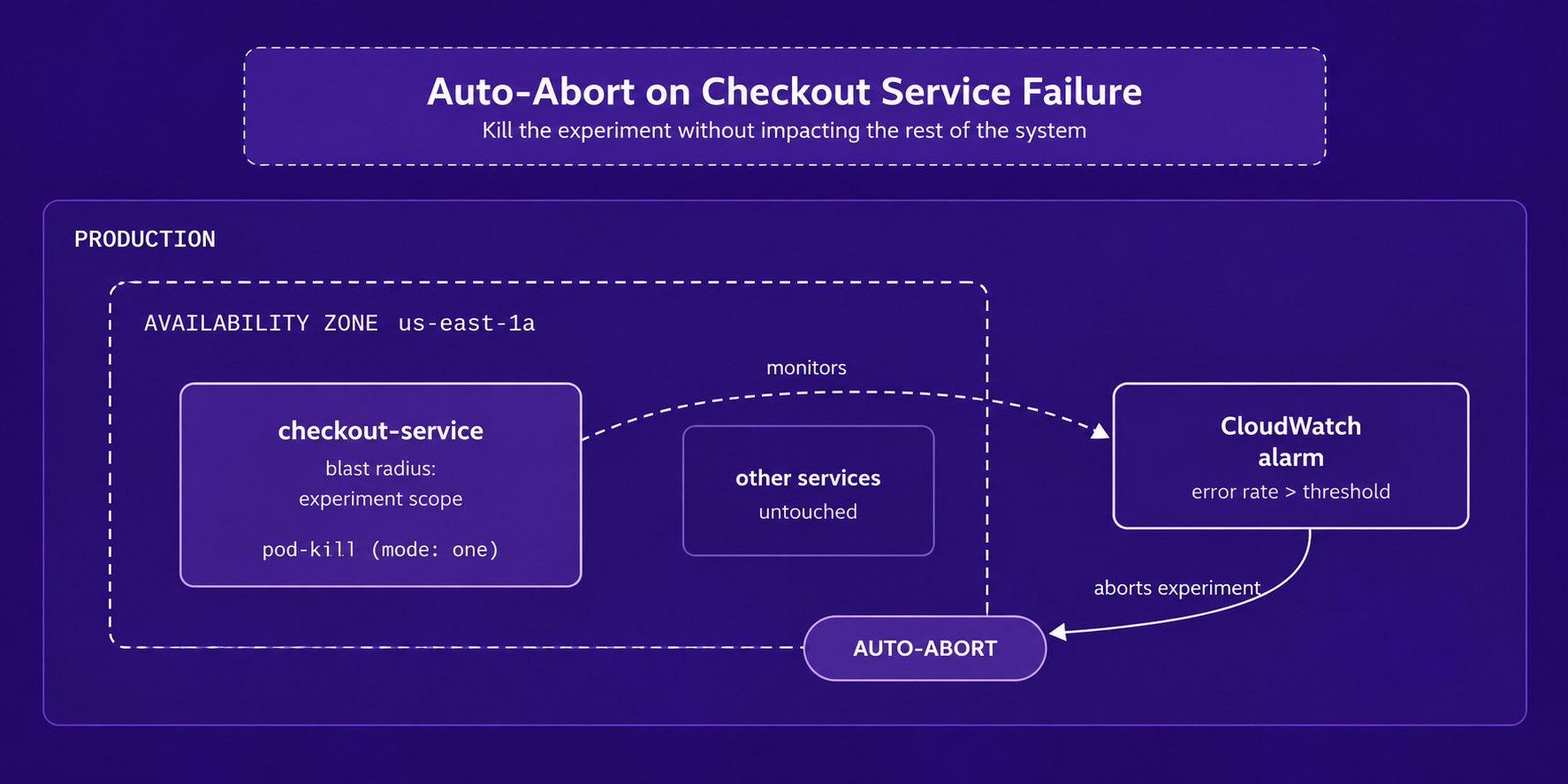
AWS Fault Injection Simulator (FIS) is AWS's own managed chaos engineering service. It can terminate instances, inject network latency, throttle API calls, or disrupt connectivity to a specific dependency, all scoped to a defined blast radius with stop conditions tied to a real CloudWatch alarm, so an experiment halts automatically if it starts causing more damage than intended.
Gremlin is a cross-cloud, managed SaaS platform built specifically for chaos engineering as a discipline rather than as an add-on to a broader platform. It supports AWS, Azure, GCP, and on-premises infrastructure from one control plane, making it a common choice for teams running chaos experiments across multiple cloud providers rather than committing to a single vendor's native tooling.
Chaos Mesh is a Kubernetes-native chaos engineering platform and a CNCF Incubating project. Originally built at PingCAP to test the distributed database TiDB, it now orchestrates chaos experiments directly inside a Kubernetes cluster through custom resources, with a web dashboard for designing and monitoring experiments. A minimal pod-kill experiment looks like this:
apiVersion: chaos-mesh.org/v1alpha1
kind: PodChaos
metadata:
  name: checkout-pod-kill
  namespace: production
spec:
  action: pod-kill
  mode: one
  selector:
    namespaces:
      - production
    labelSelectors:
      "app": "checkout-service"
  scheduler:
    cron: "@every 10m"
LitmusChaos is also Kubernetes-native and also a CNCF Incubating project, started in 2017 and built around a declarative experiment model with a shared library of pre-built chaos experiments called ChaosHub. It overlaps with Chaos Mesh in scope; both target Kubernetes, but differ in architecture and community background, so the choice mostly comes down to which experiment model and ecosystem fits an existing platform team's workflow.
The practice itself traces back to Netflix's Chaos Monkey, released in 2011 as part of the Simian Army toolset, which randomly terminated production instances to force engineering teams to build systems that tolerated failure by default rather than treating it as exceptional. Every tool on this list is a direct descendant of that original idea, applied to a progressively wider range of failure types.
Building a Resilience Testing Program: Blast Radius, Stop Conditions, and Cadence
Running a single chaos experiment once doesn't constitute a resilience testing program. A real program has three components that turn an ad hoc experiment into something repeatable and safe to run regularly.
Blast radius scoping defines exactly what an experiment can touch: a specific service, a specific availability zone, a specific percentage of traffic, rather than leaving the scope implicit. Stop conditions are what separate a deliberate test from an actual incident: an experiment should automatically halt the moment a real alarm crosses a defined threshold, rather than relying on someone watching a dashboard and manually intervening in time.
Cadence is the third piece, and it's where most programs either stall out or become sustainable. A reasonable starting rhythm: backup and restore testing runs continuously or at minimum monthly, since it's low-risk and high-value; DR failover drills run quarterly, since they're more disruptive to schedule around; and chaos engineering game days run quarterly as well, scoped to a different service or failure type each time rather than repeating the same experiment. None of this needs to be exhaustive to be useful. A program that consistently runs a narrow set of tests on a predictable schedule beats one that plans an ambitious, comprehensive test matrix and never actually executes it.
Where Periodic Testing Still Leaves a Gap
Everything covered so far answers "does this work today?" None of it answers "does this still work tomorrow, or next week, or the week after that." A quarterly game day proves the checkout service can survive a dependency failure on the day the test ran. It says nothing about whether a config change made three weeks later quietly broke that same failover path.
This is the structural limit of periodic testing, however well it's run. Infrastructure drifts in the gap between test cycles: a security group gets opened during an incident and never reverted, a new resource gets provisioned outside the normal process, a runbook goes stale because nobody updated it after the last architecture change. None of that shows up until the next scheduled test, or until a real incident forces the question. A resilience testing program built entirely on periodic checkpoints is only ever as current as its last test date.
How Firefly Supports Continuous Resilience Validation
Firefly isn't a chaos engineering platform, and it doesn't inject faults into production the way AWS FIS or Gremlin do. Its role sits earlier in the picture: making sure the thing being tested, the actual infrastructure a DR plan or a chaos experiment depends on, is accurately known and continuously verified, rather than assumed correct because a test passed last quarter.
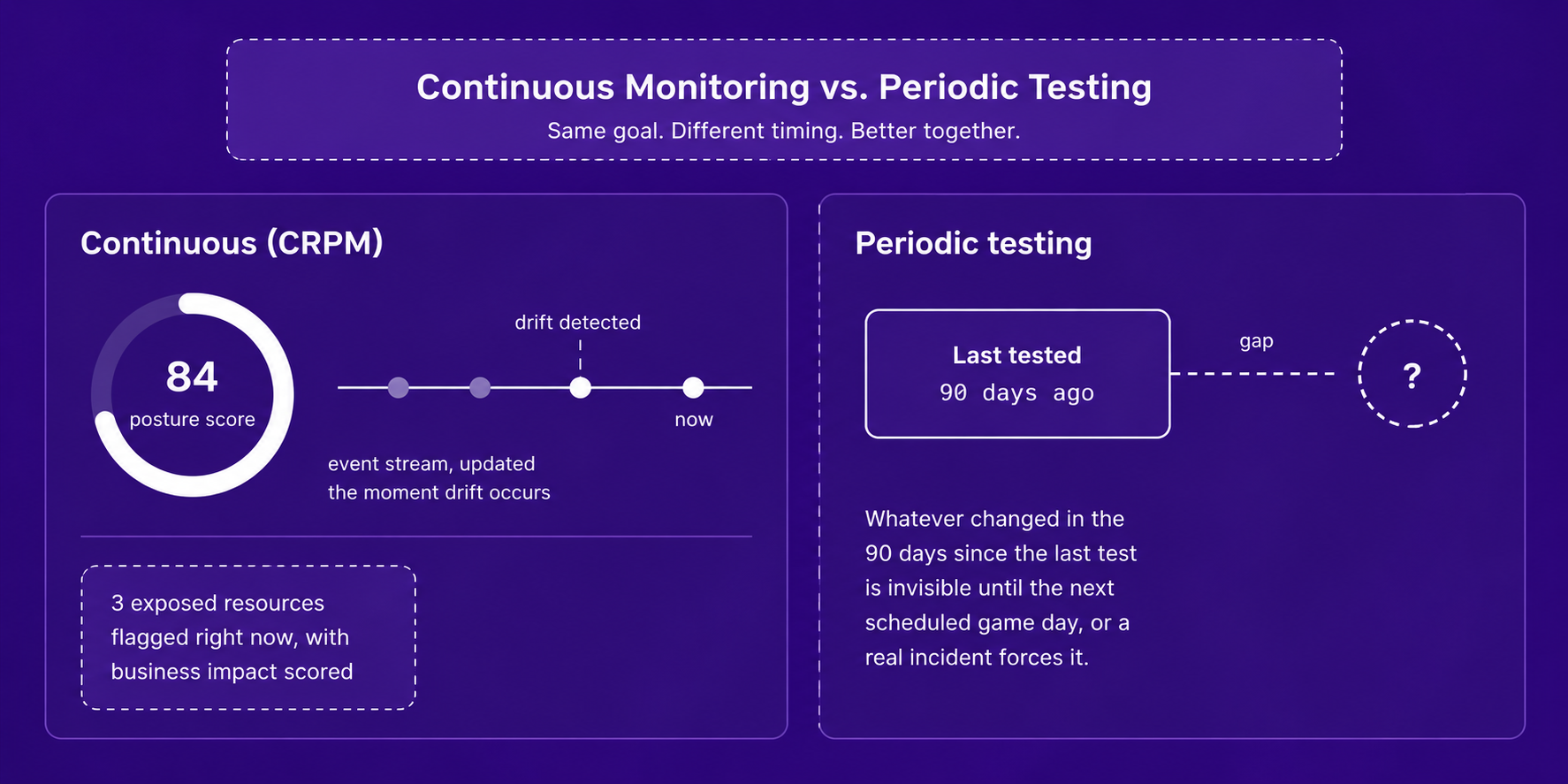
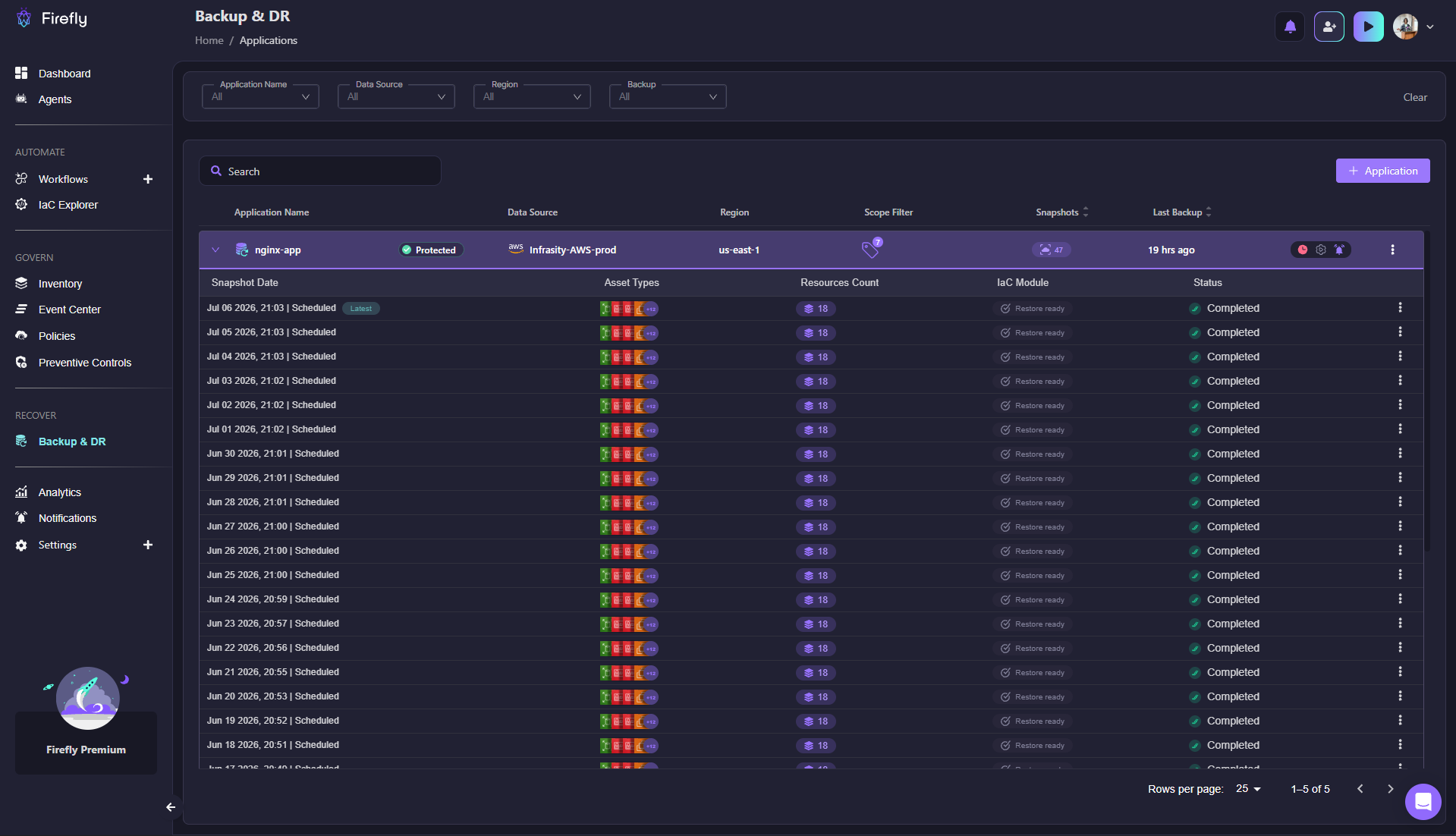
Firefly's Cloud Resilience Posture Management (CRPM) is built specifically to close the gap the previous section described. Instead of treating resilience as a quarterly checkpoint, CRPM continuously scores whether resources are actually protected and whether infrastructure can be rebuilt fast enough to matter, using the same System of Record that tracks every resource's real-time IaC status: Codified, Drifted, or Unmanaged. If drift has quietly broken a failover path since the last test, CRPM surfaces that the moment it happens rather than waiting for the next scheduled game day to find out the hard way.
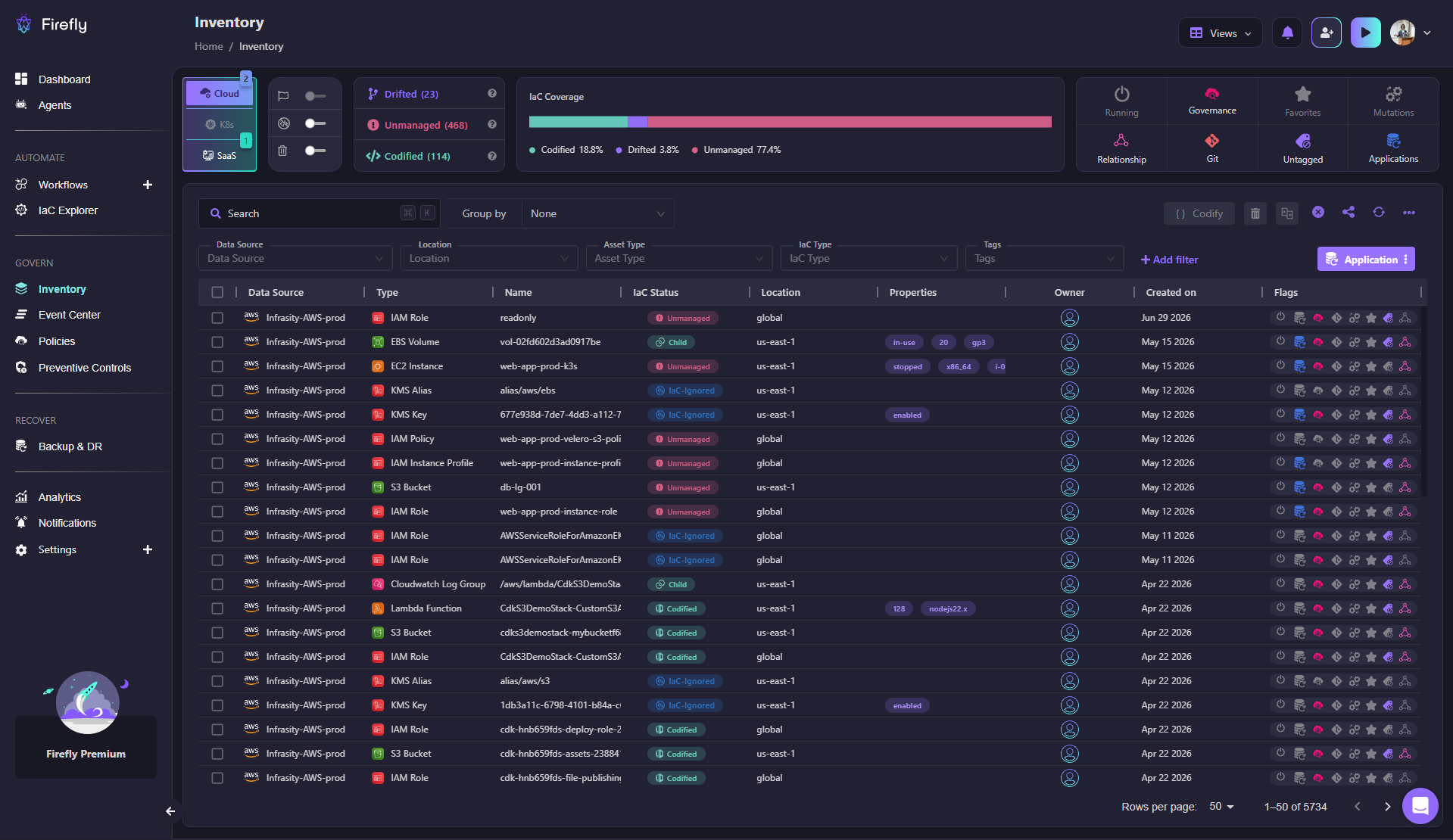
The AI Disaster Recovery Agent is what makes that score actionable rather than diagnostic. It autonomously discovers, backs up, and restores full cloud infrastructure configurations, drawing on the same System of Record CRPM scores against, so what a chaos experiment or a failover drill is actually verifying, whether the current environment could really be rebuilt, is being checked continuously in the background rather than only on the day a test happens to run. Firefly states a validated Recovery Time Objective under one hour for infrastructure recovered this way, backed by automated, audit-ready evidence for frameworks including DORA, NIS2, SOC 2, ISO 27001, and PCI-DSS.
None of this replaces chaos engineering, backup testing, or DR drills. It answers a different, earlier question: whether what's actually running matches what any of those tests assume they're testing against.
Measuring Whether a Resilience Testing Program Is Working: RTO and RPO
Two numbers determine whether a resilience testing program is actually working, and both come directly from the testing itself rather than being inferred from general uptime.
Recovery Time Objective (RTO) is the maximum acceptable time between a failure and full recovery. A DR failover drill or a full infrastructure rebuild either meets that target or it doesn't, and the only way to know is to actually run the test and measure the clock, not to estimate it from a runbook's documented steps. Recovery Point Objective (RPO) is the maximum acceptable amount of data loss, measured in time, the gap between the last good backup or replication point and the moment of failure. Backup and restore testing is what validates RPO directly: a nightly backup schedule implies an RPO of roughly 24 hours, but only a real restore test confirms that backup is actually usable when that window closes.
Tracking these two numbers before and after each testing cycle turns resilience testing from an activity into a measurable program. If RTO and RPO aren't improving, or aren't being measured at all, the testing being run isn't translating into an actual reduction in risk, regardless of how many chaos experiments happened that quarter.
Where Should You Start With Cloud Resilience Testing
Start with the cheapest, highest-value test on the spectrum: an actual backup restore, run end to end, not just a confirmation that last night's backup job completed successfully. That single test alone catches one of the most common and most consequential gaps between a resilience plan on paper and a resilience plan that works, and it requires none of the blast-radius planning a chaos experiment does. From there, layer in DR failover drills and chaos engineering on a predictable cadence, scoped narrowly enough to actually run consistently rather than planned ambitiously and never executed.
None of that testing holds between cycles without knowing what's actually running in the gaps. Firefly's CRPM turns resilience from a quarterly test result into a continuously verified score, closing the exact window periodic testing leaves open. Book a demo to see how current your own environment's resilience posture actually is, right now, not as of the last test that happened to run.
FAQs
What is resilience testing in cloud infrastructure?
Resilience testing is the practice of deliberately verifying that a system, and the plans built around it, actually hold up under a real failure condition, rather than assuming they do because a runbook or DR plan says they should. It spans a spectrum of methods from discussion-based tabletop exercises to full production chaos engineering.
What's the difference between chaos engineering and DR testing?
Chaos engineering deliberately injects real faults, terminating an instance, blocking network traffic, throttling an API, into a live or production-adjacent environment to see how the full system responds. DR testing specifically validates a disaster recovery plan by triggering a failover to a secondary region or restoring from a backup to confirm the documented recovery process works as written. Chaos engineering tests general resilience; DR testing validates a specific recovery plan.
How often should a resilience testing program run tests?
A reasonable baseline is monthly or continuous backup-and-restore validation, since it's low-risk and catches a common, high-impact gap; quarterly DR failover drills; and quarterly chaos engineering game days, scoped to a different service or failure type each cycle. Consistency matters more than ambition; a narrow set of tests run reliably beats a comprehensive test matrix that gets planned once and never executed.
What's the difference between RTO and RPO?
Recovery Time Objective (RTO) is the maximum acceptable time between a failure and full recovery. Recovery Point Objective (RPO) is the maximum acceptable amount of data loss, measured as the time gap between the last good backup or replication point and the moment of failure. RTO is validated through failover drills and infrastructure rebuild tests; RPO is validated through backup and restore testing specifically.
How is Firefly's CRPM different from a chaos engineering tool?
Firefly doesn't inject faults into production the way AWS FIS or Gremlin do. CRPM continuously scores whether infrastructure is actually protected and rebuildable, using Firefly's System of Record to track drift in real time, so it answers a different, earlier question than chaos engineering: whether what's actually running still matches what any resilience test assumes it's testing against.

.avif)
.avif)
.webp)

.webp)