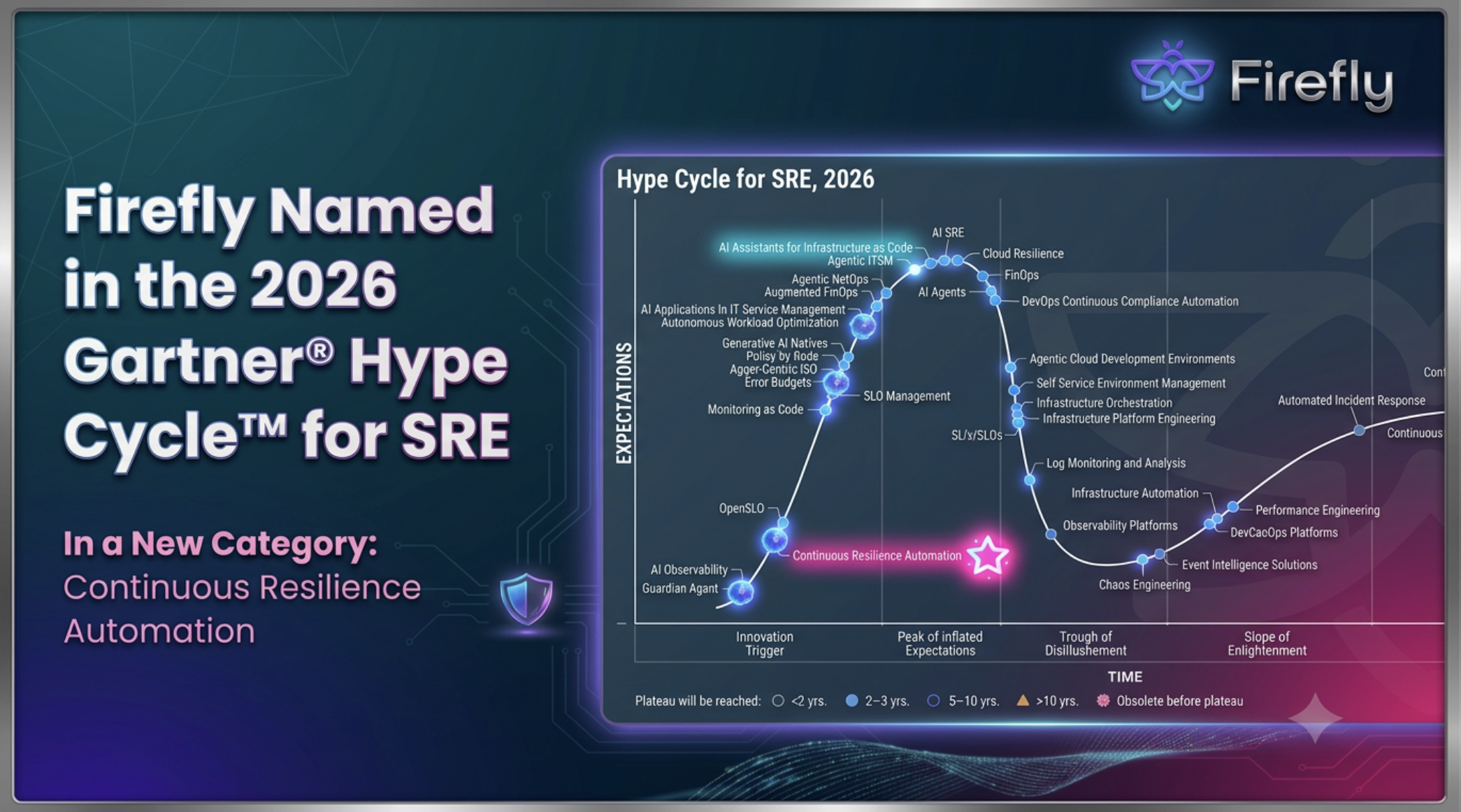
Just a few days ago, Firefly was named in Gartner's 2026 Hype Cycle for Site Reliability Engineering, in the newly defined category of Continuous Resilience Automation (CRA).
But the recognition matters less than what the category itself signals. Because Gartner doesn't create new Hype Cycle entries speculatively. Instead, they formalize what's already becoming real. Here's what CRA means, and why the teams paying attention now will be in a fundamentally different position than the ones who catch up later.
Gartner Just Formalized What Most Teams Already Know Is Broken
Continuous Resilience Automation is a new category in this year's Hype Cycle. Its existence is an acknowledgment that the industry has been managing resilience the wrong way for a long time.
The standard model (Think: build fast, stabilize in production, recover when things break) doesn't hold at modern cloud scale. Incidents compound faster than runbooks can be written. Infrastructure drifts from its intended state faster than teams can audit it, and the recovery plans that exist often haven't been validated against the environments they're supposed to protect.
Recent data only underscores that truth. Firefly's 2026 State of IaC Report found that only 11% of engineering teams have tested and validated DR plans. Lack of preparedness and lack of confidence unfortunately also go hand in hand, as 30% of teams admit they have little to no confidence in their RTOs. This isn't a skills problem, but a structural one at its core. When resilience is treated as a downstream concern, it gets perpetually deferred until an outage makes it unavoidable.
Gartner's CRA category is the formal answer to that structural problem: resilience embedded across the entire infrastructure lifecycle, not bolted on.
The Three Shifts CRA Demands from Engineering and Platform Teams
Gartner's framing of CRA centers on a reorientation of how reliability work gets done: one that has direct implications for both platform architecture and team operating models.
Resilience moves left, into design.
Recovery readiness isn't a production concern. In reality, it's a design constraint. Infrastructure gets defined as code, validated against failure scenarios before deployment, and continuously tested against the recovery objectives it's supposed to meet. By the time a real incident occurs, the recovery path has already been exercised.
Automated recovery replaces human-in-the-loop response.
In complex, nondeterministic environments, manual incident response creates a bottleneck that degrades faster than system complexity grows. CRA replaces that bottleneck with autonomous recovery logic: systems that detect, respond, and self-heal without requiring an engineer to step in.
Compliance becomes an infrastructure property, not an audit event.
Regulatory frameworks like DORA, SOC 2, and ISO 22301 are moving toward continuous resilience mandates. Under a CRA model, enforcement and auditability are built into how infrastructure is defined and operated, not assembled retroactively for the next audit cycle.
Early Placement on the Hype Cycle Doesn't Mean Early Adoption Can Wait
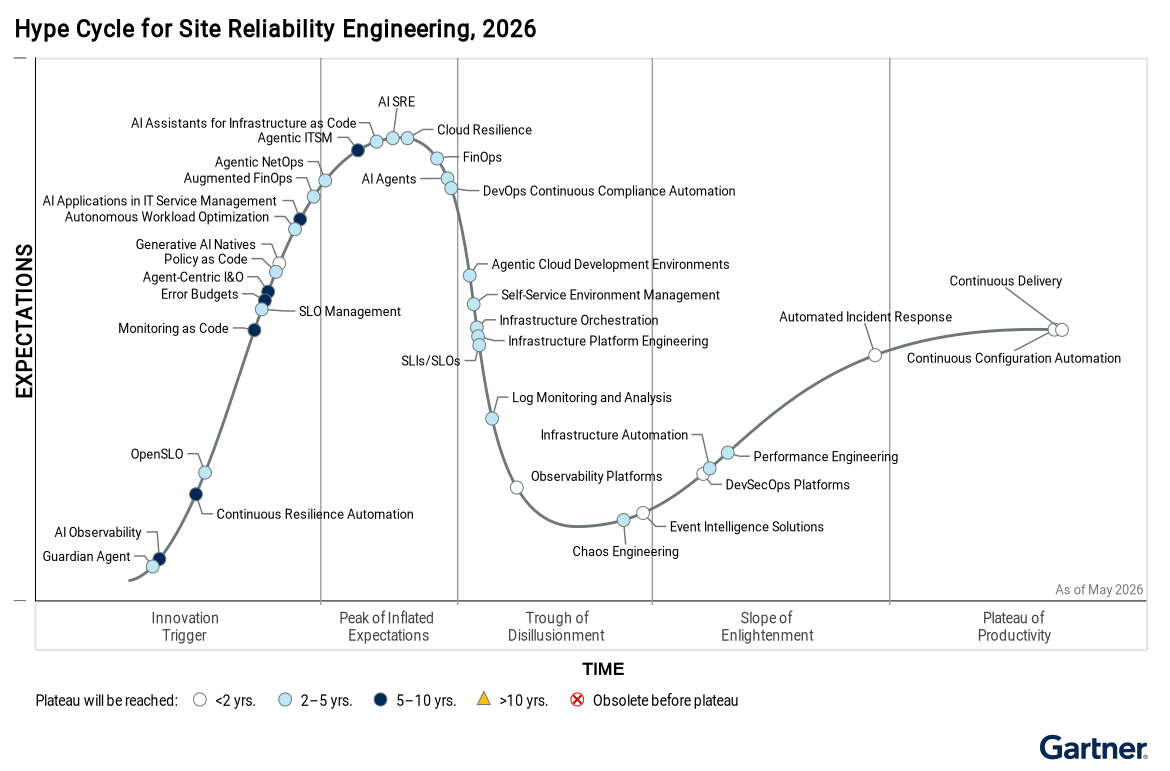
On the Gartner Hype Cycle, the Innovation Trigger is the starting point. It marks the moment a technology has been formally identified and defined, but before mainstream adoption has begun. CRA's placement there, combined with a Transformational benefit rating, means Gartner considers the potential impact high and the market still early. The 5-10 year plateau horizon is an estimate of when broad adoption will normalize, not a signal that the work can start in year four.
The organizations that won't be scrambling at year four are the ones building the foundation now.
As co-author and Gartner analyst, Hassan Ennaciri put it:
“It’s not just about keeping the lights on. It’s about balancing rapid innovation with resilient, self-healing architecture. The 2026 Gartner® Hype Cycle™ for Site Reliability Engineering dives deep [and] provides a clear roadmap for IT leaders to prioritize the practices, tools, and skills needed to build a truly effective, future-proof SRE function.”
Platform and DevOps teams that have invested in full IaC coverage, continuous drift detection, and automated recovery workflows are already operating with the resilience posture CRA formalizes. For them, this Hype Cycle entry is confirmation. For organizations still managing resilience through manual processes and disconnected tooling, it's a gap assessment (and the gap is already measurable).
CRA infrastructure takes time to instrument correctly. The cost of doing it reactively, on the other hand, will come at a cost. But it doesn’t have to. (Explore Firefly's cloud resilience capabilities to learn why.)
To get into what continuous resilience automation looks like in your environment, talk to the Firefly team. (For Gartner subscribers, access the full Hype Cycle for Site Reliability Engineering 2026 report directly through the Gartner portal.)
Note: Firefly was also named a sample vendor in the AI Assistants for Infrastructure as Code category in the same Hype Cycle, building on recognition in Gartner's inaugural Market Guide for AI Assistants for IaC earlier this year.
Gartner does not endorse any vendor, product or service depicted in its research publications and does not advise technology users to select only those vendors with the highest ratings or other designation. Gartner research publications consist of the opinions of Gartner's research organization and should not be construed as statements of fact. Gartner disclaims all warranties, expressed or implied, with respect to this research, including any warranties of merchantability or fitness for a particular purpose.

.svg)